Article
The Ultimate Guide to Striped Bass Fishing
Everything that catches stripers in one place, from the migration and the structure they feed on to tides, night fishing, tackle, the lures and baits that work, the rigs for them, and the circle-hook rule.
November 10, 2026
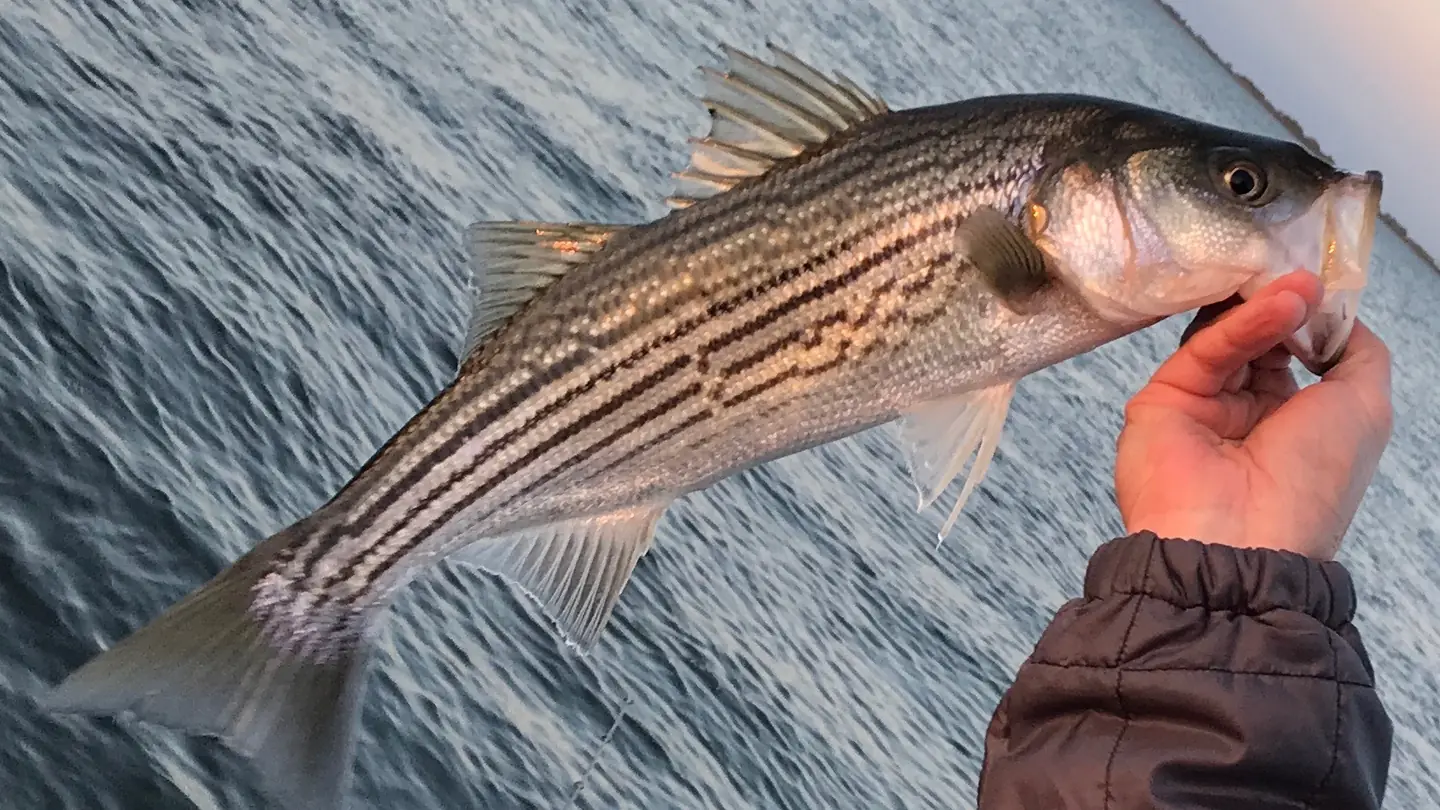
The striped bass is the fish the whole Atlantic coast plans its year around. Stripers run up rivers to spawn in spring, spread from the Chesapeake to Maine for the summer, and pour back down the coast in fall in blitzes that can turn a quiet beach into chaos. You can catch them from a jetty, a sod bank, a kayak or a charter boat; on plugs, flies, bucktails, live eels or a chunk of bunker. This guide puts it all in one place: how the fish move, where they feed, when to go, and the tackle, lures, baits and rigs that catch them.
Know the fish
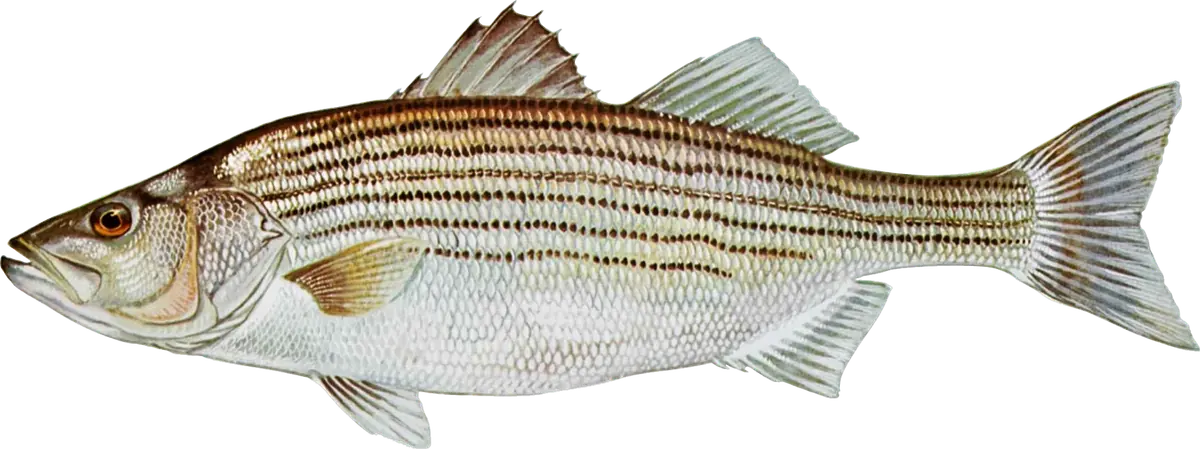
Striped bass. Painting: Duane Raver, U.S. Fish and Wildlife Service (public domain).
Stripers are silvery fish with seven or eight continuous dark stripes running from the gill cover to the tail. Adults typically run 2 to 3 feet and 10 to 30 pounds, and the biggest reach 6 feet. Their range runs from the St. Lawrence River to northern Florida and into the Gulf, and they've been introduced into inland reservoirs and the West Coast.
They're anadromous: they live in salt water but spawn in fresh water. Most of the coast's migratory fish are born in four river systems (the Chesapeake Bay and its rivers, the Delaware, the Hudson and the Roanoke), spawning near the head of tide from April into early June. Some stripers spend their whole lives in rivers and estuaries; others make the long migration along the coast every year.
Stripers will eat almost any small fish, plus crabs, squid and worms. Menhaden (bunker), bay anchovies, sand eels (sand lance), spearing (silversides), herring, mullet and squid are the big ones. Find the bait and you're most of the way to finding the bass.
The striper year
| Season | Where the fish are | What to do |
|---|---|---|
| Early spring | Rivers and back bays; holdovers waking up; first migrants arriving | Fish warm, mud-bottomed shallows and tidal rivers with soft plastics, small swimmers and bloodworms |
| Spring run | Spawning rivers, then moving north along the coast, stopping at rips, river mouths and bays | Follow the reports up the coast; herring, bunker, worms and squid are the baits |
| Summer | Spread from the mid-Atlantic to New England; deeper channels and rips by day, shallows in low light | Fish dawn, dusk and night on moving water |
| Fall run | Bait pours out of the bays and the fish follow it south; usually builds in September and peaks October into December in the Northeast | Find birds and bait; plug the beach at night; jig fish marked deep; troll to search |
| Winter | Offshore from Long Island to North Carolina; holdovers in tidal rivers and estuaries | Light-tackle holdover fishing: soft plastics on jig heads, worked slowly |
Water temperature and bait set the schedule. In fall, inshore water in the mid-50s to mid-60s°F is a good sign the fish are on the move; a warm fall pushes everything later. In winter, once the water is in the 40s, holdovers barely feed and won't chase. For the full season-by-season picture, see The Striper Year.
Where stripers feed
Stripers are structure and current fish. They hold where moving water, a change in depth or cover concentrates bait and lets them ambush it with little effort.
- Inlets, rips and river mouths: current funnels bait past waiting fish.
- Rocky shorelines, jetties, boulder fields and points: classic ambush cover, especially in white water.
- Sand beaches: fish the bars, troughs and cuts, not the flat, featureless water.
- Bays, flats and marsh creeks: shallow water that warms early in spring and fills with bait in summer and fall.
- Channel edges, drop-offs and mussel beds: where deeper water meets a feeding area.
Reading a beach
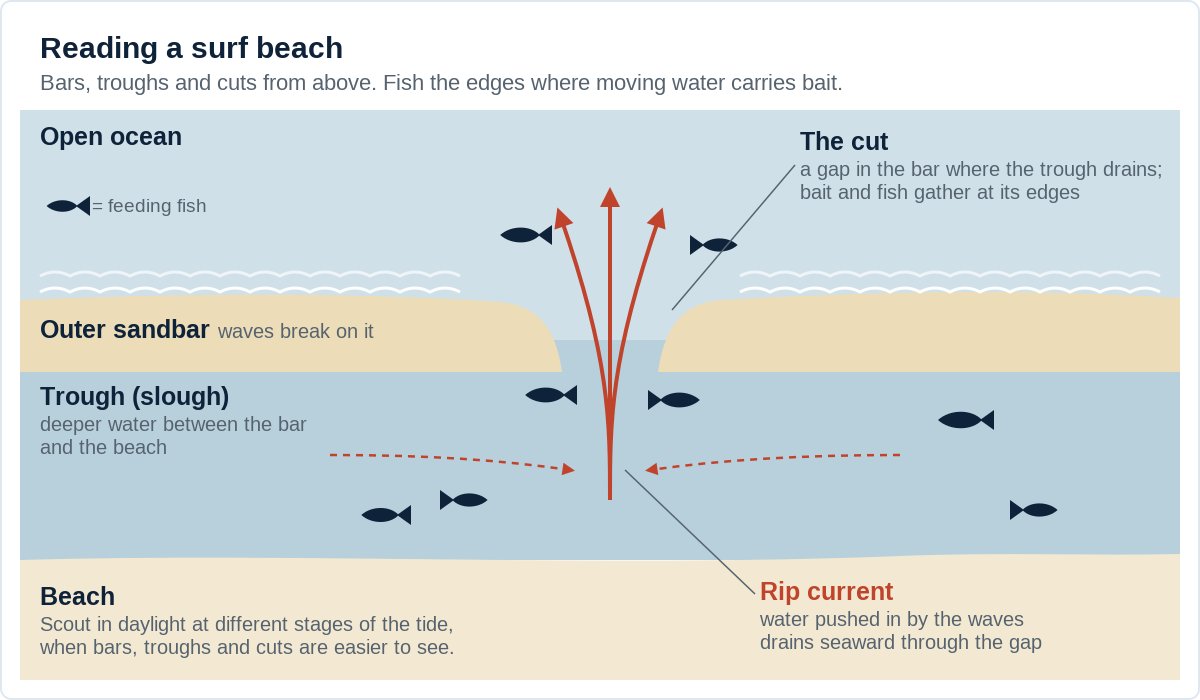
Waves breaking on an outer sandbar push water into the trough (slough) between the bar and the beach. That water drains back out through gaps in the bar, called cuts, as rip currents, and bait gets carried along with it. Good surf spots have exactly that: a drop-off or bar with current and turbulence. Bass cruise the troughs on the higher stages of the tide and set up at the edges of the cuts. Scout the beach in daylight at different stages of the tide, when the structure is easier to see, and you'll know where to cast after dark.
When to go: light, tide and moon
- Low light and darkness. Stripers are most active at dawn, dusk and through the night, and in summer that's when you catch most of them. A live or rigged eel fished at night is the most direct route to a big one.
- Moving water. They feed harder on a moving tide than at slack. On many surf beaches the best window is from about two hours before high tide through the first two hours of the outgoing.
- The moon. The days around the new and full moons are traditionally the most productive.
- The migrations. The spring and fall runs are the peak, when the fish are on the move and feeding hard.
For the night game in depth, see Night Fishing for Striped Bass.
Tackle
| Style | Rod | Reel | Line |
|---|---|---|---|
| Light tackle (bays, rivers, holdovers, kayaks) | 7 to 8 ft medium spinning | 2500 to 4000 size | 10- to 20-lb braid |
| Surf | 8 to 12 ft; about 9 ft is a good all-round length | 4000 to 14000 size, built to survive splashing | 20- to 65-lb line; about 30-lb braid is typical |
| Boat casting and jigging | 7 to 7½ ft spinning, rated about 1 to 4 oz | Medium spinning | Braid |
| Trolling and live bait | 6½ to 7½ ft conventional | Conventional | 20- to 40-lb line; wire or leadcore for spoons and tube-and-worm |
| Fly | 7- to 9-weight | Saltwater fly reel | Intermediate or slow-sinking lines for holdovers |
Leaders. With braid, add a fluorocarbon leader: about 20 pounds for shallow, clear water and spooky fish; 30 to 40 pounds around rocks and for big fish and heavy lures. Many casters tie the leader to a loop knot or a strong clip rather than adding extra hardware. For the full rundown, see Striped Bass Tackle.
Lures
You don't need a hundred plugs. A handful of types covers almost every situation.
| Lure | When and how |
|---|---|
| Bucktail jig | The most versatile striper lure: boat, surf or kayak, day or night. Swim it just above the bottom, slow to moderate; tip it with a soft-plastic or pork-style strip. Beginners usually fish them too heavy. |
| Soft-plastic swim shad or eel | Matched to the bait's size; jigged deep, swum in current or rigged on a jig head for holdovers. |
| Pencil popper and cupped popper | Surface lures that draw fish up and find them; a boil behind the plug shows you where they are. Great in blitzes. |
| Walk-the-dog stick bait | Calm water and blitzes, worked with a steady side-to-side rhythm. |
| Floating minnow plug | Calm nights, on a slow, steady retrieve. |
| Bottle plug and darter | Rough surf and current at night. Give them a few fast turns to dig in, then swim them slowly. |
| Needlefish | Slim, castable plug that barely wobbles; good at night and in current. |
| Metal-lip swimmer | Big surface wake when bass are on adult bunker or herring; slow retrieve, occasional twitch. |
| Metal jig (diamond, slim metal) | Casts farthest and sinks fastest: deep rips, fish under birds, and bass on sand eels. |
| Trolling: bunker spoons, umbrella rigs, deep-diving plugs, tube-and-worm | For covering water and big fish when nothing shows. |
At night, a slow, steady retrieve (about one turn of the reel every second or two) catches more than speed, and darker plugs show up better against the sky. In a blitz, cast to the edges of the school rather than the middle. More in Striped Bass Lures.
Baits and bait rigs
| Bait | Notes |
|---|---|
| Live eels | The best all-round striper bait, especially at night from the beach, a jetty or a drifting boat. |
| Live menhaden (bunker) | Adult bunker draw the biggest bass. Catch them with a cast net, or snag one from a school where it's legal and move it to a circle hook. |
| Peanut bunker | Juvenile menhaden; fragile, so use a small circle hook and a lighter drag. |
| Bunker, mackerel, herring and squid chunks | On the bottom from the beach or an anchored boat. |
| Bloodworms and sandworms | Early-spring back bays and tidal rivers, and on a float rig after dark. |
| Clams and sand fleas | Classic surf baits. |
| Live spot | Hardy; drifted or freelined around structure. |
| Calico crabs | Raked in the surf; remove the claws and cast them short. |
The fish-finder rig
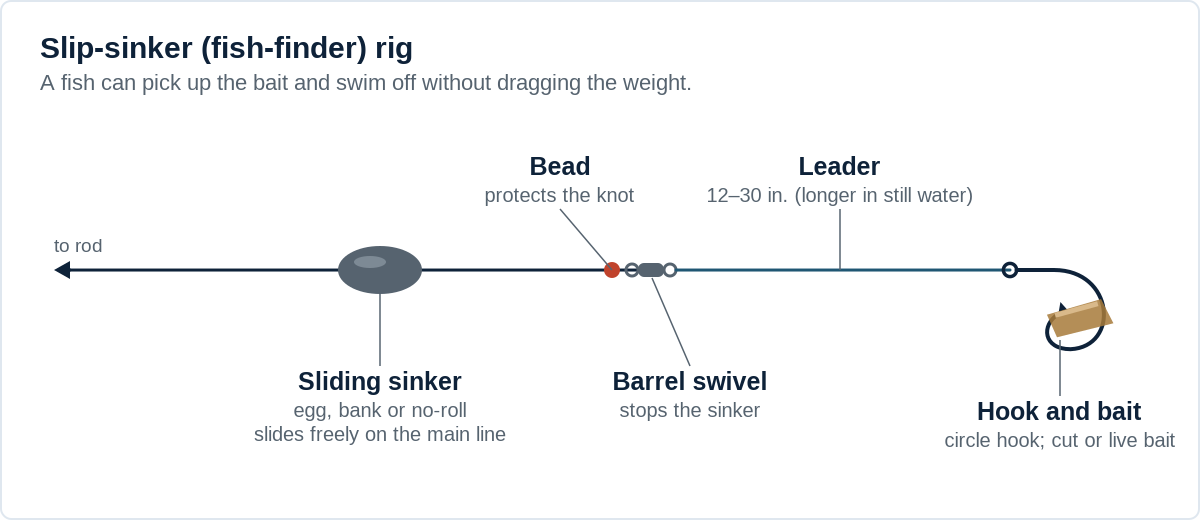
The standard surf and anchored-boat bait rig. A sinker slide (or a pyramid or bank sinker on a slide) rides on the main line above a swivel, followed by a leader (about 18 inches of 25-pound fluorocarbon for chunks) and a 6/0 to 8/0 light-wire inline circle hook. Push the hook through a small piece of bait so it doesn't fill the hook's gap. A small float on the leader lifts the bait off the bottom, away from crabs and skates.
Live eels and live bunker
For live eels, use an inline circle (about 5/0 to 8/0) on a long fluorocarbon leader, with little or no weight, and hook the eel through the nose so it swims straight. Live bunker can be freelined on a circle hook through the nose or back. Drift baits in current; at slack tide, bump the motor in and out of gear to keep them moving.
Circle hooks: required, and they work
Every Atlantic coast state requires inline (non-offset) circle hooks when you fish bait for striped bass, from shore or boat. That includes rigged eels and snagged bunker, which must be moved to a circle hook before you fish it. Lures with bait added are exempt. The rule exists because circle hooks rarely gut-hook fish, which cuts release deaths.
Fishing them is simple: don't set the hook. Let the fish take the bait and pull line, then reel down and lift with steady pressure. The hook slides to the corner of the jaw and sets itself. Use a circle about 30 percent larger than the J-hook you'd use with the same bait, and tie it on with a knot that lets it pivot. See Live and Cut Bait for Stripers.
Fishing methods
Surfcasting
Scout by day, fish at night and at dawn and dusk, and work the structure: troughs, cuts, bars and rocky points. Slow swimming plugs in the cuts and bowls at the higher tides catch the bigger fish. When a bass taps a plug and misses, cast right back to the same spot at the same pace; if you miss two or three times, rest the spot for half an hour.
Birds and blitzes
Diving terns and gulls mean bait is being driven to the surface. Run up-current or upwind of the school, shut down and drift onto it quietly; driving through the middle scatters everything. Cast to the edges. When the surface feed breaks up, or the birds are working over fish that won't take topwaters, drop a metal jig to the bottom for the fish picking up the scraps. See Reading Birds and Bait.
Jigging and trolling
From a boat, when your sonar marks fish deep but nothing breaks, jig metal or soft-plastic shads near the bottom. With no marks at all, troll to search: bunker spoons for big fish, umbrella rigs and deep-diving plugs for numbers, around 2.5 to 3 knots. Live eels can be slow-trolled or drifted at about 1 knot.
Holdovers and light tackle
In New England and the mid-Atlantic, some bass winter in tidal rivers, estuaries and salt ponds. They're mostly schoolies and they're slow, so this is finesse fishing: a soft plastic on a jig head just heavy enough to reach bottom, twitched, dragged or barely moved, on a medium-heavy spinning rod. A small rise in water temperature or a warm rain can turn them on.
Before you go
Striped bass are tightly managed. Size limits (often a "slot"), bag limits, seasons, gear rules and closed areas differ from state to state and change often. Federal waters (generally beyond 3 nautical miles from shore) are closed to striped bass fishing, and every Atlantic state requires inline circle hooks with bait. Check your state's current saltwater regulations before every trip.
Stripers and bluefish chase the same bait in the same places, so you'll often catch both. For the blues, see The Ultimate Guide to Bluefish Fishing. For the striper species page, see striped bass.
Cover photo: SFOfishing, via Wikimedia Commons (CC BY-SA 4.0, cropped). Diagrams: Basic Fishing; the beach diagram follows the National Weather Service's description of how rip currents form.