Article
Setting Up Tackle for Striped Bass
Four outfits cover nearly all striper fishing. Here's how to match rod, reel, line and leader to where you fish, and how to connect them so nothing fails on a big fish.
November 3, 2026
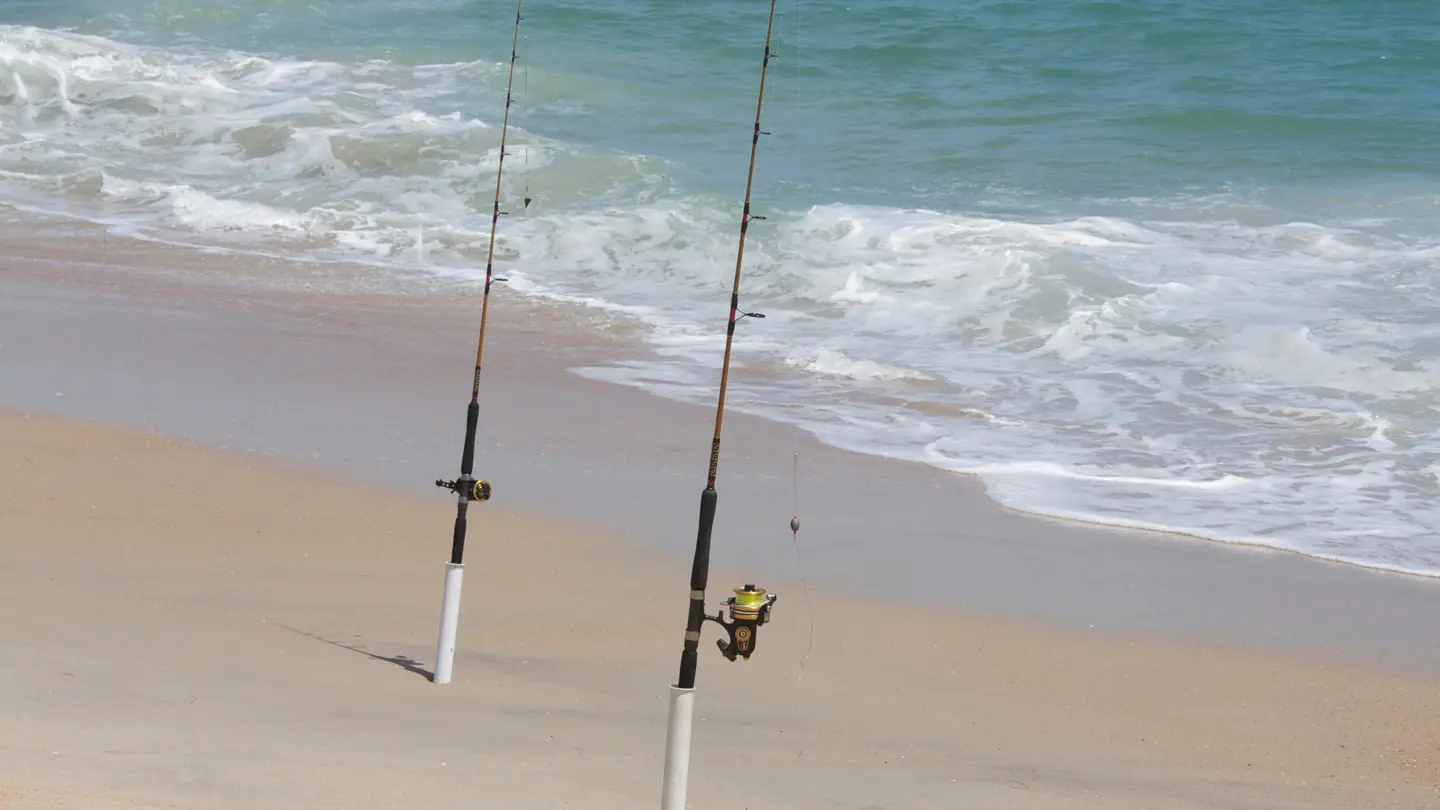
You don't need a wall of rods to fish for striped bass. Four outfits cover nearly everything: a light spinning rod for bays and rivers, a surf rod, a boat rod for casting and jigging, and a stout conventional rod for live bait and trolling. Most people start with whichever one matches where they'll fish most, and add from there.
Here's what each one should look like, then how to rig the line, leader and terminal end so the weakest link isn't somewhere you didn't think about.
The four outfits
| Outfit | Rod | Reel | Line |
|---|---|---|---|
| Back bays, rivers, light tackle | 7 to 8 ft spinning | 3000 to 4000 size | 10 to 20 lb braid |
| Surf and jetties | 8 to 12 ft surf rod | 4000 to 14000 size | 20 to 65 lb, heavier around rocks |
| Boat casting and jigging | 7 to 7½ ft spinning, rated 1 to 4 oz | Mid-size spinning | Braid |
| Live bait and trolling | 6½ to 7½ ft conventional | Conventional | 20 to 40 lb class |
Light tackle for bays and rivers
A 7- to 8-foot inshore spinning rod with a 3000 or 4000 reel and 10- to 20-pound braid handles schoolies on the flats, in marsh creeks and in tidal rivers, and it'll land a bigger fish in open water if you're patient. It's also the right rod for winter holdovers: a medium-heavy rod and a 2500 or 3000 reel is all you need for small bass in cold rivers.
If you fly fish, a 7- to 9-weight rod is the striper standard. For holdovers in deeper creeks, an 8- or 9-weight with an intermediate or slow-sinking line gets the fly down where they are.
Surf and jetty outfit
Surf rods run 8 to 12 feet, with long butt sections built for distance. Go long on open beaches where the fish may be 100 yards out; go shorter at inlets and on jetties, where rocks behind you get in the way of a long back cast. A 9-foot rod with a 5000-size reel and 30-pound braid is a good all-round setup for big fish on the beach. If most of the fish are on the smaller side, the same reel on a 7½-foot rod is lighter and more fun.
Go heavier around rocks and boulder fields, where a big fish can wrap you around a ledge. Whatever reel you choose, buy one built to survive being splashed and dunked: in the surf, it will be.
Boat rod for casting and jigging
A 7- to 7½-foot spinning rod rated for 1- to 4-ounce lures covers casting plugs and soft plastics into breaking fish and dropping metal jigs and swim shads to bass holding deep.
Live bait and trolling
For live bunker, eels and chunks from a boat, and for trolling, step up to a 6½- to 7½-foot conventional rod for 20- to 40-pound line. Trolling bunker spoons and tube-and-worm rigs deep usually calls for wire line or leadcore, which needs its own dedicated rod and reel.
Line
Braid is the default on spinning gear now. It barely stretches, so you feel every bump and bite, and it's so thin for its strength that it slices through current and you can fit plenty on the reel. Thirty- and 40-pound braid on a 5000- or 6000-size reel covers most surf and boat fishing; 20-pound on a 4000 is for light work. Around rocks, a traditional four-strand braid holds up better to scraping than the slicker, finer types.
Monofilament still has its place. Many live-bait anglers use 30-pound mono as the main line on conventional reels. It stretches, which cushions a fish's sudden lunges, at the cost of feel.
Leaders
Always put a leader between the braid and your lure or hook. Fluorocarbon is the usual choice: it's harder for fish to see than mono and stands up better to abrasion. Size it to the water and the fish:
- Shallow, clear water and spooky fish: 20-pound.
- Around rocks and structure, heavier lures, bigger fish: 30- to 40-pound.
- Trolling: 40- to 60-pound.
- Bait with circle hooks: 25-pound fluorocarbon. Make it about 30 inches long in dirty water and up to 48 inches in clear water.
- Live eels: around 4 feet of 50-pound fluorocarbon.
Connections
The knots are where most big fish are lost.
- Braid to leader: a uni-to-uni knot is the standard.
- Leader to lure: many surfcasters tie a heavy-duty clip (50- to 75-pound) to the leader with a palomar knot so they can change plugs quickly. Others tie a loop knot straight to the lure instead, which lets it swing freely and avoids extra hardware that catches weed.
- Leader length when casting: about 36 inches on a 7-foot rod, 42 on an 8-footer and 48 on a 9-footer.
- Leader to circle hook: use a palomar or a uni-knot, or snell the hook. Those knots let the circle hook pivot as it slides into the corner of the fish's jaw, which is exactly how a circle hook is meant to work. Some anglers tie the leader straight to the braid with no swivel for a cleaner bait presentation.
About teasers: a small teaser tied on a dropper about 18 inches above your plug can be deadly when bass are feeding on small bait. Leave it off when big fish are around. A heavy bass rolling on the surface can break the dropper, and the teaser is the weakest point in the rig.
Terminal tackle for bait
If you fish bait for stripers, you must use inline (non-offset) circle hooks. That's the rule all along the Atlantic coast, from shore or boat, and it applies to rigged eels and to a bunker you snagged on a treble hook (move it to a circle hook before you fish it). Lures with bait attached, like a bucktail tipped with a strip or a tube-and-worm, don't need circle hooks.
- Hook size: circle hooks of 7/0 to 10/0 suit most keeper-size bass. Go smaller (around 5/0) for spot or small eels and larger (9/0 or so) for adult bunker. A circle hook should be about 30 percent bigger than the J-hook you would have used.
- Fish-finder rig for chunks: slide a fish-finder sleeve and a bank or pyramid sinker onto the main line, tie on a swivel, then a short fluorocarbon leader to the circle hook. The fish can pick up the bait and move off without feeling the weight.
- Float rig: a small float on the leader near the hook keeps bait up off the bottom, away from crabs and skates.
- Carolina rig for live eels: a small egg sinker sliding on the main line above a swivel, then the long leader to the hook.
Each of those rigs, and how to hook the bait, is covered in Live and Cut Bait for Striped Bass.
Before you go
Striped bass size limits, bag limits, seasons and gear rules are set by each state and change often. Check your state's current saltwater rules before every season.
Cover photo: National Park Service, Cape Hatteras National Seashore (public domain).