Article
The Ultimate Guide to Bluefish Fishing
Snappers to gator blues, in one place: the bluefish year, where schools feed, tackle and the wire-or-not leader question, the lures that survive their teeth, chunking and chumming, and fishing the blitz.
November 10, 2026
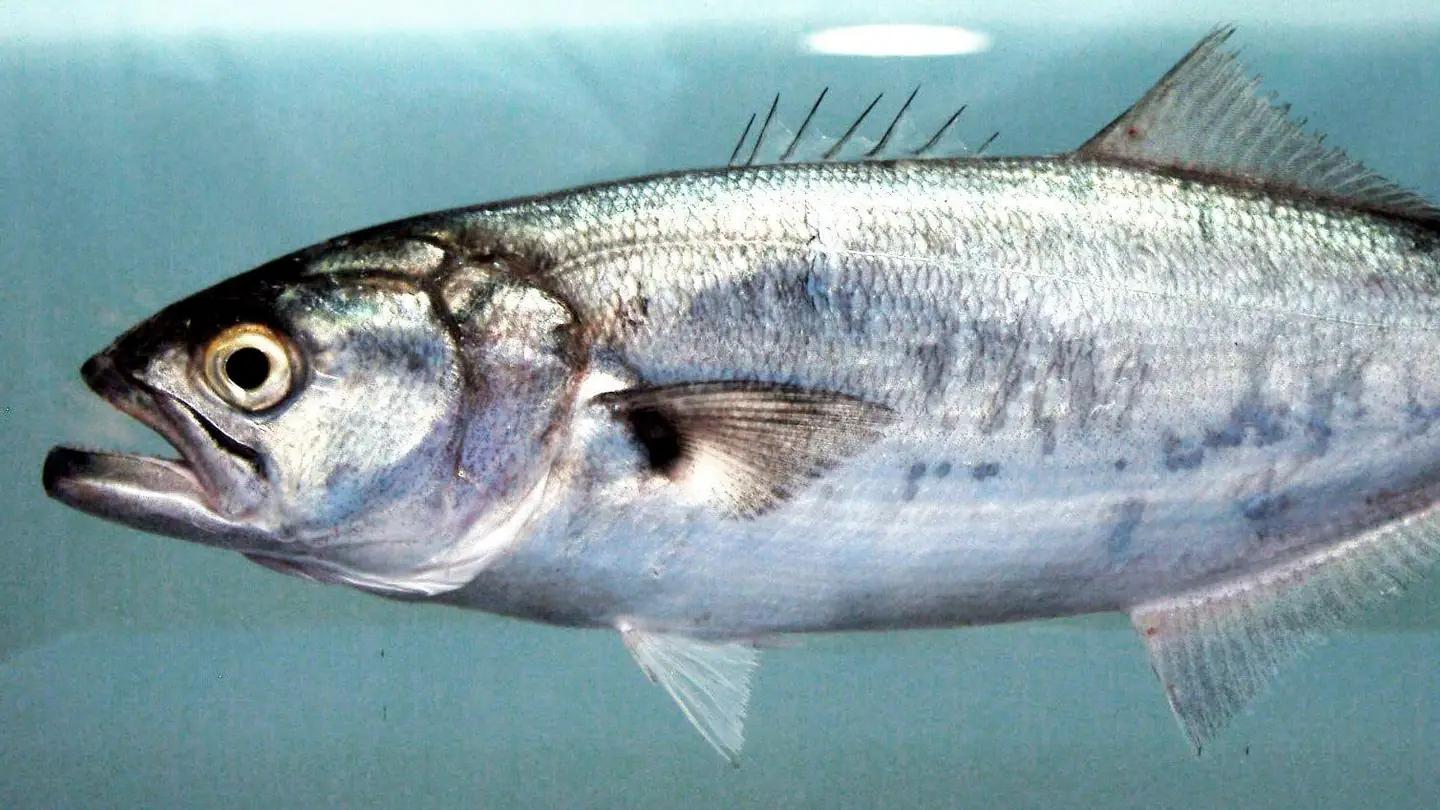
Bluefish hit hard. They travel in schools of same-sized fish, crash bait on the surface, chop lures in half and fight all the way to the boat. They show up from the surf to the offshore lumps, from snappers a few inches long in the marina to big fish in the teens. They're one of the easiest saltwater fish to find and catch once you know when they're around and how to keep them from biting you off. This guide covers all of it.
Know the fish
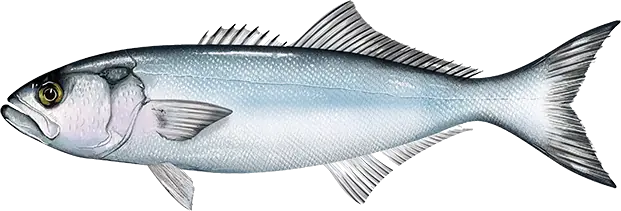
Bluefish. Painting: Jack Hornady, NOAA Fisheries (public domain).
Bluefish have a greenish-blue back, silvery sides, a forked tail, a black blotch at the base of the pectoral fin and a jaw full of razor-sharp, triangular teeth. They range from Nova Scotia to Florida and into the Gulf, and they're found in oceans around the world. They can live 12 years or more, top 40 inches and weigh more than 20 pounds, though most fish anglers catch are well under that.
Anglers name blues by size:
| Name | Size | Where and when |
|---|---|---|
| Snappers | A few inches to about 10 inches | Bays, tidal creeks, marshes, canals, docks and marinas, summer to early fall |
| Cocktail blues | Around 2 pounds | Bays, inlets and the surf, much of the season |
| Big blues | 10 to 20 pounds, sometimes more | Ocean beaches, inlets and offshore lumps, especially early and late in the season |
A bluefish's forked tail and sharp teeth separate it from young weakfish, which are often caught alongside snappers in the same water.
The bluefish year
Bluefish are warm-season visitors in most of their range. Water temperature and day length drive their migration: north along the coast in spring and summer, back south in fall and winter. North of the Carolinas they're around only in the warmer months.
| When | What's happening |
|---|---|
| Late April to June | First schools show up offshore in spring, following menhaden, river herring and mackerel; big blues gather on inshore lumps where migrating bunker collect. |
| Summer | Blues spread through bays, sounds and the ocean. In hot weather they feed best in the early morning and late evening and drop deeper during the day. Snappers appear in the bays in June. |
| August and September | Often the best fishing. Snappers grow to about 6 inches by August and 10 by late September. |
| October and November | The biggest fish are usually the last to arrive and the last to leave. Fall surf fishing peaks as the bait pours out of the bays. |
| Winter | Blues leave the mid-Atlantic once the water drops below the high 50s °F and winter to the south. |
For more on timing by size, see Bluefish Seasons and Sizes.
Where bluefish feed
Bluefish follow bait: menhaden (bunker), bay anchovies, silversides (spearing), herring, mackerel and squid. Most of their life is spent in water less than about 65 feet deep.
- Blitzes. Schools drive bait to the surface near shore, and birds pile in over them. These are the most exciting fish in salt water to cast to.
- Inlets and rips. Current funnels bait past feeding blues.
- The surf. Especially in fall, and around bars, troughs and cuts (see the beach diagram in The Ultimate Guide to Striped Bass Fishing).
- Lumps, ridges and channel edges in the ocean and big bays, where bunker gather. These are prime chumming and trolling spots.
- Back bays, creeks and docks for snappers.
Tackle
| Fishing | Rod | Line |
|---|---|---|
| Snappers | Ultralight or light spinning, or a cane pole | Light line, small hooks |
| Piers, docks, calm beaches and boat casting | 7 to 9 ft medium to medium-heavy spinning | 12- to 15-pound mono or braid |
| Ocean surf | 9 ft or longer, to reach past the breakers | Heavier line than you'd use from a pier |
| Bait and chumming from a boat | Conventional, rated for 12- to 30-pound line | 12- to 30-pound line |
Gear up for the big fish even when you expect small ones.
Wire, or not?
Bluefish teeth cut monofilament like scissors, so the classic answer is a short wire leader. But bluefish also have excellent eyesight, and wire can make baits and lures look unnatural and make blues leader-shy, especially in clear water or in a chum slick. You have options:
- Wire (coffee-colored is less visible): for trolling, big fish and lures with treble hooks. An 18-inch piece of heavy wire is standard.
- Heavy fluorocarbon or mono, 50 to 100 pounds, 2 to 4 feet long: less visible, lets baits sink naturally, and usually survives several fish before you retie. Many casters use 50- to 60-pound fluorocarbon and get no more cutoffs than with wire, as long as they keep tight contact with the lure and the fish.
- Long-shank hooks keep the teeth away from the leader.
- Circle hooks with bait hook blues in the corner of the jaw, away from the leader.
- Diamond jigs are long enough to act as their own leader and can be tied straight to the line.
Avoid shiny swivels and snaps; blues hit them and cut the line above the leader. For the details, see Bluefish Tackle and Wire.
Lures
| Lure | How to fish it |
|---|---|
| Poppers | The most exciting way to catch them. Hard-plastic poppers survive the teeth. Rig with a single tail hook instead of trebles for easier unhooking. |
| Metal jigs (diamond jigs, slab spoons) | Cast far and sink fast; cast to breaking fish or jig them deep. |
| Spoons | Wide spoons for a slower retrieve; small shiny ones for snappers. |
| Swimming plugs | Cast or trolled; swap trebles for single hooks. |
| Bucktails | For deeper fish in inlets and channels; long-shank bucktails with synthetic hair hold up better. |
| Soft-plastic swimbaits | Durable ones only; blues shred soft baits fast. |
| Trolling: plugs, spoons, tubes, umbrella rigs | On wire leaders, to search for scattered fish. |
Retrieve fast. Blues chase, so a moderate to fast retrieve is the starting point, and burning a lure as fast as you can reel is often best for surface-feeding schools. If they don't hit, vary the speed until they do.
Bait: chunking and chumming
Fresh menhaden is the standard bluefish bait, whole, as chunks of about 2 inches, or as slabs. Butterfish, spot and other oily fish work too.
From the beach: a fish-finder or standard bottom rig with a chunk of bunker and a pyramid sinker on sand. In rough surf, half a bunker stays on the hook better than softer baits. Use a 4/0 to 8/0 hook on a wire or heavy mono leader, or a circle hook of similar size.
Chumming
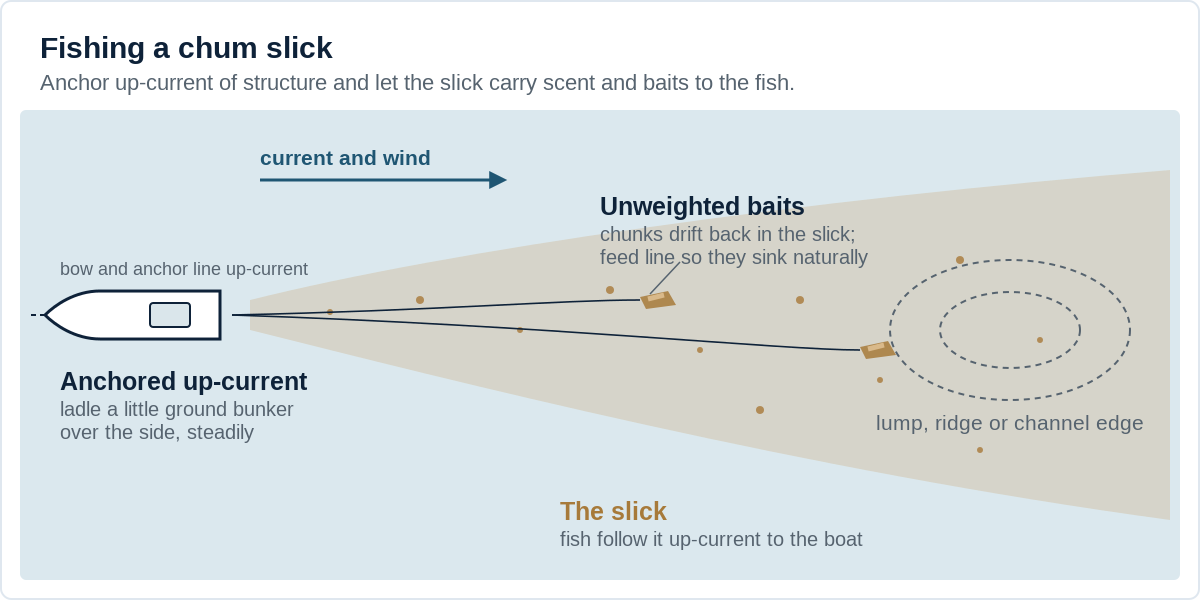
Chumming is the classic summer way to catch big blues from a boat once they stop feeding on top:
- Anchor up-current of a lump, ridge or channel edge where bunker gather.
- Ladle ground menhaden, thinned with an equal amount of water, over the side about every 30 seconds. Keep it small and steady. The idea is to attract fish, not fill them up. Two 5-gallon buckets of chum last most of a tide in midsummer.
- Drift unweighted baits back in the slick. Hook a 4- to 6-inch slab of bunker, butterfish or spot through the thick end on a 5/0 to 7/0 hook and feed line so it sinks naturally with the chum, 50 to 75 feet back. Reel in and repeat.
- Use heavy mono or fluorocarbon leaders so the baits look natural in the slick.
Once blues are behind the boat, a big topwater plug skipped fast through the slick can draw explosive strikes.
Fishing the blitz
When birds are diving and the water is boiling, it's tempting to run straight into the middle. Don't. Surface-feeding blues spook easily, and a boat in the middle scatters the school and the bait.
- Run up-current or upwind of the school, shut down, and drift onto it quietly.
- Cast to the edges of the school rather than the middle. A lure that looks like a straggler gets hit first.
- Reel fast.
- When the surface feed breaks up, drop a metal jig to the bottom for the fish picking up scraps.
When blues crash a ball of anchovies, the bait and the birds spread out over a wide area; follow the birds. See Reading Birds and Bait.
Snappers
Snapper fishing is simple, light-tackle fun. In summer, young-of-the-year blues fill tidal creeks, marshes, canals, docks and marinas. Use a cane pole or light spinning rod with a small float and a small hook baited with a young spearing or killifish, or cast small shiny spoons, metal and flies on ultralight tackle.
Before you go
Bluefish have sharp teeth; unhook them with a dehooker or long-nose pliers, never your fingers, and never let children unhook them. Bluefish are managed along the coast with bag limits and, in some places, size limits, and those rules change. Check your state's current saltwater regulations.
Stripers chase the same bait in the same places, so you'll often catch both; see The Ultimate Guide to Striped Bass Fishing. For more on lures and bait, see Catching Bluefish on Lures and Bait, and for the species page, see bluefish.
Cover photo: Brandi Noble, NOAA Fisheries Southeast Fisheries Science Center (public domain). Chum slick diagram: Basic Fishing.