Article
The Ultimate Guide to Trout Fishing
Rainbows, browns and brook trout in streams, ponds and lakes: telling them apart, reading a stream, the seasons and temperatures that move them, baits and rigs, spinners and spoons, flies, stocked trout and light tackle.
November 10, 2026
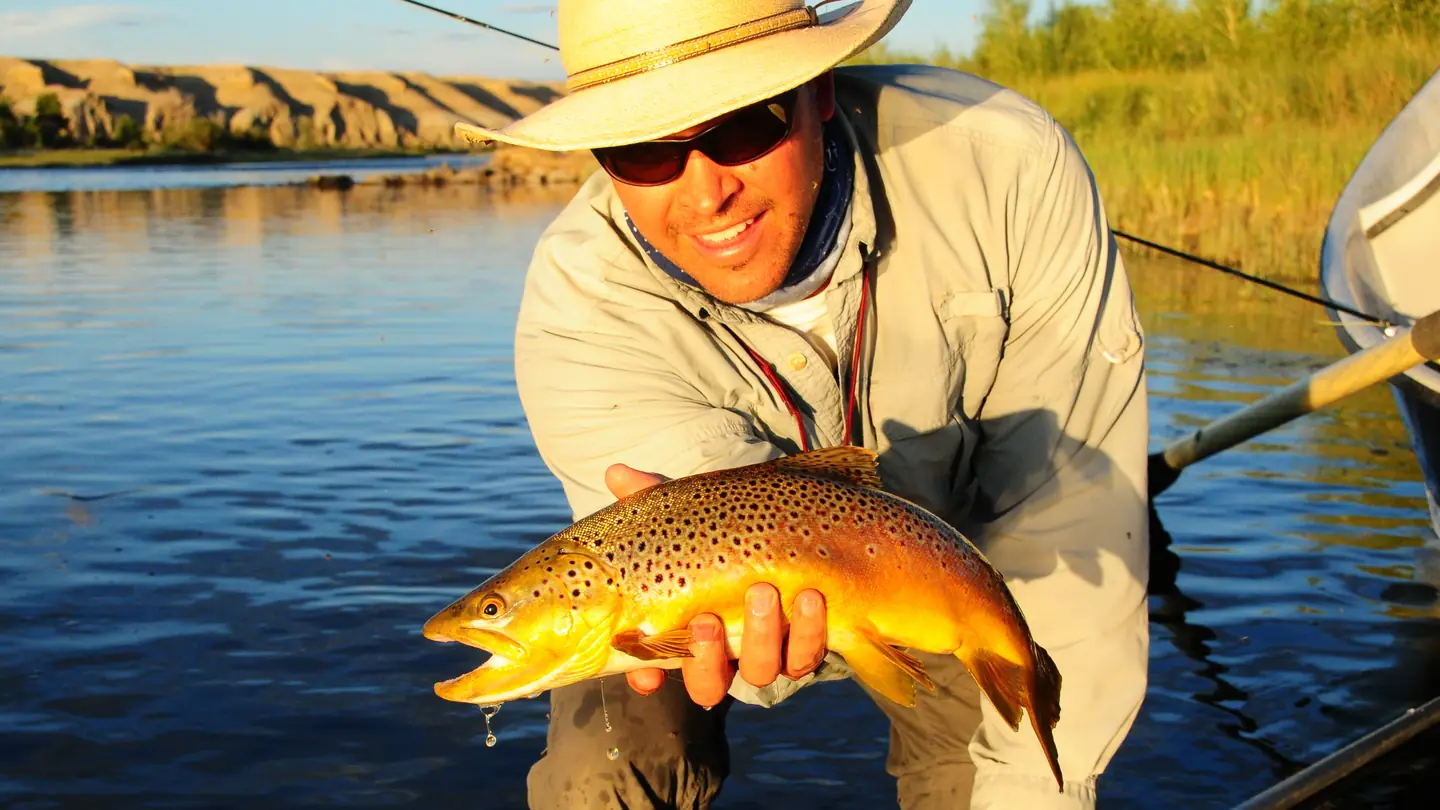
Trout are the fish a lot of anglers fall in love with: a cold, clear stream, a fish rising to a bug, a rainbow jumping on a pond. They're also some of the most widely available fish in the country, because states stock them into streams, ponds and lakes. Whether you're chasing stocked rainbows on opening day or wild browns on a mountain creek, the same rules apply: find cold, clean water; read where the fish hold; and present something small, naturally, without spooking them. This guide covers all three trout most anglers catch, in moving and still water, through the year.
Know your trout
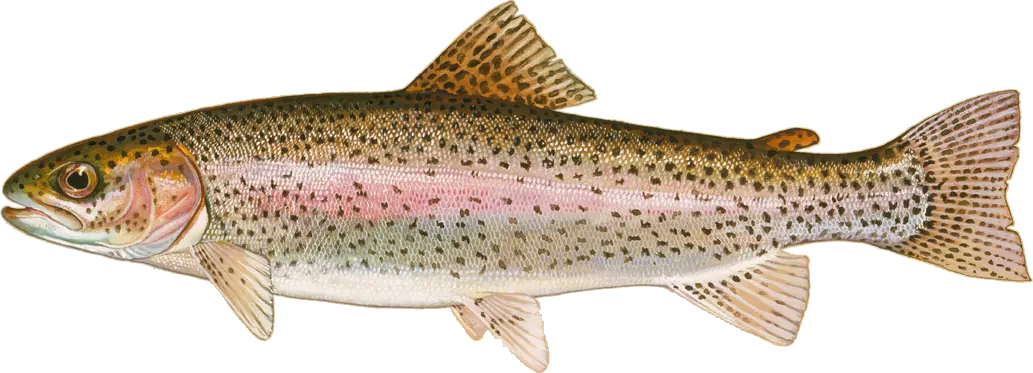
Rainbow trout. Painting: Duane Raver, U.S. Fish and Wildlife Service (public domain).
Rainbow trout have a pink to red band along the side and black spots over the body and onto the tail. Native west of the Rockies, they've been introduced into every state and are the backbone of put-and-take stocking, with stocked fish usually 10 to 13 inches. They're often the easiest trout to catch, especially in cold water.
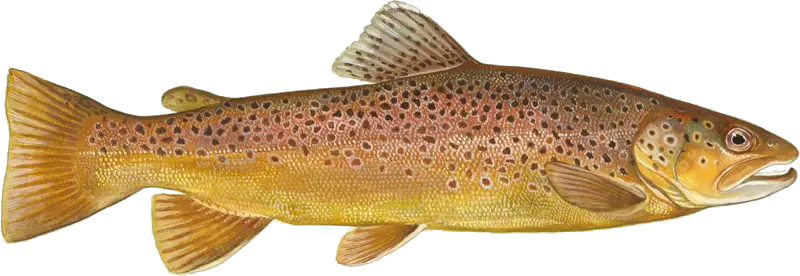
Brown trout. Painting: Duane Raver, U.S. Fish and Wildlife Service (public domain).
Brown trout are golden to yellow-brown, with black spots ringed in pale halos above the midline and red spots below. Native to Europe, they tolerate somewhat warmer water than other trout (their preferred range is the mid-50s to upper 60s °F). Browns are warier and more nocturnal than rainbows, and big ones eat fish.
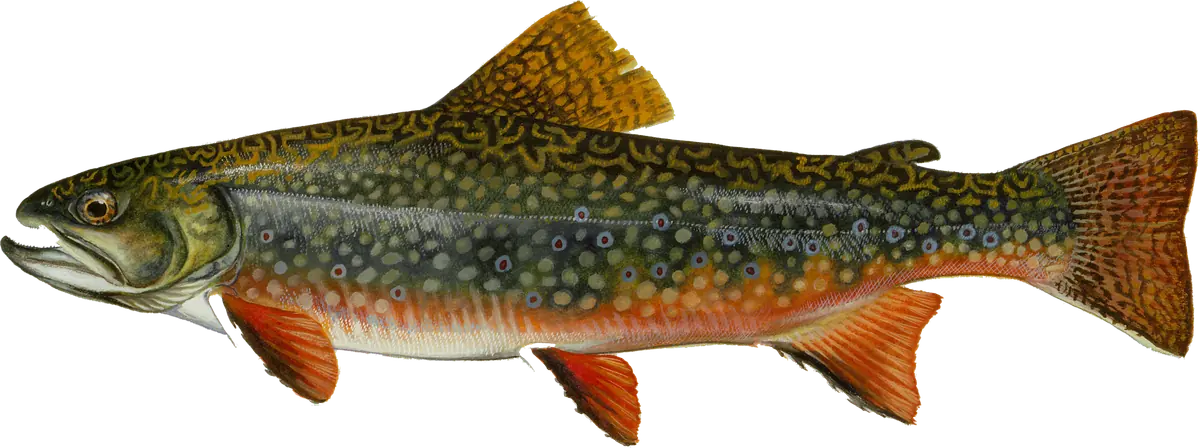
Brook trout. Painting: Duane Raver, U.S. Fish and Wildlife Service (public domain).
Brook trout have dark, worm-like markings on an olive back, red spots with blue halos, an orange belly and lower fins edged in white. They need the coldest, cleanest water of the three: about 55 to 60°F is ideal, and they can't survive long in water near 75°F. Wild brookies in small headwater streams rarely top 6 or 7 inches, but lake and pond fish grow much bigger. Stocked brook trout are fairly easy to catch.
The common thread is cold water. Trout are cold-water fish. They do best below about 70°F, and they're most catchable in water from the mid-30s to the mid-60s °F. Water temperature shapes almost everything about where and when you'll find them.
Reading a trout stream
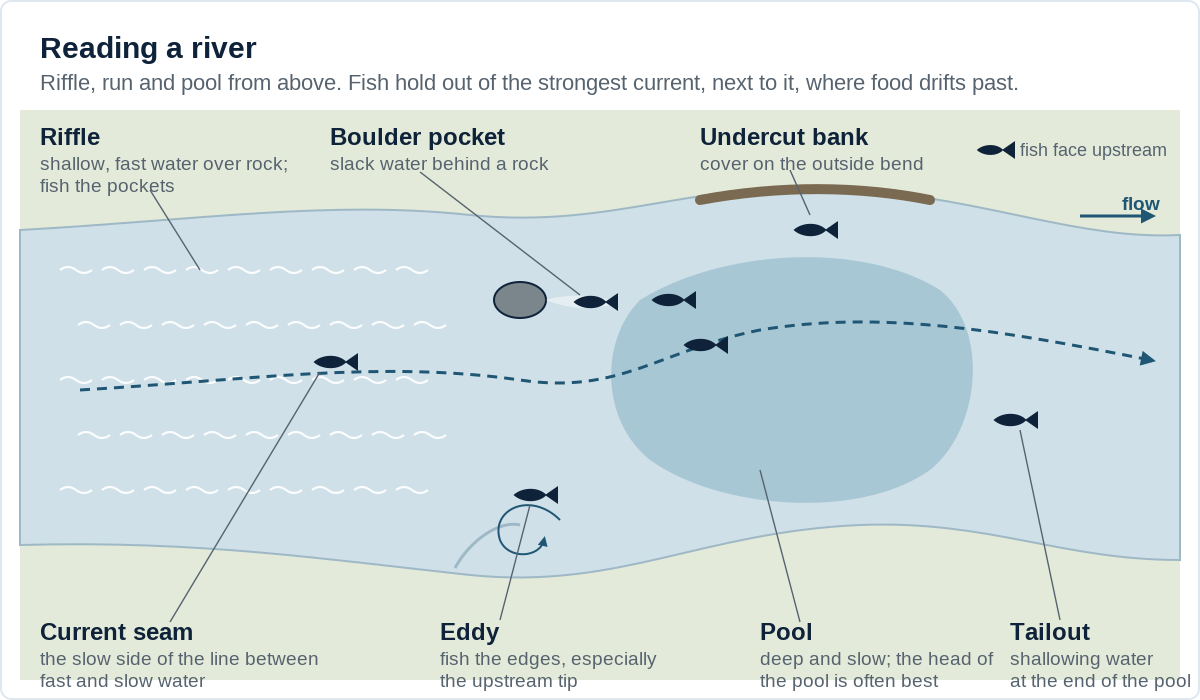
Streams come in three kinds of water that repeat: riffles (shallow, fast water over rock, where mayflies, stoneflies and caddisflies live), runs (deeper, smooth-flowing water) and pools (deep, slow water, a trout favorite). Trout face upstream and hold where they can rest out of the hardest current and still grab food drifting past:
- The slow side of a current seam, where fast water meets slow. The most active fish sit at the upstream tip of a seam or eddy.
- Pockets behind boulders and the edges of eddies.
- The head of a pool, where a riffle dumps food into deeper water, and the inside edges of runs and pools from head to tail.
- Undercut banks, logs and branches for cover.
- Anywhere you can't see the bottom. Fish every spot deep or broken enough to hide a trout.
Water level changes the map. At normal flows, trout spread through pools and pocket water. High water pushes them toward the banks, wherever the current is blocked. In low water, depth, shade, cover and broken surface water are the keys, and pockets in riffles still hold fish.
Don't spook them. Stream trout bolt at shadows, footfalls, sudden movement, wading wakes and stirred-up mud, more so in small streams. If you can see them, they can see you. Wear drab clothes, move slowly, keep cover between you and the fish, and wear polarized glasses. Wade upstream, make short casts first and lengthen them gradually, and rest a spooked pool before you try it again.
For more, see Where Trout Hold in Streams.
Trout through the year
| Season | Streams | Ponds and lakes |
|---|---|---|
| Spring | Stocking season in many places; worms and spinners shine after rain. Browns get more active as the water warms. | Stocked fish school in the shallows and roam the whole pond; rainbows and browns cruise near shore and inlets. |
| Summer | Fish early and late; midafternoon heat stresses trout. Look for shade, riffles and cold tributaries, and move upstream to cooler water. | Trout go deeper toward the middle, but not so deep that the oxygen runs out; a narrow band of cool water holds them. A boat or kayak helps. Evenings are best. |
| Fall | A second season where fall stocking happens; browns and brook trout spawn. | Fish move back into the shallows and along shorelines. |
| Winter | Trout hold in slow water (back eddies, side channels, inside seams) and won't move far. Fish late morning to mid-afternoon, go smaller and slower, and cover water thoroughly. | Through the ice, trout can be at any depth, sometimes right under the ice. Small jigs tipped with wax worms. |
Low light helps all year: the two hours after sunrise and before sunset are generally the most productive, and overcast days and light rain can turn the fish on. In bright sun, trout seek shade. See Trout in Lakes and Ponds Through the Year.
Bait and bait rigs
Where bait is allowed, it's the easiest way to catch trout.
| Bait | Notes |
|---|---|
| Worms and nightcrawlers | The best all-around trout bait. Hook a worm once or twice with the tail free; use a smaller piece if fish nip the tail. Especially good after rain. |
| Floating dough (synthetic) baits | The most effective bait for recently stocked trout, which are used to pellet food. Floating forms sit off the bottom where trout see them. |
| Salmon eggs | A classic for stocked rainbows. |
| Wax worms, mealworms and maggots | Small grubs for small hooks and cold water. |
| Minnows and shiners | For browns and bigger trout, where legal. |
| Corn and marshmallows | Old standbys, especially for pressured stocked fish. |
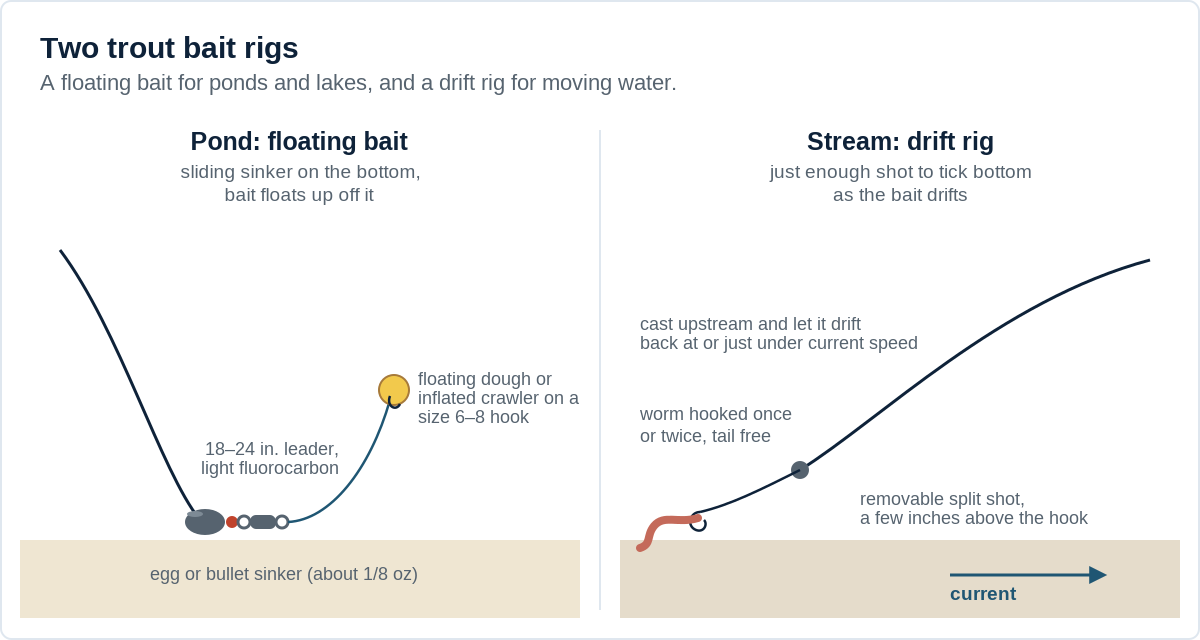
- In streams, drift it. Use size 6 to 10 hooks and only enough removable split shot to let the bait tick the bottom as it drifts. Cast upstream and let it come back at or just under the speed of the current, near the bottom but not dragging; too much weight snags and looks unnatural. In slow pools or deep runs, hang the bait under a small float.
- In ponds, float it. Slide a small egg or bullet sinker (about 1/8 ounce) onto the line, add a swivel, then an 18- to 24-inch leader of light fluorocarbon and a size 6 or 8 hook with enough floating dough to float it, or an inflated nightcrawler. The bait rides up off the bottom where cruising trout find it. This rig snags in streams, so keep it for still water. If nothing bites in about 10 minutes, check the bait and recast.
See Trout Baits and Rigs for more.
Lures
Small lures cover water and catch trout that won't take bait, and where only artificials are allowed, they're the main event.
- Inline spinners (about 1/32 to 1/16 ounce) are the most versatile trout lure: they spin at slow speeds, sink fast and cast accurately into tight spots. Gold and silver are classics.
- Small spoons (about 1/16 to 1/4 ounce): in streams and lakes; bright spoons for browns.
- Small minnow and crayfish crankbaits: for browns and bigger trout, especially at dusk and night.
- Small jigs, tubes and twister tails: year-round.
How to fish them in a stream: land the lure upstream of where you expect a fish and start the retrieve as soon as it hits the water. Cast upstream and retrieve downstream to keep the lure low, or cast across and let it swing across and down on a tight line in front of cover; go lighter if it drags bottom. Fish upstream with a fast lure to find aggressive fish, then work back down with something slower. A small ball-bearing snap swivel cuts line twist. Trout color preferences change day to day, and subtler colors work better in low, clear water. When pond trout follow a spinner without hitting, add a short leader with a baited hook behind it.
In lakes, cast or troll small spoons, spinners and crankbaits, or troll a worm or small spoon behind an attractor while the water is cool.
See Trout Lures: Spinners, Spoons and More.
Flies
Fly fishing and trout go together. Stocked trout are less selective than wild fish and take big, bright flies such as worm and egg patterns and stripped woolly buggers, though they soon learn to act like wild fish. On ponds, morning and evening are prime, a floating line handles fish near the surface, and an intermediate or sink-tip line reaches them deeper.
Stocked trout
Most trout anglers fish for stocked trout at least some of the time. A few things to know:
- They stay close to where they're stocked, at least for a while. Most stocked trout in one study stayed within about a mile and a quarter of the stocking site, and anglers catch more near the stocking spot in the weeks after.
- They school in the shallows of ponds in spring and fall and spread out deeper in summer.
- They often bite better a few days after stocking than right off the truck.
- They're easier to fool with bait (floating dough, worms, salmon eggs) and with flashy lures, but heavily fished trout get line- and bait-shy, so go lighter and try something different.
Tackle
| Use | Rod | Line |
|---|---|---|
| Streams | Light or ultralight spinning, about 4½ to 8½ ft (shorter for brushy creeks, longer for bigger water) | 2- to 8-pound line, as light as the water allows |
| Ponds and lakes | Light to medium spinning or spincast | About 4-pound fluorocarbon leaders for bait rigs |
| Fly fishing | A trout fly rod with a floating line; intermediate or sink-tip lines for ponds | Lighter tippet in winter and for pressured fish |
Use the lightest line the water allows, check it for nicks, and change it often.
Before you go
Trout regulations are some of the most detailed of any fish: seasons, opening days, daily limits, size limits, closed periods around stocking, and special waters that are fly-only, artificial-only or catch-and-release, plus rules on bait such as minnows. Check your state's current freshwater rules for the exact water you plan to fish.
Cover photo: Tom Koerner, U.S. Fish and Wildlife Service (public domain). Diagrams: Basic Fishing.