Article
The Ultimate Guide to Tautog Fishing
Blackfish from the spring jetties to the winter wrecks: where tautog live through the year, anchoring on structure, crabs and how to hook them, two-hook rigs and tog jigs, the bite and the hookset, and the heavy tackle it takes to pull them out of the rocks.
November 10, 2026
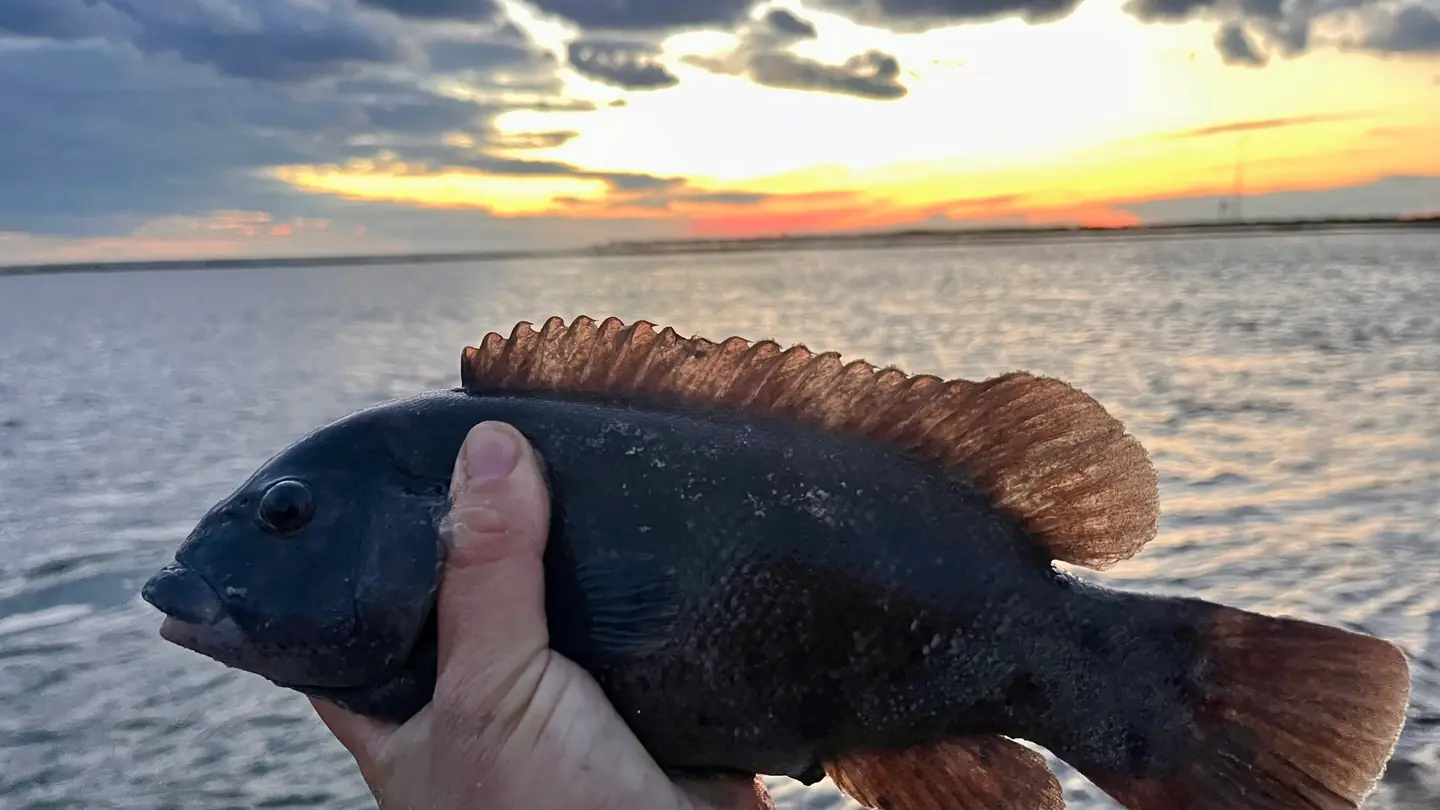
Tautog (blackfish, or just "tog") are the bulldogs of the inshore rocks. They live in the nastiest structure on the coast, eat crabs and mussels with a mouthful of crushing teeth, steal bait faster than you can react, and the moment they're hooked, they dive for the nearest hole. Tog fishing is precise: you have to put a crab on exactly the right rock, read a bite that's easy to miss, and win a tug-of-war in the first few seconds. This guide covers all of it.
Know the fish
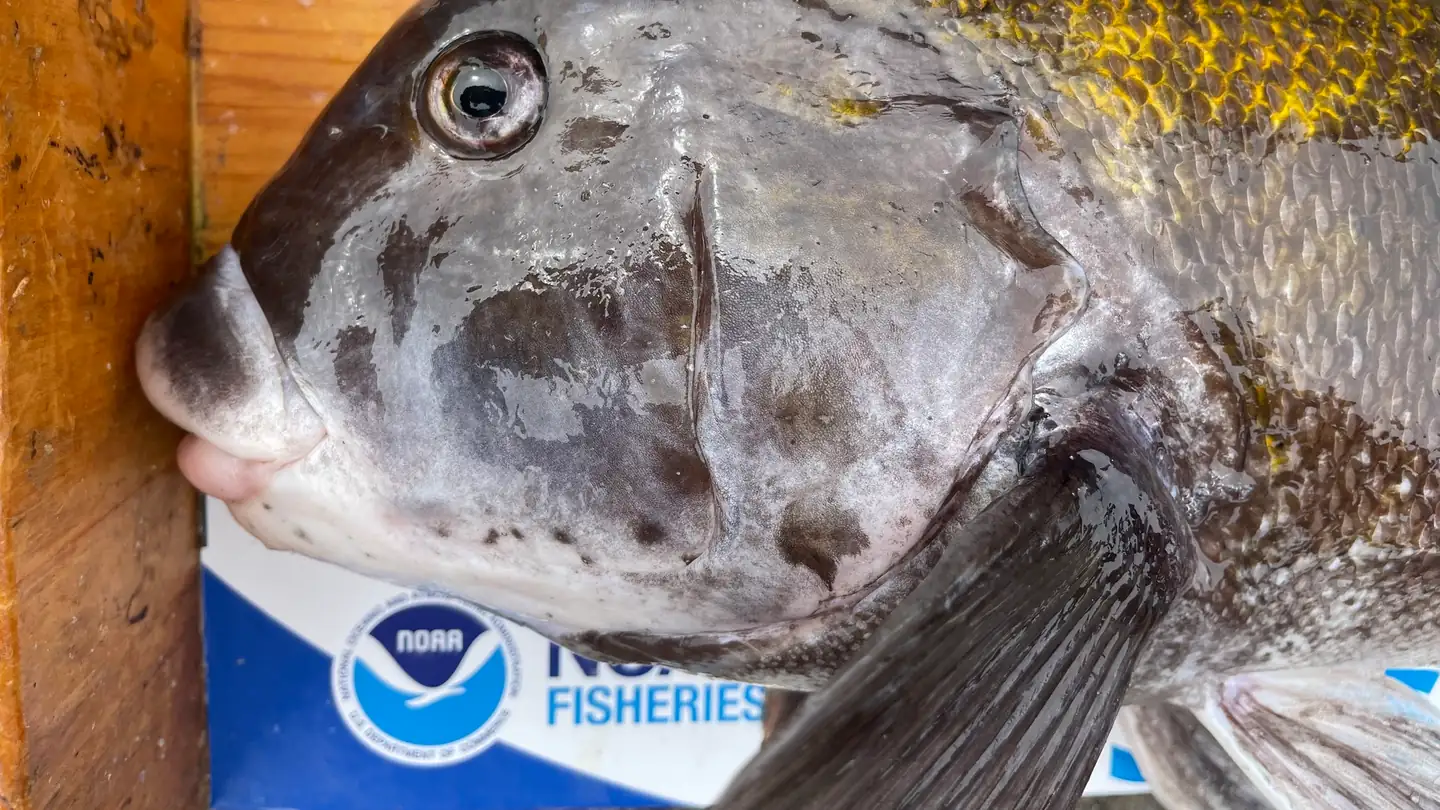
Tautog. Photo: Bobby McCabe, via iNaturalist (CC BY 4.0, cropped).
Tautog are stout, blunt-headed fish, brown to black with darker bars or blotches, with thick, rubbery lips and strong teeth: conical ones in front for pulling shellfish off the rocks, and crushing ones in the back. Big males have a white chin. They range from Nova Scotia to South Carolina and are most common from Cape Cod to Delaware Bay. The average fish anglers catch is a few pounds; a "bulldog" over 10 pounds is a prize, and they can reach about 25. They're slow-growing and can live 30 to 40 years.
Tautog feed only during the day, on crabs, clams, mussels, barnacles and other shellfish, and rest in holes at night. They live on hard structure and nowhere else: rocks, reefs, wrecks, jetties, bridges, pilings, bulkheads, mussel beds and broken bottom.
The tautog year
Tog don't make long coastal migrations; they move inshore and offshore with the water temperature.
| Season | Where they are | Notes |
|---|---|---|
| Spring (April–May) | Moving inshore to shallower wrecks, rock piles, inlets and jetties, often in 5 to 25 feet | Soft baits like clams work well early. |
| Summer | Harder to find inshore as the water warms | Many move to deeper, cooler structure. |
| Fall (mid-September into December) | Back inshore on jetties, bridges, reefs and rock piles, then sliding deeper: 30 to 40 feet, then 60 to 100 feet or more | The classic season, and the best time on many reefs. Crabs are the bait. |
| Winter | Deep wrecks offshore, often in 50 to 150 feet | From New York south, winter into spring can be prime time for the biggest fish, in water in the high 40s to low 50s °F. |
Tog return to the same wrecks and rock piles year after year. The biggest fish usually come from high-profile, lightly fished structure, from the holes in it, and from the edges where the wreck or rock meets the bottom.
Where and when to fish
- Structure is everything. Fish right in the rocks, not near them. Big tog live in the holes.
- Fish the slack. Tog usually bite best around slack tide or the slower part of the tide, often the end of the incoming and the start of the outgoing from shore.
- Fish by day. They feed in daylight; early light to mid-morning can be very good.
- Shore spots: jetties, piers, bridges, bulkheads, canals and inlets all hold tog in spring and fall. Wear studded footwear on jetties.
- Boat spots: wrecks, artificial reefs, rock piles and mussel beds.
Anchor right on the structure
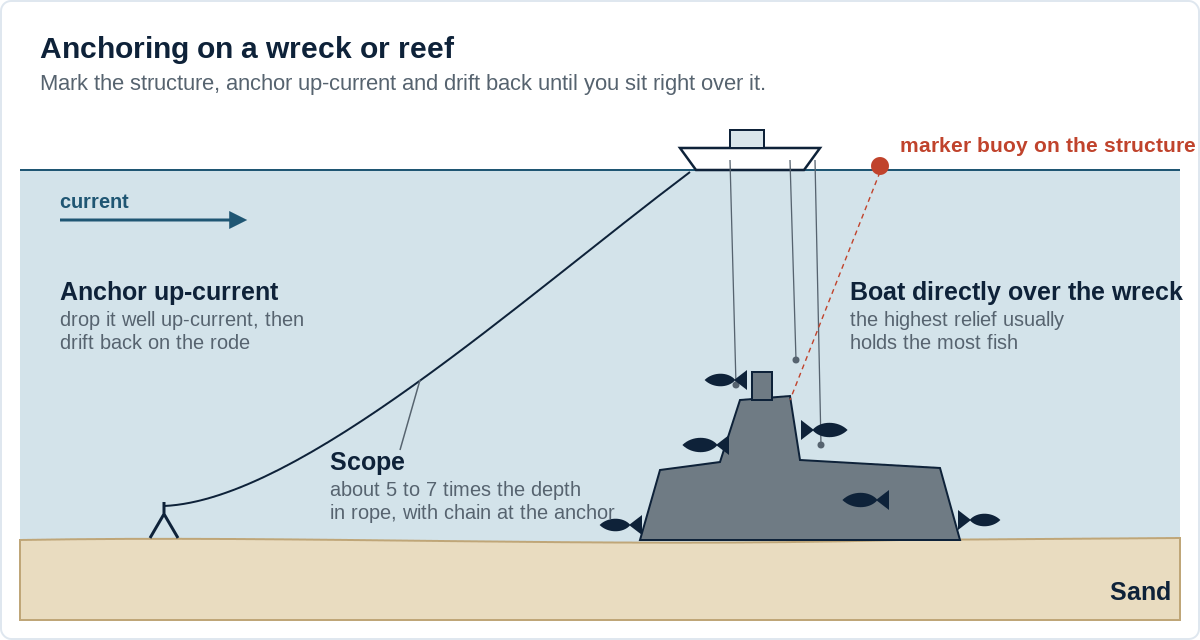
From a boat, placement is the whole game. Tog won't move far for a bait, so you need to sit directly over the structure, and stay there.
- Find the spot with GPS, then circle it watching your sounder to see exactly where the structure is.
- Drop a marker buoy right on it.
- Put the boat in neutral to see how wind and current set you.
- Run up-current, set the anchor (many tog anglers use two, set off the bow about 45 degrees apart, for a steadier boat) and drop back on the rode until you're over the buoy.
- If the bite is slow, fish the other side of the boat or let out or take in a little rode to shift onto a different part of the structure.
See Anchoring on Wrecks and Reefs.
Baits: crabs, crabs, crabs
| Bait | Notes |
|---|---|
| Green crabs | The most common tog bait. Use whole crabs for big fish when the bite is good, halves or quarters when it's slow. |
| Asian shore crabs and fiddler crabs | Excellent, especially inshore; you can collect your own. A couple of small fiddlers on one hook. |
| Hermit, calico (lady) and blue crabs | Hermits are a top bait; calicos and fiddlers can get more bites in warm months. |
| Jonah (white-legger) and rock crabs | Late-fall and winter baits for big fish on deep structure. |
| Clams and mussels | Good early in spring, but they draw small fish. |
Hooking crabs: run the hook in through one leg socket (knuckle) and out another so the crab stays on. Crack the shell of whole crabs to let the scent out. Go big when small tog and bergalls keep stealing your bait. Green crabs are invasive but legal bait in the region; don't release leftover nonnative crabs.
See Crabs and Baits for Tautog.
Rigs and jigs
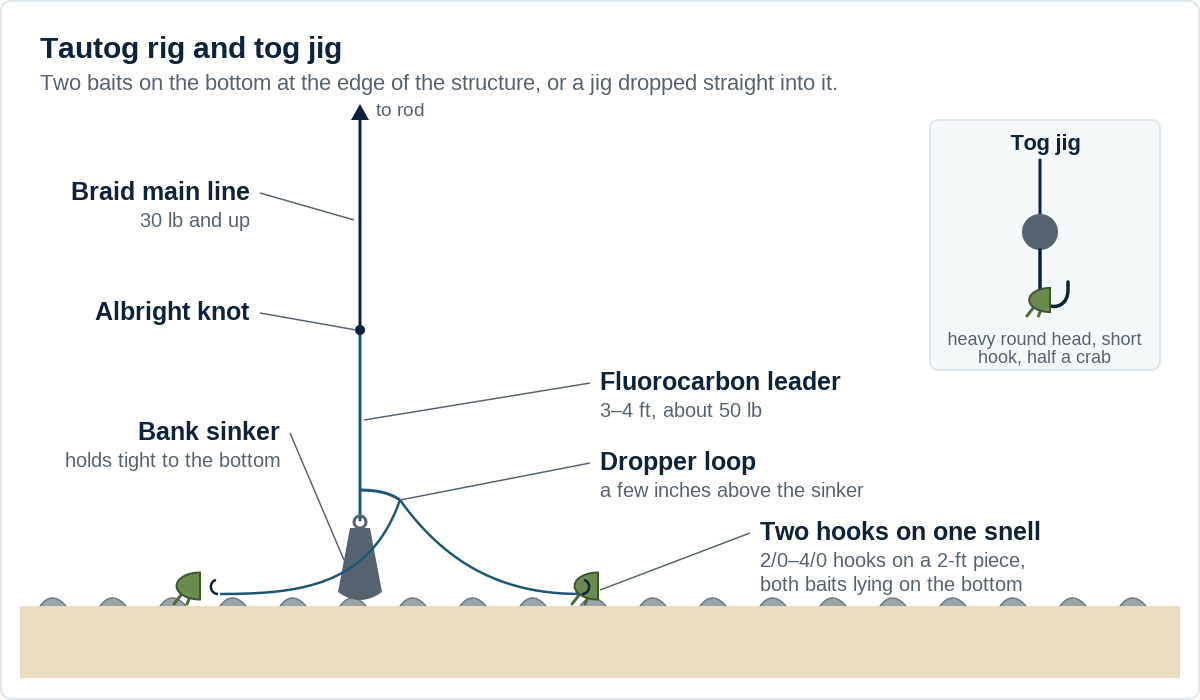
Keep it simple. Every extra piece of hardware is another thing to snag. The standard rig:
- About 3 to 4 feet of 50-pound fluorocarbon tied to the braid main line.
- A loop at the bottom for a bank sinker, heavy enough to hold tight to the bottom.
- A dropper loop a few inches above the sinker, holding a 2-foot piece of fluorocarbon with a hook snelled on each end, so both baits lie on the bottom.
Variations include a single hook on a short dropper, or two dropper loops. Virginia-style hooks are traditional (about No. 2 to 1/0 for small fish, 2/0 to 4/0 for bigger ones), and octopus hooks of 5/0 to 7/0 are used for trophy fish with whole crabs. Many anglers tie the sinker on with lighter line so it breaks away when it snags.
Tog jigs are a heavy, round jighead (about 1 to 3 ounces) with a short-shank 3/0 to 5/0 hook, baited with half a crab or a chunk of crab or clam and dropped straight into the structure. Use the lightest jig that reaches the bottom and keep the line straight up and down.
Whether rig or jig, walk the sinker or jig slowly along the structure to find the holes, and once you start getting small bites, stay put. For more, see Tautog Tackle, Rigs and Jigs.
Reading the bite and setting the hook
Tog are among the hardest fish to hook. They often crack a crab and pick at it with their lips before they eat it, and they can strip a hook clean before you react.
- Learn the difference between the tapping and scratching of a fish working the shell and the solid pull of a fish that has taken the bait. Light taps mean the fish doesn't have a good hold yet.
- Wait for the pull, often the second grab, then set hard and crank. Don't wait too long, or they'll clean the hook.
- For big fish, some anglers drop the rod tip as the fish takes, to give a moment of slack, then come tight.
- Win the first few seconds. A hooked tog heads straight for the rocks. Reel fast and haul it up and away from the structure. A drag set near locked helps on big fish.
- If it holes up, give it slack. About half the time, a wedged tog swims back out.
Once a tog is hooked, its rubbery lips usually hold the hook. See Hooking and Landing Tautog.
Tackle
| Fishing | Rod | Reel and line |
|---|---|---|
| Rigs on wrecks and reefs | 6- to 7-foot stiff, fast rod with a sensitive tip and enough backbone for an 8-ounce sinker (8 feet on crowded party boats) | Conventional reel with low gear for torque or high speed for retrieve; 30- to 50-pound braid with a fluorocarbon topshot |
| Tog jigs | 7-foot medium spinning or conventional | About 20-pound braid with a 30-pound fluorocarbon leader |
| Shore and jetties | Long spinning rod to lift fish over the rocks | Abrasion-resistant line, about 20 to 30 pounds |
Braid lets you feel the bite, hold bottom with less weight, and put enough pressure on a fish to keep it out of the rocks. Expect to lose tackle; it's part of tog fishing.
Before you go
Tautog are slow-growing and closely managed, with size limits, bag limits and seasons that differ by state and change often. Check your state's current saltwater regulations. You'll often find black sea bass and scup on the same structure; see The Ultimate Guide to Black Sea Bass Fishing. For the species page, see tautog.
Cover photo: iNaturalist contributor, via Wikimedia Commons (CC0). Diagrams: Basic Fishing.