Article
The Ultimate Guide to Black Sea Bass Fishing
Where black sea bass live through the year, how to find the right rock pile or wreck and sit on it, the high-low rigs and jigs that catch them, how to cull the big ones, and how to release fish from deep water.
November 10, 2026
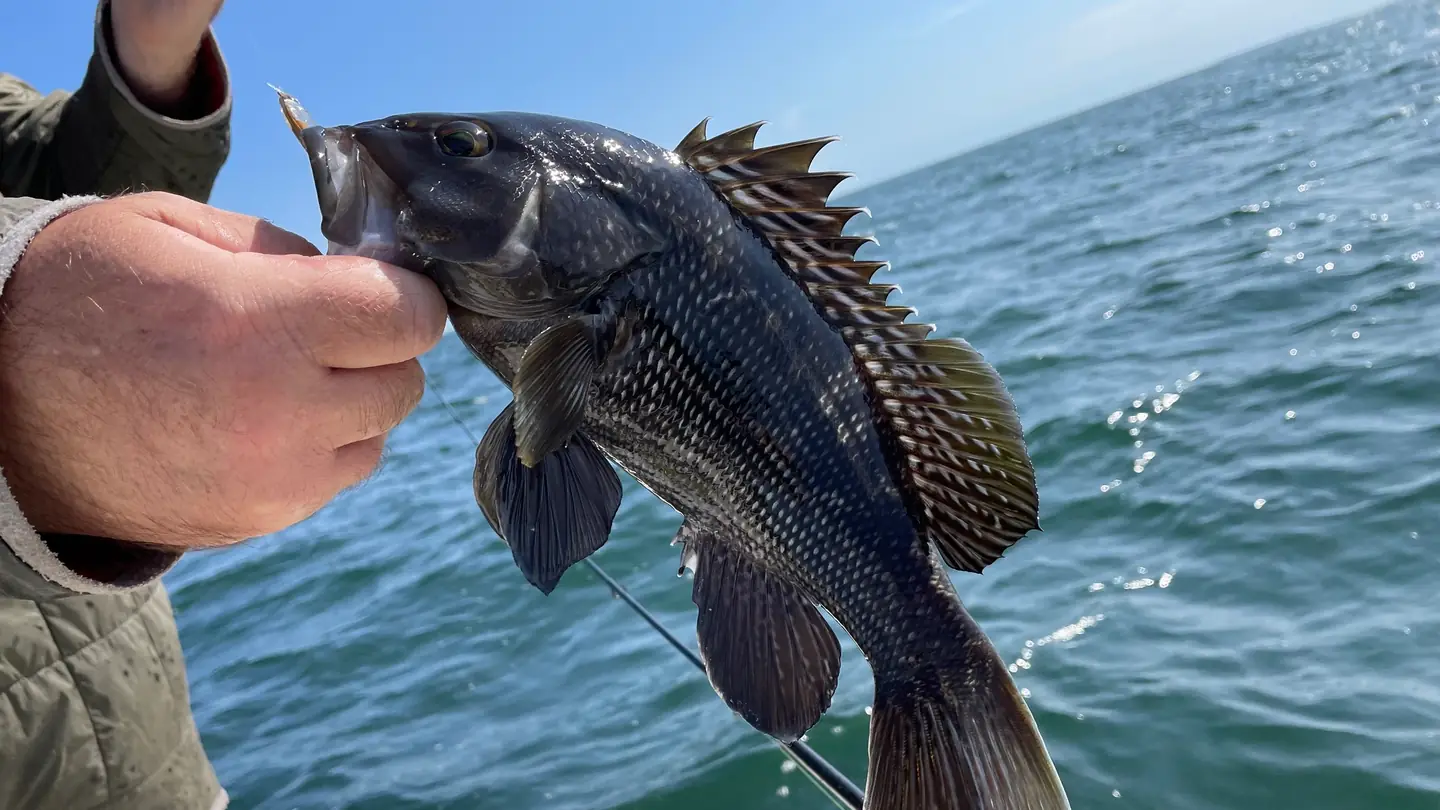
Black sea bass are the bread and butter of reef and wreck fishing on the Atlantic coast. They live on rocks, wrecks and reefs from the beaches out past 200 feet, they bite all day, they hit hard for their size, and once you find a school you can catch them as fast as you can get a bait down. The trick is finding the right piece of bottom, staying on it, and getting past the small fish to the big humpbacked males. This guide covers all of it.
Know the fish
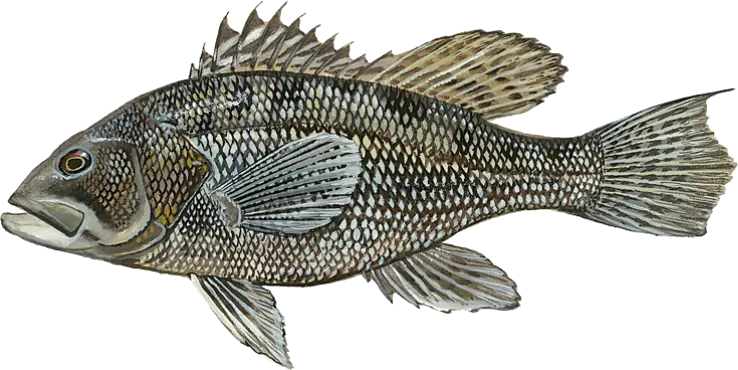
Black sea bass. Painting: Duane Raver, U.S. Fish and Wildlife Service (public domain).
Black sea bass are stout, dark bluish-black fish with pale spots in rows along the sides and a three-pointed tail. Most run about a foot long; they can reach 2 feet and top 8 pounds. They range from Maine to the Florida Keys and the Gulf. The fish north of Cape Hatteras are migratory; those to the south mostly stay put. Their range has spread north as the water has warmed, and they're now common well into southern New England.
Sea bass start life as females, and some of the larger females become males. Big males develop a hump on the head, and anglers call them humpbacks or knotheads. They eat crabs, baby lobsters, mussels, razor clams, worms, squid and small fish, and they feed by day.
Where and when
Sea bass are reef fish. They live tight to hard structure, and you won't find them on the sand a short distance off the spot.
- Natural structure: rock piles, ledges, boulder fields and hard humps, especially deep rock piles surrounded by sand.
- Wrecks and artificial reefs: sunken ships, tanks and other material dropped on reef sites.
- Inshore structure: jetties, pilings, oyster bars and rock edges, especially in late spring.
- Rips over structure: where current pushes over a reef or ledge, sea bass hold all season.
| Season | Typical depth | Notes |
|---|---|---|
| Spring (May–June) | 20 to 60 feet, plus jetties and inshore rocks | Fish move inshore and north; shore anglers catch them near jetties and drop-offs. |
| Summer | Shallow reefs early, deeper reefs as the water warms | Lots of fish, but many are throwbacks. |
| Fall | 60 to 120 feet | Often the best time on the reefs as fish gather and move deeper. |
| Winter | 120 to 240 feet or deeper | In the southern part of the migratory range, the biggest fish end the year on the deepest wrecks. |
Finding the spot
- Look for sharp contours. On a chart, where the depth rises and falls abruptly, there's usually hard bottom.
- Fish lightly fished spots. Unmarked reefs and spots away from the crowds get less pressure. On popular reefs, go midweek and get there first.
- Find the fish on the structure. Circle the wreck or rock pile watching your sonar before you set up; fish can be 100 yards off the mark. The highest point of a wreck creates eddies where sea bass feed, and the best part of a spot can shift with the tide.
- Time the tide. Sea bass often turn on when the current slows, about an hour either side of slack.
Anchor or drift
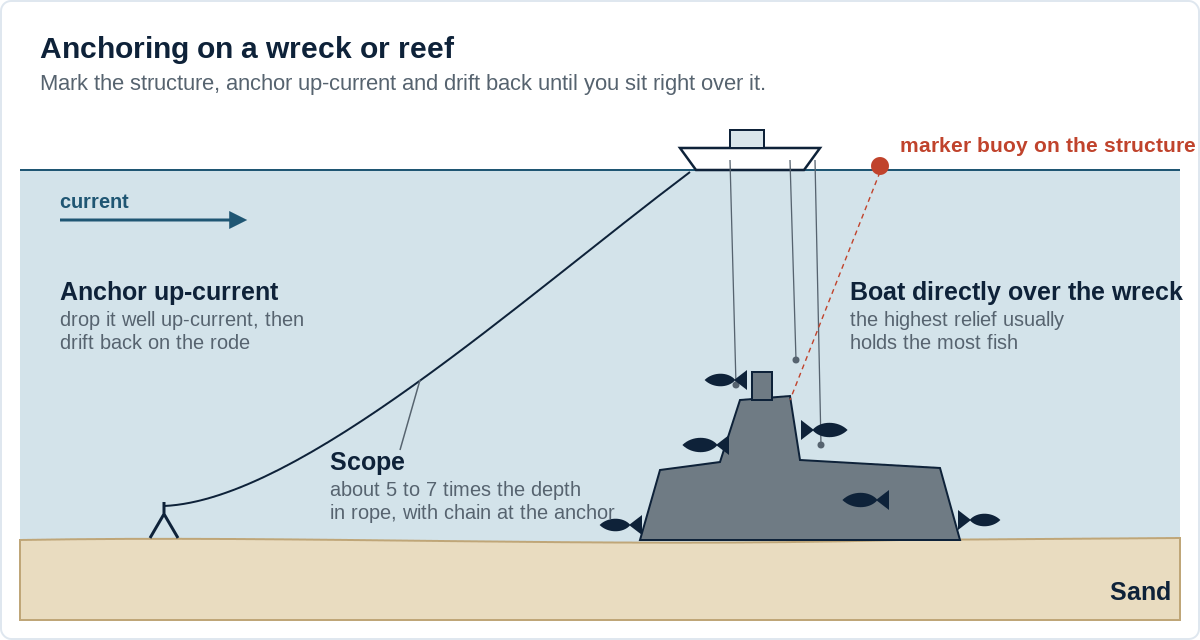
Anchoring holds you on the structure, which is how you catch numbers and how you chum. Mark the spot with a buoy, shut down to see how wind and current set the boat, then run up-current, drop the anchor and drift back on the rode until you're over the buoy. Use a lot of rode: about 5 to 7 times the depth. A second anchor, or a bridle line to shift the boat sideways, puts you exactly where you want to be. Set up well away from another boat already on a spot. See Anchoring on Wrecks and Reefs.
Drifting makes it easy to leave a slow spot and to make repeated passes over a school, and it's often better in deep water and strong current. It costs more rigs. Keep your line as vertical as you can; if the rig drifts away from the boat, reel up and drop again.
Rigs and baits
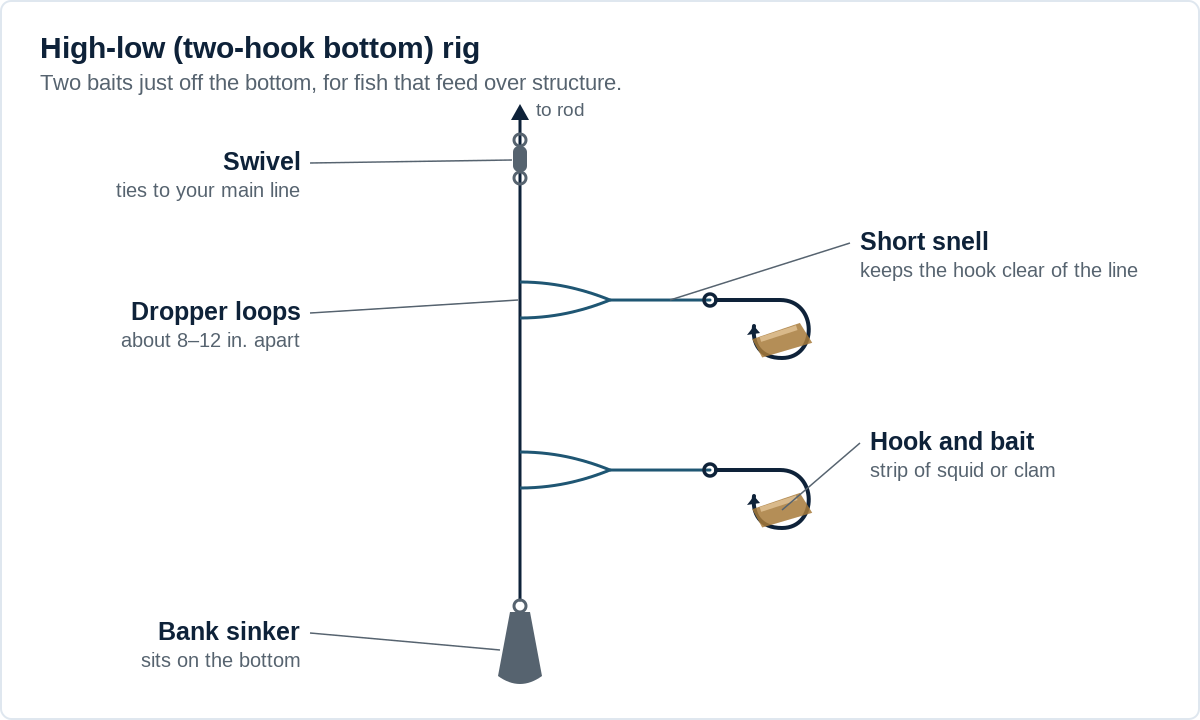
The high-low (top-and-bottom) rig is the classic: a swivel at the top, two dropper loops about 8 to 12 inches apart with 3/0 to 5/0 hooks, and a loop at the bottom for a bank sinker. Squid or clam on a high-low rig catches sea bass just about anywhere. Many anglers tie their own from 30- to 50-pound mono or fluorocarbon; fluorocarbon is stiffer and stands up better to rough structure. Circle hooks hook fish in the jaw and make releasing small ones easy.
- Baits: squid (the most popular), fresh or salted clam, and strips or chunks of fish; crabs, sandworms, bloodworms and scented artificial baits also work. Use fresh, tough bait cut big enough to hide the hook but small enough to swallow. Smaller pieces sink faster.
- Sinkers: just enough to hold bottom, often 4 to 8 ounces offshore. Braid's thin diameter lets you use less. On a party boat, use the same weight as everyone else so lines don't tangle.
- Fish it: keep the line vertical, keep the rig bouncing just off the bottom so it doesn't snag, and check your bait often. When the first fish hits, it often pays to wait a moment for a second fish to grab the other hook.
Jigging for bigger fish
A high-low rig catches everything: small sea bass, porgies (scup) and the occasional big one. To cull the bigger fish, switch to a jig. Larger sea bass usually hit the jig, while small fish and porgies mostly ignore it, and you don't have to rebait.
- Jigs: diamond and flutter jigs, and bare jig heads tipped with squid, clam or a scented soft plastic. Metal works better than bucktails in deep water because it sinks faster. Use a thin metal jig when sand eels are around.
- Weight: the lightest that reaches and holds bottom: about 3 to 4 ounces in shallow bays, 6 to 8 ounces in deeper water, and up to 12 ounces far offshore.
- Hooks: single 5/0 to 7/0 hooks rather than trebles over rough bottom.
- Teaser: a dropper 8 to 18 inches above the jig with a small soft plastic or bucktail on a 3/0 hook adds a second offer, though it snags more often.
- Action: keep it close to the bottom, within a rod length. Use short 8- to 12-inch strokes or slow cranks, and let the line go slack on the drop so the jig flutters. Strikes often come on the fall.
A sea bass bite is a distinct thump. Set the hook quickly. For more, see Black Sea Bass Rigs and Jigs.
Tackle
| Fishing | Rod and reel | Line |
|---|---|---|
| Shallow reefs and inshore (10–60 ft) | 6 to 7½ ft medium-heavy spinning | 20- to 30-pound braid, 15- to 20-pound fluorocarbon leader |
| Deeper water and current | 6 to 7 ft fast conventional with a small levelwind reel | 15- to 40-pound braid; 24 to 36 inches of 30- to 50-pound leader for jigging |
Braid's lack of stretch lets you feel the bite in deep water, and a fast reel gets fish up and away from the structure.
Releasing sea bass from deep water
Millions of sea bass are released every year, and fish brought up from deep water often suffer barotrauma: the gas in the swim bladder expands, bloating the fish and pushing its stomach out of its mouth, so it can't swim back down. It can show up in fish from as shallow as 65 feet and gets worse with depth. A descending device, which carries the fish back down and releases it at depth, gives it the best chance. Circle hooks and a dehooker let you release small fish quickly without handling them. See Releasing Fish Caught in Deep Water.
Before you go
Black sea bass have size limits, bag limits and seasons that differ by state and change often, and some areas require descending devices on board. Check your state's current saltwater regulations. You'll often catch tautog and scup on the same structure. For the species page, see black sea bass.
Cover photo: Jim Arrigoni, via iNaturalist (CC BY 4.0, cropped). Diagrams: Basic Fishing.