Article
Black Sea Bass Rigs and Jigs
A two-hook bait rig catches sea bass by the dozen; a metal jig catches the big ones. Here's how to set up both, how to work a jig, and what tackle to bring.
November 3, 2026
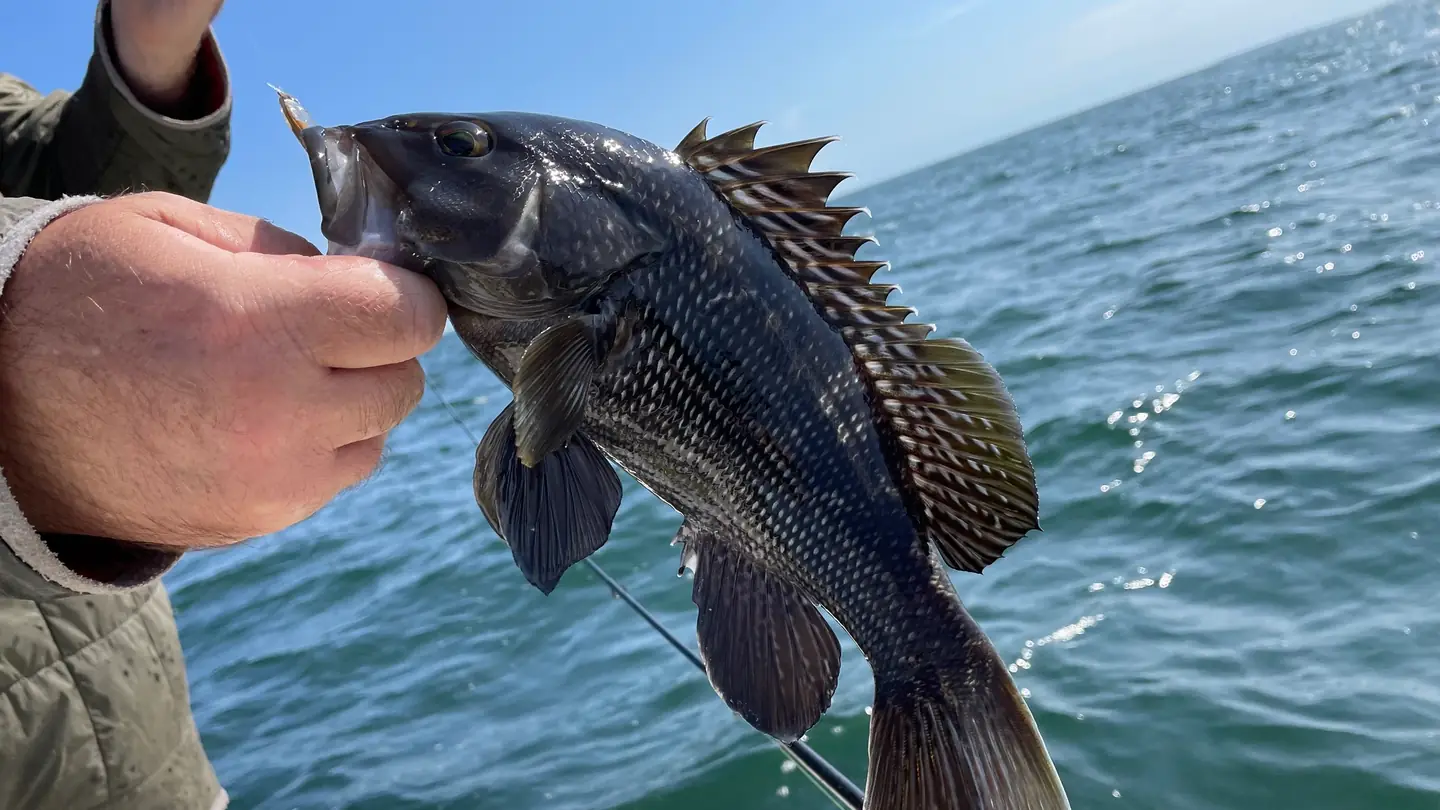
Sea bass aren't hard to catch. Drop a baited hook onto the right rock pile and you'll get bit almost right away. The challenge is catching big sea bass instead of a steady stream of shorts and porgies. That comes down to choosing between two approaches: a bait rig for numbers, or a metal jig for size.
The high-low bait rig
The standard sea bass rig is a two-hook bottom rig, often called a high-low or top-and-bottom rig. Store-bought rigs work, but a simple homemade one from heavy mono or fluorocarbon catches more, because it's less visible and has less hardware to snag.
How to tie it:
- Cut about an arm's length (3 feet or so) of 30- to 50-pound mono or fluorocarbon. Fluorocarbon is stiffer and tougher against rocks.
- Tie a swivel to the top end with a palomar knot.
- Tie a loop at the bottom end (a surgeon's loop or a simple overhand loop) to hold the sinker.
- Tie two dropper loops above the sinker, about 8 to 12 inches apart.
- Loop or tie a hook onto each dropper.
Hooks: 3/0 to 5/0. Baitholder hooks hold clam and squid well; circle hooks hook fish in the corner of the mouth and make small ones easy to release with a dehooker.
Sinker: a bank sinker heavy enough to keep the rig on the bottom with the line straight down, usually 4 to 8 ounces, more in deep water and current. On a party boat, use the same weight as everyone else, or your line will drift into theirs.
Bait
- Squid is the most popular sea bass bait. It's tough and stays on.
- Clams, fresh or salted, work well too.
- Fish strips and baitfish catch sea bass and stand up to picking.
- Scented soft baits stay on the hook longer than natural bait.
Cut bait in strips or chunks big enough to cover the hook but small enough for a fish to swallow. Chunks with skin stay on better, and a smaller piece sinks faster and stays down.
Fishing the rig
- Keep the line vertical. Hold the rod. If the rig drifts away from the boat, reel up and drop it again.
- Lift over snags. On rough bottom, feel for the bottom changing and raise the rig a little to keep it out of the rocks.
- Set quickly. A sea bass bite is a sharp thump. Lift and reel.
- Go for doubles. When the first fish hits, you can wait a moment for a second fish to grab the other hook before reeling.
- Check your bait. If the bite is hot and you're not getting hit, your hooks are probably bare. Porgies and small sea bass pick baits clean fast.
The downside of bait: you'll catch lots of small fish and porgies. That's where jigs come in.
Jigging for bigger sea bass
Big sea bass have big mouths and eat fleeing prey. A metal jig fished near the bottom keeps shorts and porgies off your hook and catches more of the large fish. Sea bass anglers have found again and again that the bigger fish hit the jig while the small ones avoid it.
The jigs
- Diamond and flutter jigs are the main tools. Metal sinks fast and works in deep water and current, where bucktails sink too slowly.
- Weight: use the lightest jig the depth, wind and current allow. That might be 3 to 4 ounces in shallow bays, 6 to 8 ounces in deep sounds, and up to 10 or 12 ounces offshore.
- Hooks: a single hook, 5/0 to 7/0. Avoid treble hooks over rough bottom; they snag and foul-hook fish.
- Sweeten it: a strip of squid, clam or cut bait, or a soft-plastic grub, on the hook.
- Teaser (optional): a small soft-plastic squid or bucktail on a 3/0 hook, on a dropper 8 to 18 inches above the jig. It often catches a fish. Some anglers skip it because it snags more and the biggest fish tend to hit the jig on the bottom anyway.
- If sand eels are around, a slim metal jig that matches them is the best choice.
Working the jig
- Drop it to the bottom.
- Stay close to the bottom. Big sea bass hold tight to structure and rarely rise far to feed. Keep the jig within a rod's length of the bottom.
- Lift and drop. Use short strokes of 8 to 18 inches, letting the jig bounce along just off the bottom. Or try a slow "squidding" retrieve: about eight turns up from the bottom, then drop back.
- Let it fall freely. The drop matters as much as the lift. Drop the rod tip quickly so the line goes slack and the jig flutters sideways like a wounded baitfish. Lower it too slowly and it just sinks.
- Stay in touch. Many strikes come on the drop. If the jig stops falling early or you feel a tap, reel and set.
Jig on a leader
In shallower water, under about 70 feet, you can fish a small jig head on a 3-foot fluorocarbon leader with an egg sinker sliding above a swivel. In deeper water, fix the weight to the leader instead; a sliding sinker tangles on the way down. Color can matter on any jig: if one isn't working, try another.
Rods, reels and line
- Rod: a 6- to 7-foot conventional rod with medium-fast to fast action, in the 12- to 30-pound class. It needs enough backbone to lift fish off the bottom and handle heavy jigs.
- Reel: a small levelwind conventional reel. A fast retrieve helps get fish away from the structure.
- Line: 15- to 40-pound braid. Braid is thin, so you need less weight to reach bottom, and it doesn't stretch, so you feel bites and set the hook instantly.
- Leader: 2 to 3 feet of 30- to 50-pound mono or fluorocarbon.
Rig or jig?
| You want | Use |
|---|---|
| Lots of action, a mixed bag, kids aboard | High-low bait rig |
| Bigger fish, fewer shorts and porgies | Metal jig |
| Doubles | Bait rig |
| No rebaiting | Jig |
Many anglers fish one of each. When striped bass or bluefish are blitzing on top over a reef, big sea bass are often right on the bottom below them. Leave the blues alone and drop a jig.
For finding the fish, see Black Sea Bass: Where They Live Through the Year. Sea bass caught in deep water often can't swim back down on their own; see Releasing Fish Caught in Deep Water.
Before you go
Sea bass size limits, bag limits and seasons are set by each state and change often. Check your state's current saltwater rules before you go.
Cover photo: Jim Arrigoni via iNaturalist (CC BY 4.0, cropped).