Article
The Ultimate Guide to Sunfish Fishing
Bluegills, pumpkinseeds, redears, redbreasts and green sunfish, from telling them apart to finding them in every season, the baits and tiny jigs they eat, float rigs, fly fishing, and how to catch the big ones.
November 10, 2026
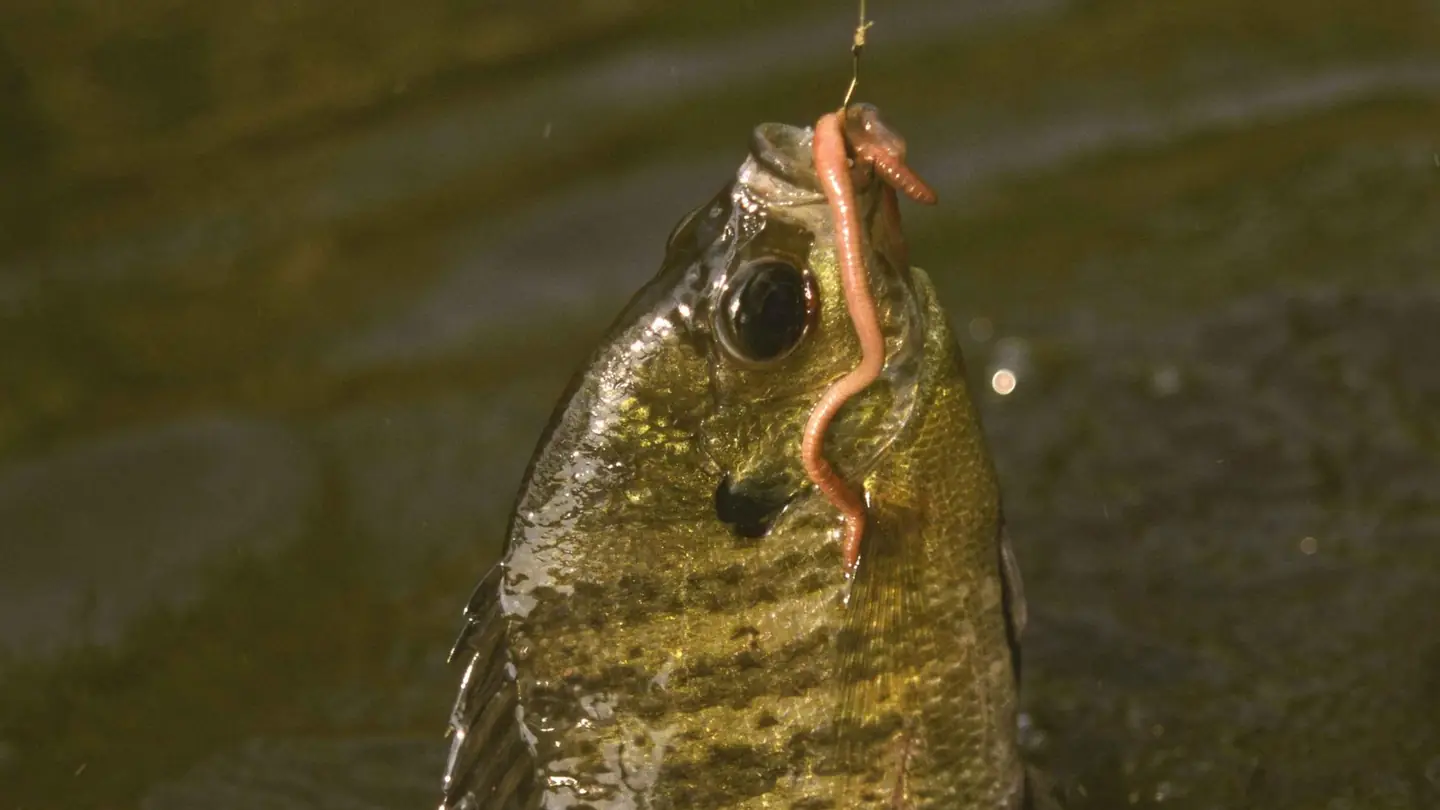
Sunfish are the perfect fish for a kid's first trip and for a lazy summer evening. They live in nearly every pond, lake and slow river, bite all summer, and fight hard on light tackle. But there's a lot more to sunfish than a worm under a bobber off the dock, and the anglers who catch the big ones (the hand-sized "bull" bluegills and the pound-plus shellcrackers) fish them as seriously as any bass angler fishes for bass. This guide covers the main species, where they are in every season, what they eat, and the rigs, jigs and flies that catch them.
Know your sunfish
"Sunfish," "bream" and "panfish" get used loosely, but the fish in the bucket are usually one of five species, and each lives and feeds a little differently. The ear flap (the dark tab at the back of the gill cover), the mouth and the pectoral fins tell them apart.
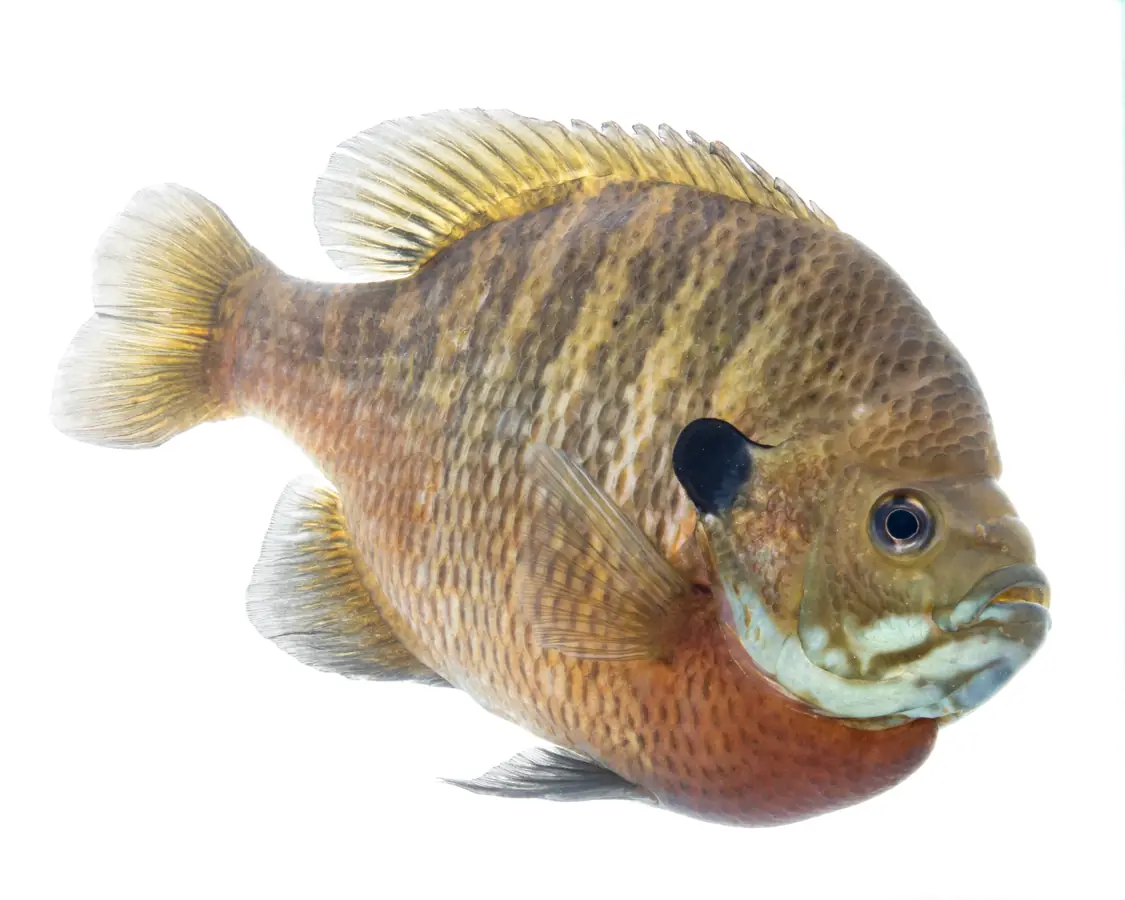
Bluegill. Photo: U.S. Fish and Wildlife Service, Mountain-Prairie Region (public domain).
Bluegill. The most common and most widely stocked. A small mouth that doesn't reach the front of the eye, long pointed pectoral fins, a solid black ear flap and a dark blotch at the back of the dorsal fin. Dark olive-green with a yellow to reddish-orange breast and a blue chin. Most run up to about 9½ inches. Bluegills feed by sight at every depth and eat mostly insects, plus small fish, crayfish and snails.
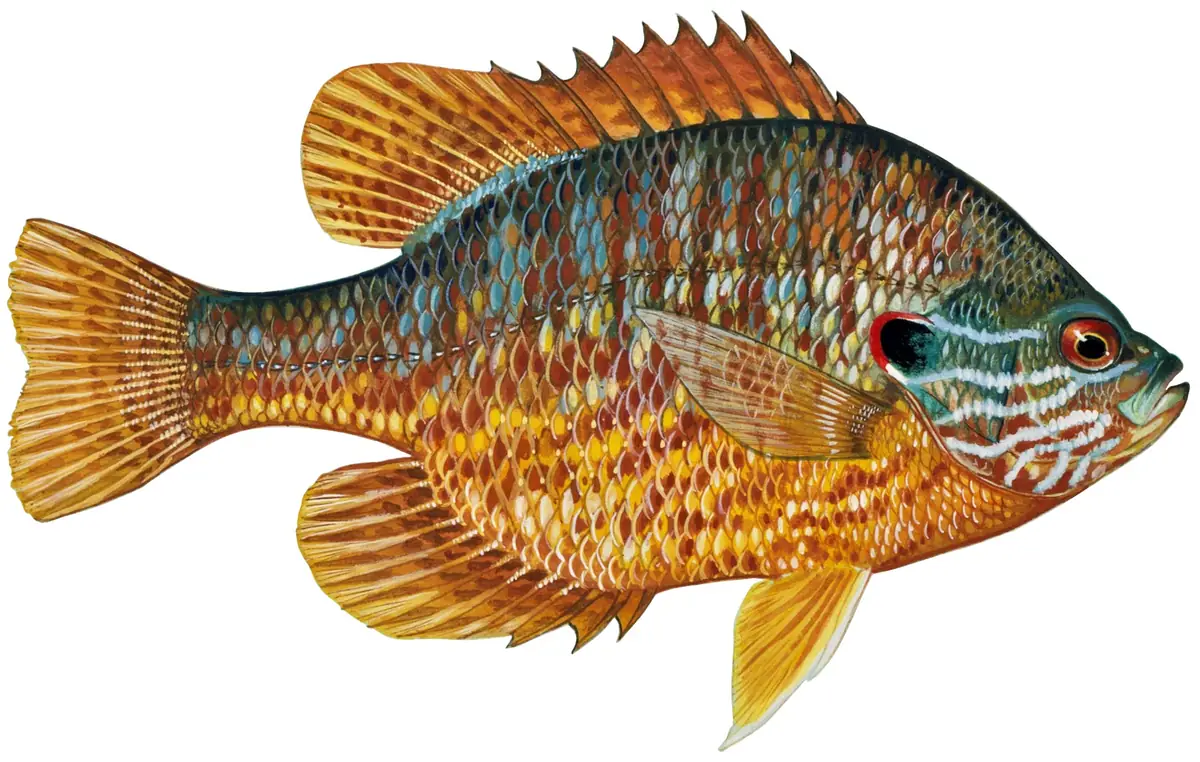
Pumpkinseed. Painting: Duane Raver, U.S. Fish and Wildlife Service (public domain).
Pumpkinseed. The most colorful of the bunch: orange speckles, wavy blue lines on the cheek, and a short ear flap with a small red spot at its edge. Long pointed pectorals like a bluegill. Commonly 3 to 6 inches. Native to the north-central and northeastern U.S., it likes still water with moderate to heavy weeds.
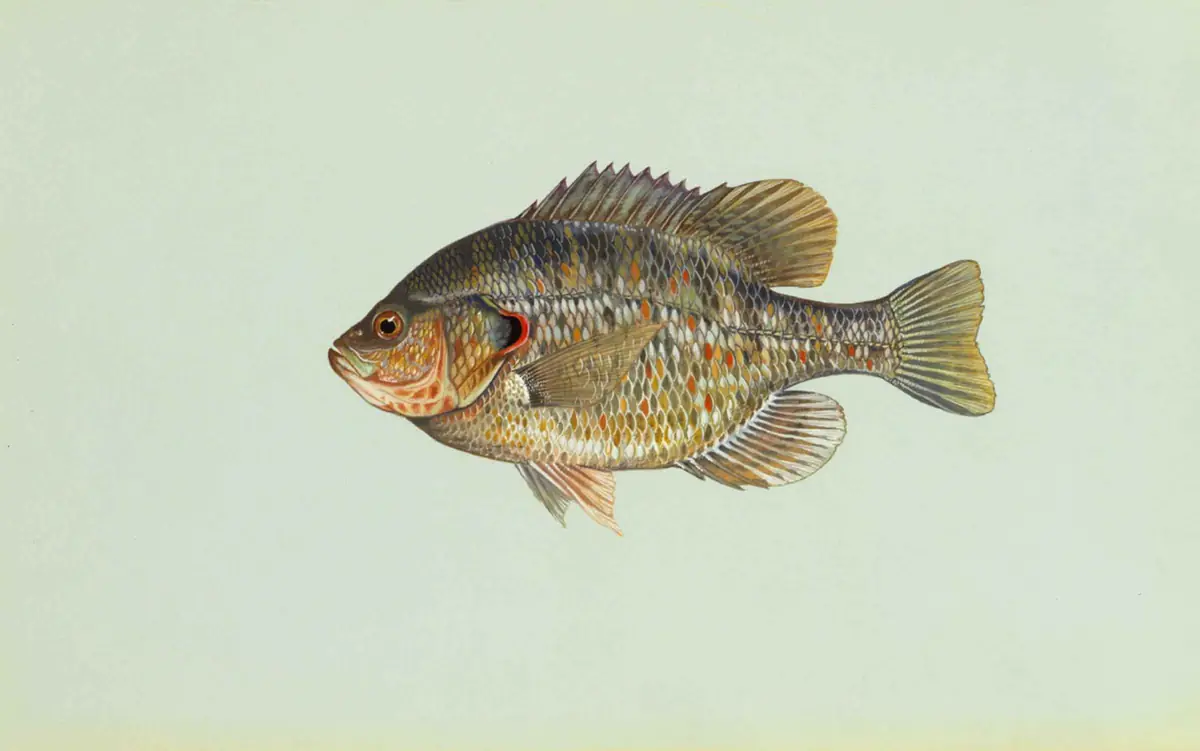
Redear sunfish. Painting: Duane Raver, U.S. Fish and Wildlife Service (public domain).
Redear sunfish ("shellcracker"). Deep and slab-sided, golden to light olive, with a black ear flap edged in white and marked with an orange or red spot. Typically 8 to 10½ inches, and can top a foot and several pounds. Redears eat mainly snails and other mollusks, crushing the shells with flat teeth in their throats, so they feed near the bottom and around weeds. Native to the South and stocked into ponds and reservoirs far beyond it.
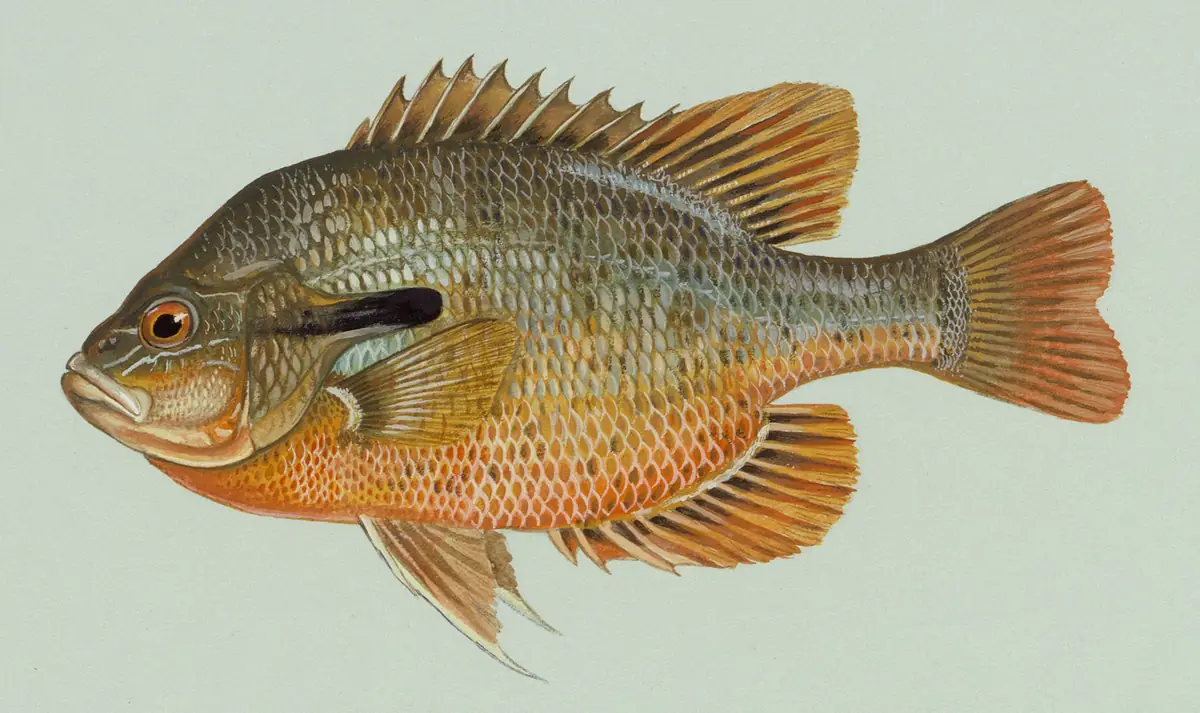
Redbreast sunfish. Painting: Duane Raver, U.S. Fish and Wildlife Service (public domain).
Redbreast sunfish. The river sunfish of the Atlantic coast, from New Brunswick to Florida. A long ear flap that's black all the way to its edge, short rounded pectoral fins and an orange-red belly. Commonly 4 to 6 inches. Redbreasts handle current better than other sunfish and like clear water and rocky stretches of rivers and large streams more than weeds.
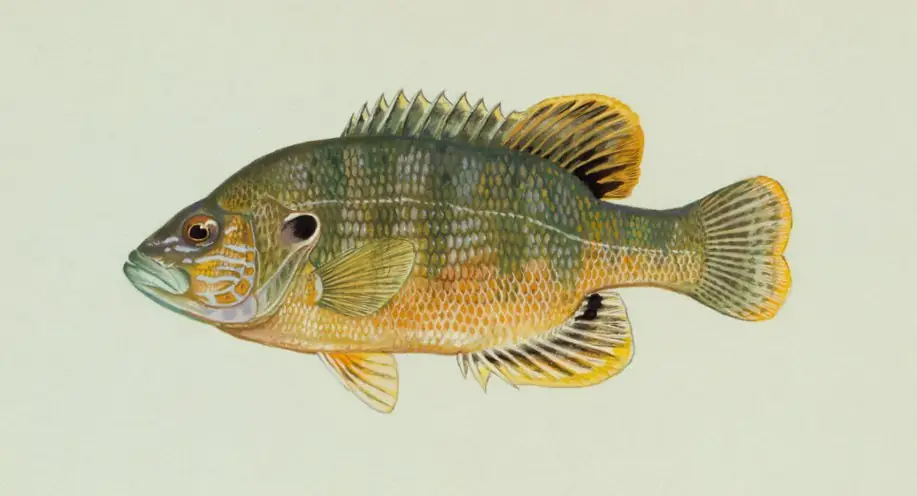
Green sunfish. Painting: Duane Raver, U.S. Fish and Wildlife Service (public domain).
Green sunfish. Thick-bodied, with a big mouth that reaches about the middle of the eye, blue streaks on the head and white- or salmon-tipped fins. Usually 6 to 8 inches. Green sunfish live almost anywhere fish can, down to small, isolated creek pools, and eat insects, crayfish and small fish.
| Mouth | Ear flap | Where you'll find it | Eats | |
|---|---|---|---|---|
| Bluegill | Small | All black | Ponds, lakes, reservoirs, slow rivers | Insects, zooplankton, small fish, crayfish, snails |
| Pumpkinseed | Small | Short, red spot at the edge | Weedy lakes and ponds | Small invertebrates |
| Redear | Small | Black, white edge, red or orange spot | Clear, weedy ponds and reservoirs | Snails and mussels |
| Redbreast | Medium | Long, black to the edge | Rivers and streams with current | Small invertebrates |
| Green sunfish | Large | Dark | Nearly anywhere, even tiny creeks | Insects, crayfish, small fish |
Think small
Most sunfish eat small things: aquatic insects and their larvae, tiny crustaceans and zooplankton, the tiny drifting animals in open water. They rarely chase. They swim up to food and suck it in, so the first rule of sunfish fishing is small baits, small hooks, small jigs and small, sensitive floats. Hooks from about size 8 to size 14 and jigs from 1/80 to 1/32 ounce cover most of it.
The exceptions prove the rule. Redears root on the bottom for snails. Green sunfish, and big bluegills in clear, rocky lakes, will eat crayfish-sized baits. More on those below.
Sunfish through the year
Early spring: find the warmest water
With the water still in the 40s, sunfish are sluggish and bite lightly. They gather wherever the water warms first:
- Small bays, inlets, backwater sloughs, canals and shallow marina basins
- Spots sheltered from cold north winds and in full sun
- Shallow edges with dark bottoms or last year's dead weeds, which soak up heat
Fish tiny jigs (1/32 to 1/80 ounce) with soft-plastic bodies half an inch to an inch and a quarter long with thin, wiggly tails, or tip them with a couple of maggots. Hang them under a small float and barely move them. Orange, red, chartreuse and black all work.
Late spring and early summer: the beds
This is the easiest fishing of the year. Bluegills start spawning when the water reaches about 60°F, often May into early July in the North and earlier farther south. Green sunfish wait for water over about 70°F. Redears nest in May or June and sometimes again in August.
Finding beds. Male sunfish sweep out round nests about a foot across, usually on sand or gravel, and the nests are grouped in colonies, sometimes dozens together. They show up as pale, cleaned-off saucers on the bottom. Look in coves, inlets and corners sheltered from waves and current, with sand sloping toward deeper water nearby. Bluegills bed in 1 to 8 feet, deeper in clear water, and spawn again and again through the summer, moving from 1 or 2 feet in late spring to about 6 feet as the water warms. Spawning activity often peaks around the moon phases.
Fishing beds. A worm, cricket or small jig under a float, set just above the beds, is all you need. Bedding bluegills are aggressive, and if you spook them they're back in a few minutes. Redears are different: in clear water they're skittish, and once run off a bed they stay off much longer. Anchor a long cast away, fish the nearest beds first and work your way in. Big redears want a slow-falling bait (a 1/32-ounce jig in water under 4 feet), and a piece of nightcrawler or a scented bait helps.
Go deeper for bigger fish. In every setting, bigger redears hold deeper than the obvious shallow beds, often 6 to 10 feet along the edges and openings of reed and weed beds.
Summer: weeds, shade and deeper water
After spawning, sunfish slide deeper and hold in or near weeds, brush, docks and drop-offs. Bluegills often travel in loose groups of 20 to 30, feeding in the shallows in the morning and evening and moving to deeper water or shade at midday. Redears go deeper too and stay there for the rest of the year.
- Low light: early morning and evening are best in shallow, clear water. Big fish come up onto the flats then.
- Midday: fish shade and depth: under docks, along deep weed edges, and in weed beds 3 to 8 feet deep, which hold fish all day.
- Deep cover: submerged trees, brush piles, logjams and fish cribs hold some of the biggest sunfish in the lake.
- Open water: big bluegills roam offshore feeding on zooplankton, and in some lakes the biggest ones sit on deep rock in 20 feet or more.
Fall and winter
Sunfish keep biting through the cold months, including through the ice in the North. See Ice Fishing for Panfish for that.
Baits
| Bait | How to fish it |
|---|---|
| Garden worms, red worms, nightcrawler pieces | The classic. Every sunfish eats them. Keep them cool. |
| Mealworms | Tough and hold up in the heat. Under a bobber, on the bottom with a split shot, or on a jig. |
| Wax worms and maggots | Small grubs for tiny jigs, especially in cold water and through the ice. |
| Crickets and grasshoppers | Top summer baits for bluegills. |
| Tiny jigs and soft plastics | 1/80 to 1/32 ounce, small bodies with thin tails; tip with a maggot or wax worm. |
Rigs and how to fish them
The float rig
- Put a small, sensitive float on 4-pound line.
- Tie on a size 8 to 14 hook or a tiny jig.
- Pinch on just enough split shot to stand the float up, so a fish can pull it under easily.
- Set the depth so the bait hangs just above the bottom, the weeds or the beds.
Watch the float closely. Sunfish often just make it twitch, lean or slowly sink instead of pulling it under. To fish deeper than your rod is long, switch to a slip float.
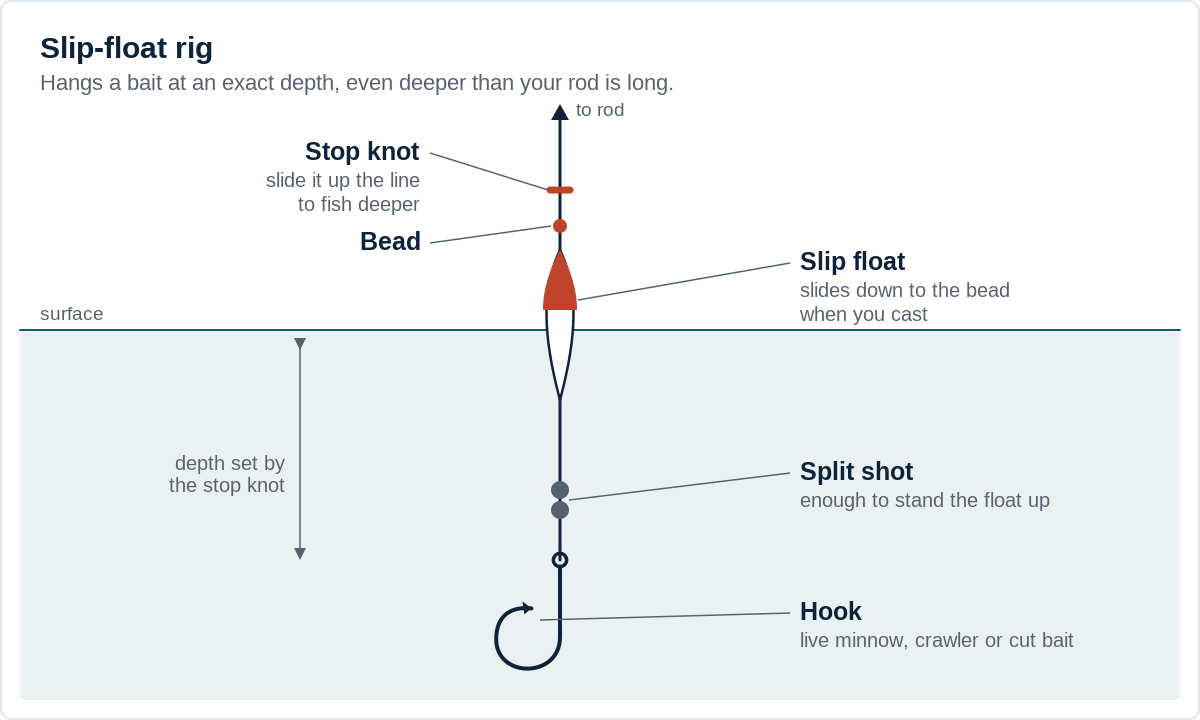
Bottom rigs for redears
Redears want the bait on or right near the bottom, so a float that suspends the bait above them misses the mark. Pinch a couple of split shot 5 or 6 inches above a worm, cast it out and crawl it slowly along the bottom. With a slip float, set the stop knot so the bait rests on the bottom and the float is only a strike indicator.
Vertical jigging in cover
Once sunfish move off the beds into brush, timber and cribs, the biggest ones are buried in the thickest cover, where most lures hang up. Get right on top of the cover and fish straight down. A small, compact jigging spoon with a single hook, tipped with a wax worm, a piece of red worm or a tiny plastic, slips through branches that would grab a jig and float. Drop it until you feel branches, then jig it in place.
Bigger baits for big fish
In clear lakes and quarries with rock, gravel and plenty of crayfish, big bluegills, redears and green sunfish eat bigger meals than you'd think. A 3/16-ounce football-head jig with a small, crayfish- or hellgrammite-like soft plastic (green pumpkin is the go-to color) crawled down ledges, along deep bottoms and over hard, sparsely weeded flats can catch fish bigger than you'd ever get on a worm. Small finesse plastics on a mushroom-head jig, fished like a bass angler's Ned rig, and a drop-shot with a small plastic 4 to 6 inches above the weight catch big ones too.
River sunfish
Redbreasts handle current better than other sunfish, but river sunfish of every kind gravitate to the softer water. Look for clear, rocky stretches of larger streams and for the slow pocket on the downstream side of a laydown, where the branches also draw small baitfish. The same small baits, jigs and flies work there.
Fly fishing for sunfish
Bluegills may be the best fish there is for learning to fly fish. They're everywhere, eager, and need little skill to catch, and everything you practice on them carries over to trout and bass.
Gear. A 9-foot 5-weight trout rod works fine. A short 6- to 7-foot 3-weight is more fun, and better under overhanging trees on small creeks. Use a weight-forward floating line, and any simple reel; you'll strip in most fish by hand. A tapered leader with 4X or 5X tippet finishes it.
Flies:
- Panfish poppers. Small foam or cork poppers. Often the fish race over and take it right after it lands. If not, a slight shake makes it look like a struggling insect, and a sharper strip makes it chug.
- Small woolly buggers, size 12 or smaller. Black looks like a leech or cricket, brown a tiny crayfish, white a baitfish. Strip and pause; bluegills often take it on the fall.
- Grasshopper and cricket patterns. Fish them dry, or add a split shot a foot up the leader so the "drowned" bug sinks slowly.
- Nymphs under a very light strike indicator. If nothing bites, drag the indicator a few feet and let the fly settle again.
- Worm flies under an indicator pick out bigger bluegills, because small fish grab the ends and let go.
Where to cast: flats at dawn and dusk, shade under docks (cast at the dock from the water, not from the dock), the downstream side of laydowns on streams, flooded grass edges, and the tops of deep weed beds.
Tackle
A light or ultralight spinning rod, 5 to 6 feet long, with 4-pound line covers almost all sunfish fishing. It casts tiny jigs accurately and lets you feel the lightest bite, and it makes a hand-sized bluegill a real fight. A cane pole or a long, light rod with a fixed bobber is still as effective as anything along a shoreline.
Keep the big ones coming
Big sunfish are easy to catch on their beds, and many lakes have been fished down to small fish. When the big ones are taken out, a sunfish population can become overcrowded and stunted. Take pictures of the biggest fish and let them go, and keep medium-sized fish if you're keeping some. Some lakes have special limits to protect big bluegills, and every state sets its own sunfish limits, so check your state's current freshwater rules before you go.
For a shorter, season-by-season look, see Bluegill and Sunfish Fishing. For other panfish, see Crappie Fishing Through the Seasons and Yellow Perch Fishing.
Cover photo: Eugene Hester, U.S. Fish and Wildlife Service (public domain). Rig diagram: Basic Fishing.