Article
Bluegill and Sunfish Fishing
Bluegills and other sunfish are the easiest fish to find and some of the most fun to catch. Here's where they are from early spring to late summer, how to fish the spawning beds, and how to catch the big ones.
November 3, 2026
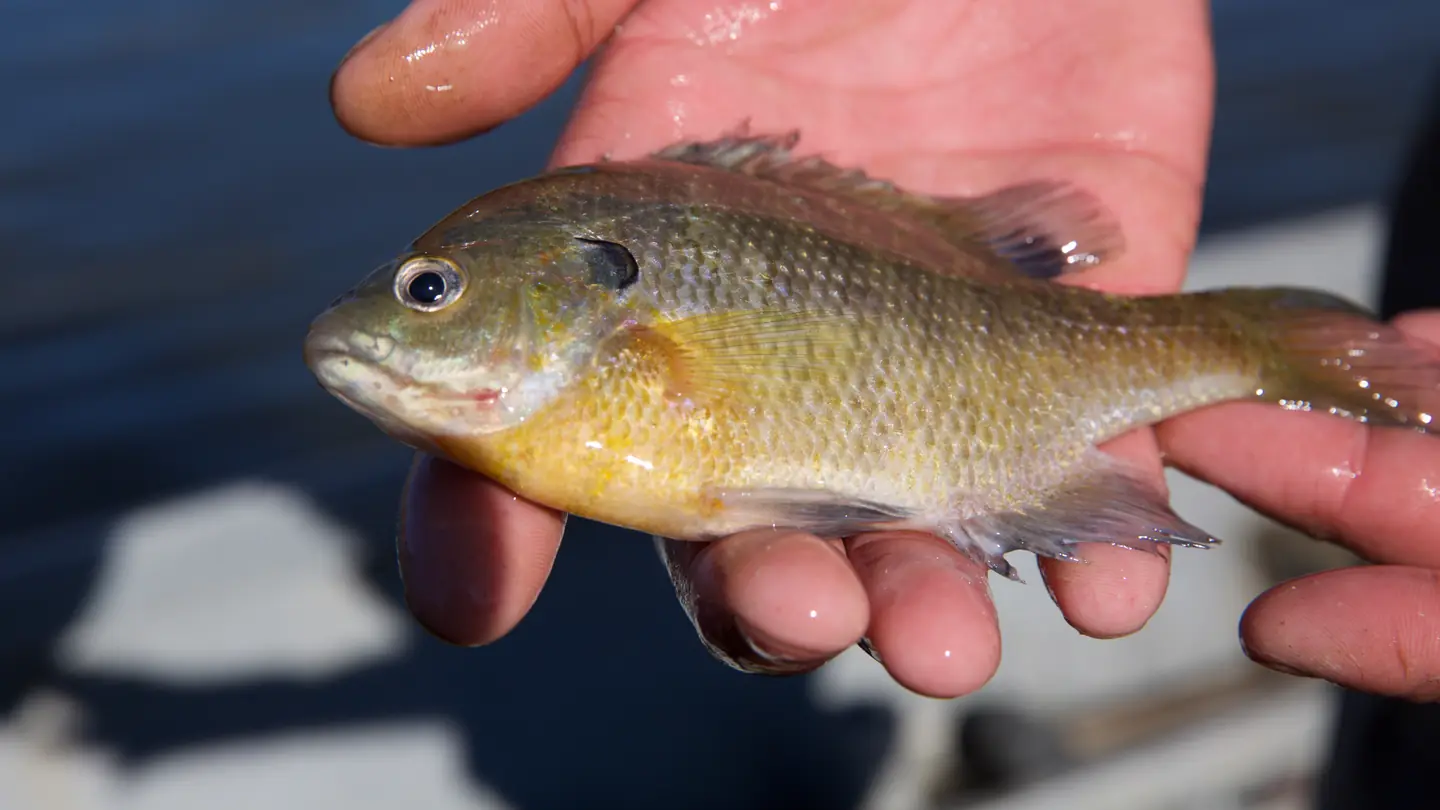
Every angler's first fish should be a bluegill. They live in almost every pond, lake and slow river, they bite all summer, and they fight hard on light tackle. But there's more to sunfish than a worm and a bobber off the dock, especially if you want the big "bull" bluegills.
What sunfish eat
Bluegills and other sunfish eat small things: aquatic insects and their larvae, tiny crustaceans, and zooplankton, the tiny drifting animals in the water. Big bluegills roam open water feeding on zooplankton. They rarely chase their food; they swim up to it and suck it in. That's the most important thing to know about catching them: small baits, small hooks, small jigs, small floats.
Early spring: find the warmest water
When the water is still in the 40s, bluegills are shy and bite lightly. They gather wherever the water warms first:
- Small bays, inlets, backwater sloughs, canals and shallow marina basins
- Spots sheltered from cold north winds and getting full sun
- Shallow edges with dark bottoms or last year's dead weeds, which soak up heat
How: tiny jigs, 1/32 to 1/80 ounce, with very small soft-plastic bodies (half an inch to an inch and a quarter) with thin, wiggly tails, or tipped with a couple of maggots. Hang them under a small, sensitive float, and barely move them. Orange, red, chartreuse and black all work.
Late spring and early summer: the beds
Bluegills start spawning when the water reaches about 60°F, usually May into early July in the North. This is the easiest time of year to catch a lot of them.
Where: males sweep out round nests about a foot across on sandy or gravelly bottom, usually in 1 to 8 feet of water, deeper in clear water. The beds are in groups, sometimes dozens together, and look like lighter, cleaned patches on the bottom. Look in coves, inlets and corners protected from waves and current, with sand that slopes to deeper water nearby. Bluegills use the same spawning areas year after year.
When: spawning peaks around the moon phases. Bluegills spawn more than once through the summer, moving from beds in 1 to 2 feet in May out to about 6 feet as the water warms.
How: a worm, cricket or small jig under a float, set just above the beds. Bluegills guarding beds are aggressive and territorial. If you spook them by running over the beds, wait a few minutes. They come right back.
Summer: weeds, shade and deeper water
After spawning, bluegills slide a little deeper, often suspending in or near weeds, brush and drop-offs. Some of the biggest bluegills in a lake go even deeper; in Midwest lakes, big ones are sometimes found on deep rock in 20 feet of water or more.
When: early morning and evening are best in shallow, clear water. In shade and deeper water, especially along deep weedbeds, they bite all day.
How: a worm, nightcrawler piece, cricket or grasshopper under a bobber, set at the depth of the fish. Small jigs and soft plastics work too.
Baits
| Bait | Notes |
|---|---|
| Garden worms and nightcrawler pieces | The classic. Every sunfish eats them. Keep them cool. |
| Mealworms | Tough and hold up in heat. Under a bobber, on the bottom, or on a jig. |
| Wax worms and maggots | Small grubs, great on tiny jigs, especially in cold water. |
| Crickets and grasshoppers | Excellent summer baits. |
| Tiny jigs and soft plastics | 1/80 to 1/32 ounce with small bodies. |
The float rig
- Clip or slide a small, sensitive float onto 4-pound line.
- Tie on a small hook, size 8 to 14, or a tiny jig.
- Add just enough split shot to stand the float up so the fish can pull it under easily.
- Set the depth so the bait hangs just above the bottom, the weeds or the beds.
Watch the float closely. Bluegills often just make it twitch, lean or slowly sink rather than pulling it under.
Tackle
A light or ultralight spinning rod, 5 to 6 feet, with 4-pound line. It casts small baits accurately and lets you feel the lightest nibble.
Finding the big ones
If you're catching only small bluegills:
- Go deeper, off the edges of the weeds and drop-offs.
- Look offshore. Big bluegills roam open water feeding on zooplankton.
- Try the deep weed edges at midday.
For other panfish, see Crappie Fishing Through the Seasons and Yellow Perch Fishing. For winter, see Ice Fishing for Panfish.
Before you go
Sunfish bag limits are set by each state, and some lakes have special limits to protect big bluegills. Check your state's current freshwater rules before you go.
Cover photo: Steve Martarano, U.S. Fish and Wildlife Service (public domain).