Article
The Ultimate Guide to Largemouth Bass Fishing
Where largemouth bass live and how water temperature moves them through the year, the soft plastics, jigs and hard baits that catch them in every season, the four rigs every bass angler uses, and the tackle to match.
November 10, 2026
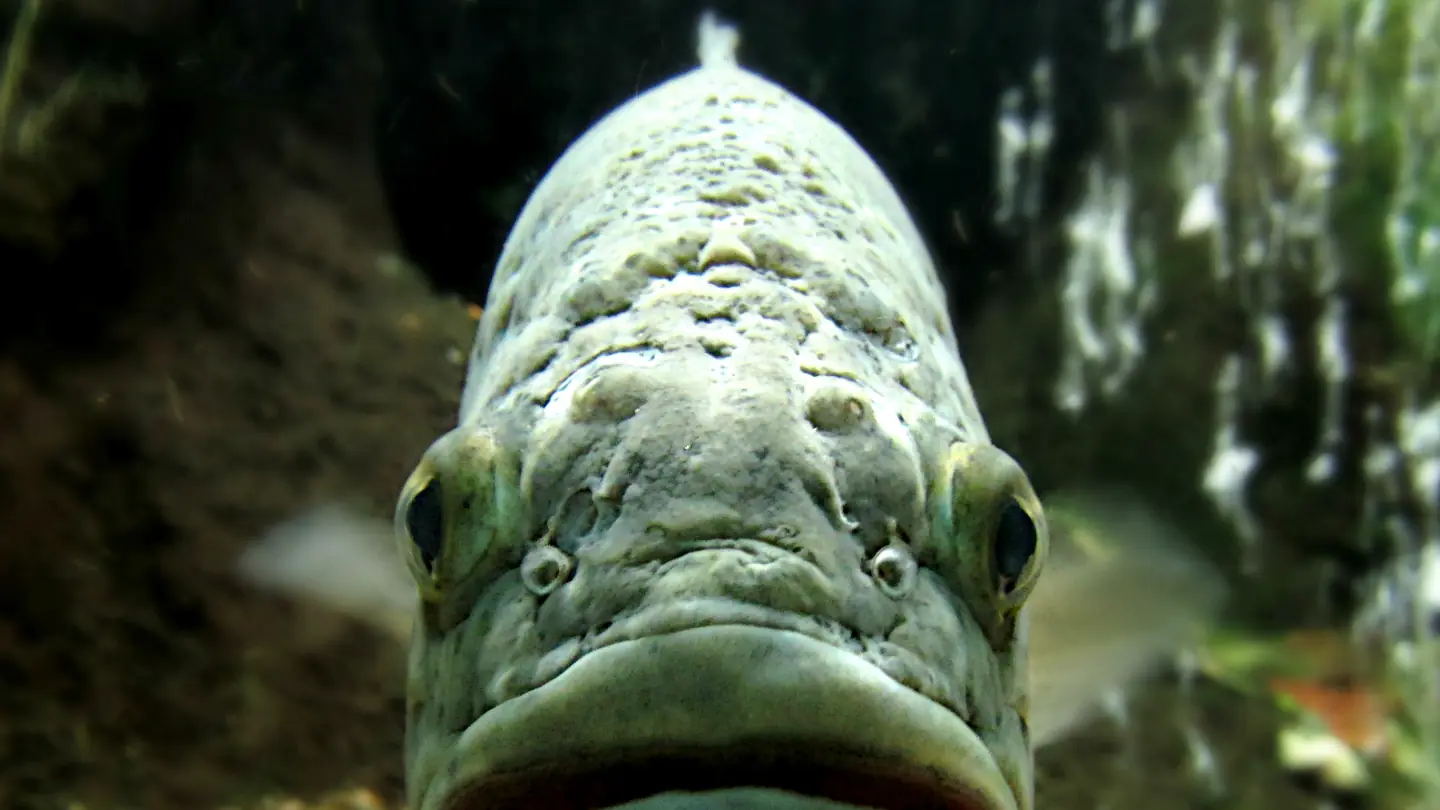
The largemouth bass is the most popular game fish in America for good reason. It lives in nearly every pond, lake, reservoir and slow river; it eats lures of every kind, fights hard, and grows past 20 pounds in the best waters. Bass fishing can get as technical as you want, but it rests on two simple ideas: bass live in and around cover, and water temperature tells you where they are. This guide puts the whole picture in one place.
Know the fish
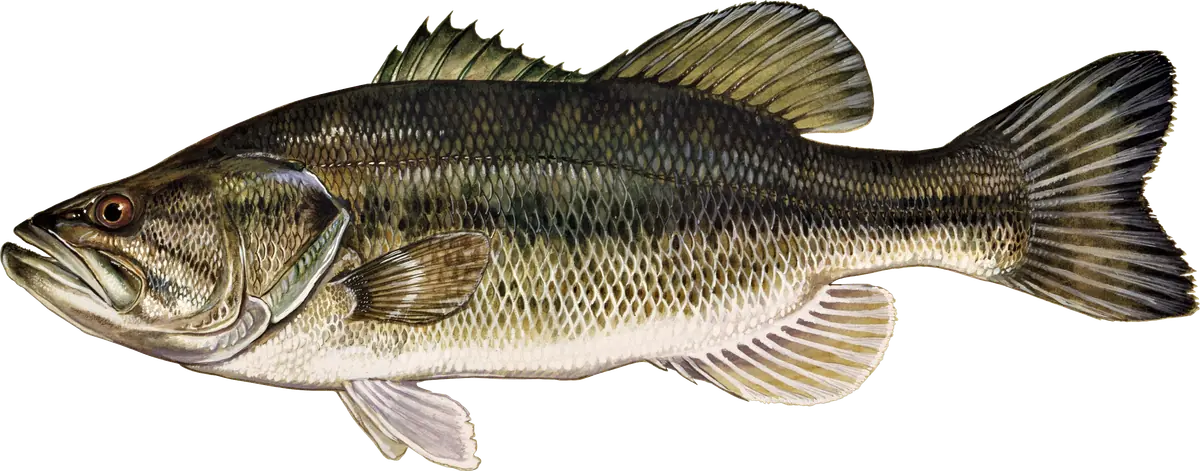
Largemouth bass. Painting: Duane Raver, U.S. Fish and Wildlife Service (public domain).
Largemouths are green, heavy-bodied bass with a dark stripe or row of blotches along each side. The giveaway is the jaw: on a largemouth, the upper jaw reaches past the back of the eye. Originally native to the Great Lakes and Mississippi basins, they've been stocked across North America and around the world, and they live in water from fresh to slightly brackish. Adults eat mostly fish and crayfish, ambushing them from weeds, wood and other cover.
They're warm-water fish. Their optimum is the low 80s °F, but they survive from about 40°F to nearly 98°F. Because they're cold-blooded, water temperature controls how much they eat, how fast they move and where they go.
Cover first
Largemouths like warm, shallow water with cover: moderately thick weeds, brush, fallen trees, docks, stumps and rocks. Where weeds are scarce, they'll use any wood they can find; even a single branch along a pond bank can hold a bass or two. Open-water feeding happens, but it's the exception. At any time of year, most of the bass in a lake are on a certain kind of structure; once you figure out which kind, you can run the lake looking for more of it.
The year by water temperature
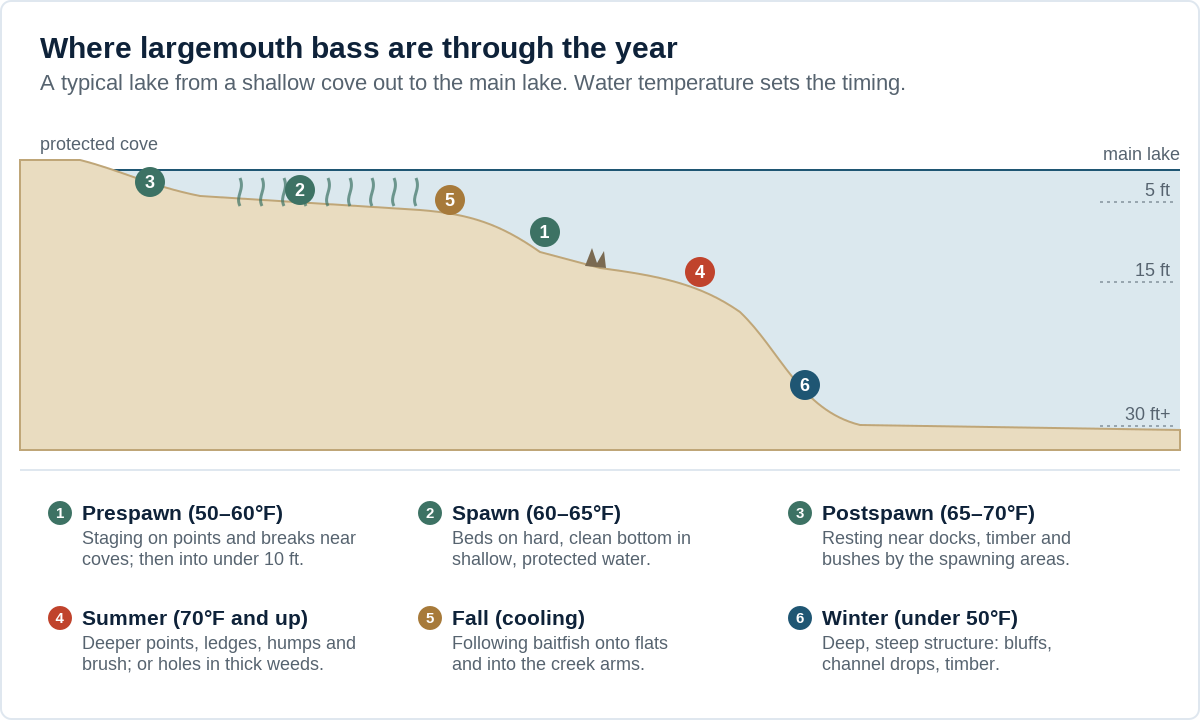
A surface temperature reading is one of the most useful bass tools you can have, with one caution: it's most reliable when fish are shallow, since a few warm days can heat the top few feet fast while deeper water barely changes. In a prespawn lake, a pocket just a degree warmer can hold most of the fish.
| Water temperature | Period | Where the bass are | What to throw |
|---|---|---|---|
| Under 50°F | Winter | Deep, often past 15 feet, on steep structure on the main lake: bluffs, channel drops, standing timber, steep banks. Deeper in clear lakes, shallower in murky ones; out of the current in rivers. | Slow: jigs, Ned rigs and drop-shots on the bottom; suspending jerkbaits with long pauses |
| 50 to 55°F | Early prespawn | Moving toward spawning areas, feeding hard from about 52°F. Staging on main-lake and secondary points near coves and creeks; north banks warm first. | Jerkbaits, jigs, crawfish crankbaits, slow-rolled spinnerbaits, lipless crankbaits |
| 55 to 60°F | Late prespawn | Pushing into less than 10 feet around laydowns, boulders, brush, docks and new weeds. | Reaction baits: spinnerbaits, squarebill crankbaits, vibrating jigs, lipless crankbaits; a jig for every piece of cover |
| 60 to 65°F | Spawn | Beds on the hardest, cleanest bottom in shallow, protected water near cover, usually 2 to 8 feet. Often around the full or new moon; the biggest fish spawn first. | Soft plastics in or near the bed |
| 65 to 70°F | Postspawn | Resting near vertical cover close to the spawning areas, then ganging up on spawning baitfish around docks, riprap and brush. | Wacky rigs and finesse baits for tired fish; topwater and swim jigs for active ones |
| 70°F and up | Summer | Most move to deeper main-lake structure (points, humps, ledges, brush and rock), often past 15 feet; others stay in thick weeds, on holes and edges. Best early and late; deeper or in shade on bright days. | Texas and Carolina rigs, football jigs, deep crankbaits, drop-shots; frogs and pitched worms in weeds; buzzbaits and prop baits at dawn and dusk |
| Cooling | Fall | Following baitfish onto flats, long points and into the creek arms, working farther back as the water cools. | Baitfish imitations that stay off the bottom: spinnerbaits, shallow and medium crankbaits, topwater for schooling fish |
A few more things that matter:
- Fall turnover. As a lake cools, the surface water sinks and mixes with the bottom water. Fishing can be tough for about a week on any one lake, but the cold-water period afterward can produce some of the biggest bass of the year.
- Reservoirs vs. natural lakes. In reservoirs, the upper end warms first and bass follow shad schools into the creek arms in fall. In natural lakes, bass follow the weeds, retreating to the last green weeds as fall comes on.
- New lake? Let the season narrow the search: spawning flats and the backs of creeks in spring, deep water near channel drops in summer and winter, creek arms and flats with bait in fall.
For more on each period, see Largemouth Bass Through the Seasons.
Soft plastics and the four rigs
Soft plastics catch more bass than anything else because you can rig them for almost any depth and cover.
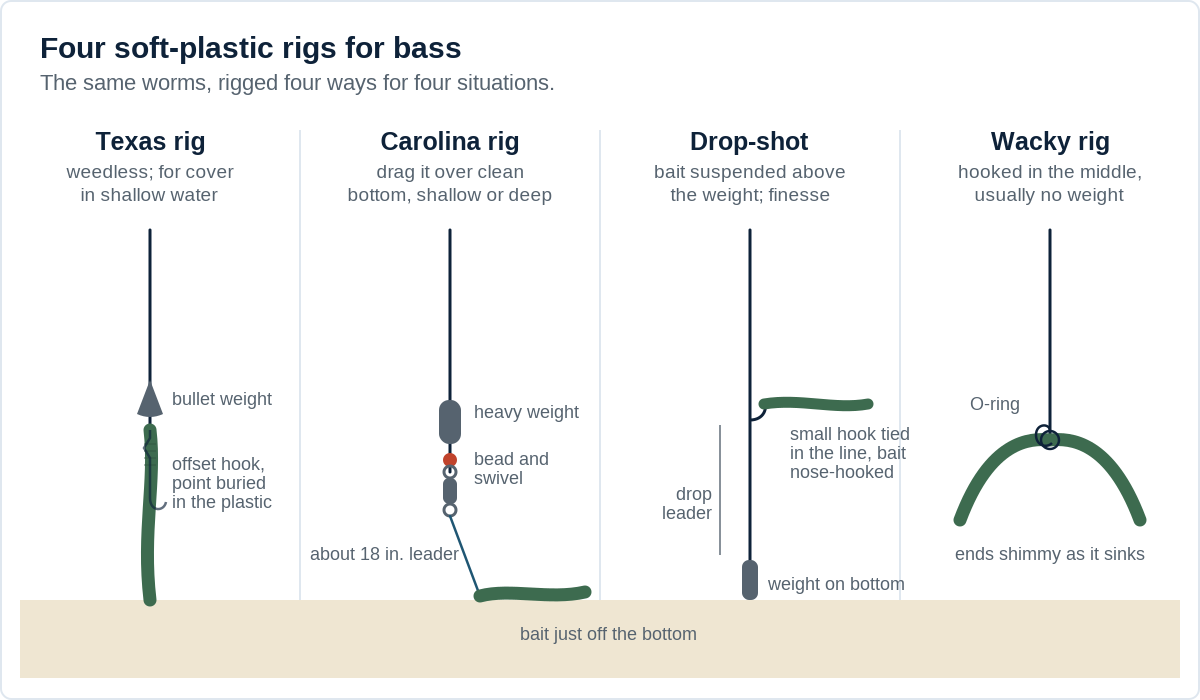
- Texas rig. A bullet weight, an offset or wide-gap worm hook, and a soft plastic with the hook point buried just under the skin so it slides through weeds and wood. The go-to for cover in under 10 feet: pitch, flip or cast it, let it fall, then drag or hop it. A 3/8- to 1/2-ounce weight and a 4/0 hook with a creature bait or 6- to 7-inch worm cover most situations; peg the weight with a bobber stop for heavy cover. Bites are a thump or the line swimming off on the fall: drop the rod tip, reel down and set hard.
- Carolina rig. A heavy weight and a bead on the main line, a swivel, and a leader of about 18 inches to a Texas-rigged bait. Drag it slowly over clean bottom, shallow or deep. It shines after the spawn and in summer on deeper points and flats.
- Drop-shot. A small hook tied right in the line with the bait nose-hooked, and a weight below it on a short drop leader. Fish it on light spinning gear around brush, boulders and sparse cover, and in cold water.
- Wacky rig. A 4- to 5-inch stick worm hooked through the middle (an O-ring makes baits last), usually with no weight, so both ends shimmy as it sinks. In cold water let it fall on slack line; in warm water add light twitches. Prime time is the postspawn, around docks and laydowns in 8 to 12 feet.
Two more to know: a Ned rig (a small plastic on a light, flat jighead that stands up on the bottom), deadly in more than 5 feet on bare bottom; and a tube on an internal jighead. For the details, see Soft Plastics for Bass.
Jigs
A skirted jig with a soft-plastic trailer works almost anywhere and appeals to big bass in every season. The 3/8- and 1/2-ounce sizes are the most popular. Flip and pitch it into thick cover, especially in bright sun and after cold fronts, when bass tuck tight into cover. Black and blue, brown and purple, green pumpkin and white cover most water.
Hard baits and topwater
| Lure | When it shines |
|---|---|
| Suspending jerkbait | Clear, cold water (below about 50°F) and suspended fish. Twitch and pause; most strikes come on the pause, which can be long. |
| Lipless crankbait | Covering water in prespawn, and ripping over shallow weeds in spring and early summer. |
| Squarebill and shallow crankbait | Bumped off stumps, docks and rock in shallow water. |
| Deep-diving crankbait | Summer ledges and deep points; pick one that reaches the bottom and dig it in. |
| Spinnerbait | Murky water and shallow cover. Colorado blades thump hardest for dirty water; willowleaf blades flash and come through grass. Slow-roll it in cool water. |
| Swimbait and swim jig | Slow, steady retrieves for big fish and around postspawn bait. |
| Topwater (poppers, walking baits, prop baits, buzzbaits) | Calm, shallow water early and late, from about 60°F through early summer, and for schooling fish in fall. Quieter in clear, still water; louder in wind or murky water. |
| Hollow-body frog | Thick weed mats, where some of the biggest bass live. Give the fish a few seconds after the blowup, then set hard. |
Match the size and color of your lure to the local forage: shad, shiners, bluegills or crawfish. See Bass Lures: Crankbaits, Spinnerbaits, Jerkbaits and Topwater.
Live bait
Live minnows and nightcrawlers fished near cover catch plenty of bass.
Tackle
| Use | Rod | Reel and line |
|---|---|---|
| Texas rigs, jigs and frogs in cover | 7-ft heavy or about 7'3" medium-heavy baitcasting | Fast (about 7:1) baitcasting reel; 17-pound fluorocarbon, or 30-pound braid in heavy cover |
| Deeper soft plastics and crankbaits | Medium-heavy or medium baitcasting | About 15-pound fluorocarbon |
| Finesse: drop-shot, wacky, Ned, jigworm | Medium-light spinning | 6- to 10-pound braid with an 8- to 10-pound fluorocarbon leader |
Before you go
Bass seasons, size limits and rules on fishing for spawning bass are set by each state, and many lakes have special regulations. Check your state's current freshwater rules before you go. For bass in rivers and rocky lakes, see The Ultimate Guide to Smallmouth Bass Fishing, and for the species page, see largemouth bass.
Cover photo: U.S. Fish and Wildlife Service, Mountain-Prairie Region (public domain). Diagrams: Basic Fishing.