Article
The Ultimate Guide to Smallmouth Bass Fishing
Smallmouth in rivers and in lakes: how to tell them from largemouth, reading current and rock, the seasonal moves and magic temperatures, the jerkbaits, tubes, drop-shots and jigs that catch them, and light tackle to match.
November 10, 2026
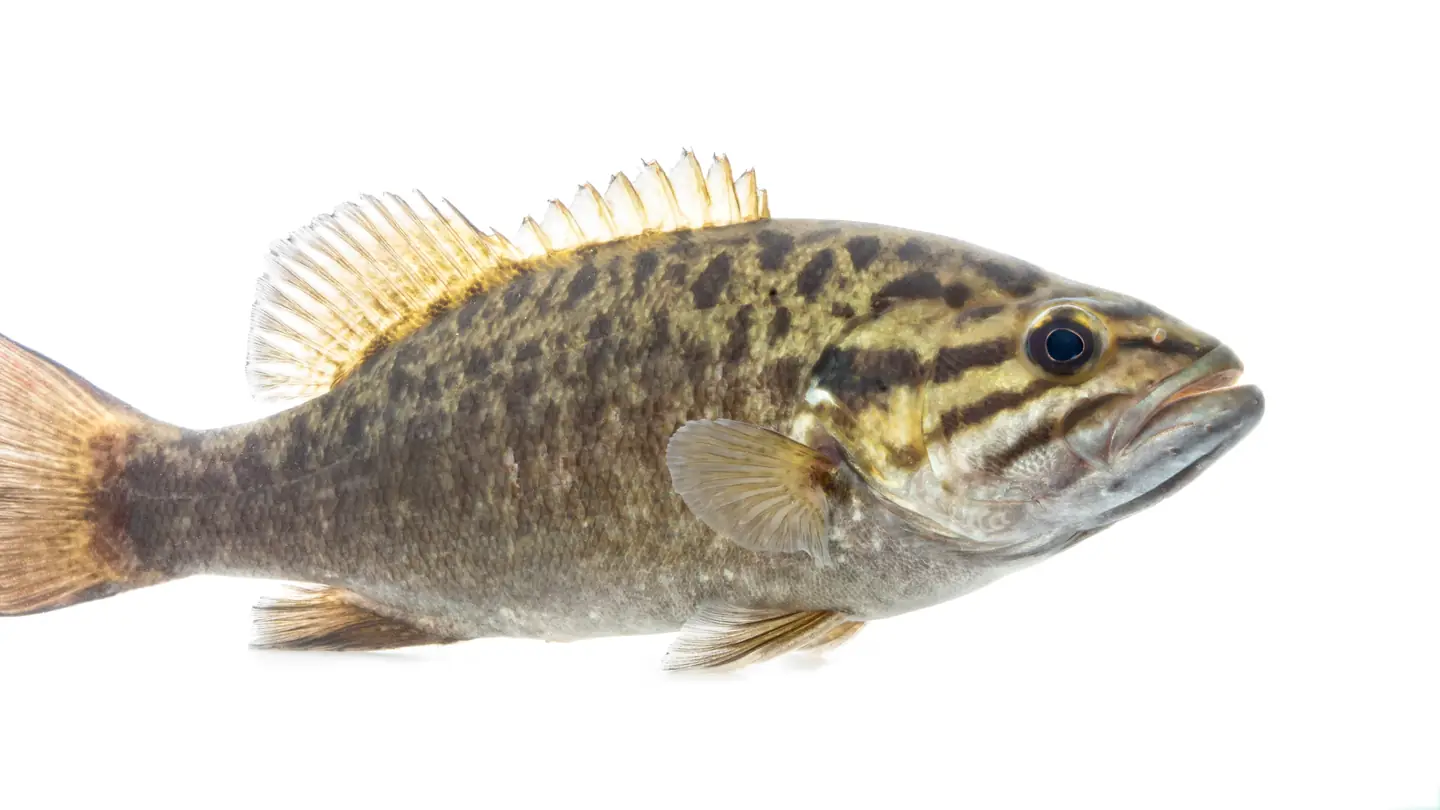
Smallmouth bass are the rock-and-current cousins of the largemouth. They like clearer, cooler water with rock, gravel and moving current; they eat crayfish more than anything else; and they're as much at home in a wadeable river as in a big northern lake. They're known for their jumps and their topwater strikes. This guide covers both kinds of smallmouth water, the seasons, the lures and the tackle.
Know the fish
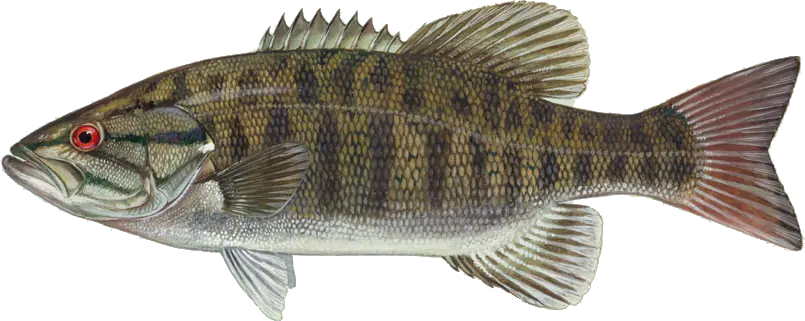
Smallmouth bass. Painting: Duane Raver, U.S. Fish and Wildlife Service (public domain).
Smallmouth are bronze to green with dark vertical bands, not the horizontal stripe of a largemouth. The jaw settles it: on a smallmouth, the upper jaw never extends past the eye. Native to the Great Lakes, St. Lawrence, Hudson Bay and Mississippi basins, they've been established in nearly every state.
They want clear, cool water with rock: big, clear lakes and cool, gravel-bottomed streams and rivers. Young smallmouth eat insects; adults eat fish and, above all, crayfish, which is why rock and gravel are the first things to look for. They spawn as the water approaches 60°F, on nests near shore in lakes or just downstream of boulders in streams, and the males guard the nest and fry.
River smallmouth
Read the water
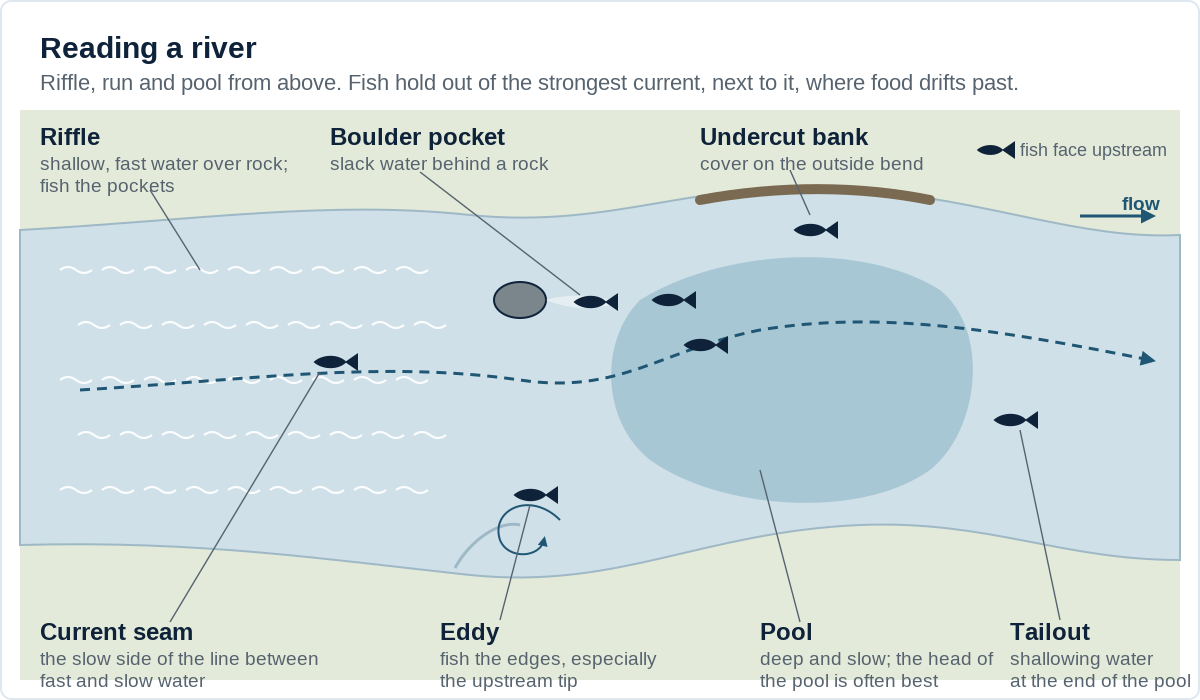
River smallmouth sit out of the strongest current, or right beside it, and grab food as it drifts past. Look for:
- Current seams, where fast water meets slow. Bass hold on the slow side and dart into the fast side to feed.
- Current breaks: behind boulders, logs, ledges and bridge pilings.
- Deep pools, rocky riffles, undercut banks and slow runs. Bigger fish often use the deeper holes, the water under bridges and the tailouts of pools.
- Rock and gravel bottom, where the crayfish are.
The ambush window in swift water can be as small as the slack behind one rock, so accurate casts catch fish. River bass also roam: a stretch full of fish one month can be empty the next, so scout before you commit.
The river year
| River temperature | What smallmouth do |
|---|---|
| Winter (below about 40°F) | Gather in slow, deep holes and barely feed; mostly eat baitfish. |
| Early spring (about 40 to 50°F) | The first warming trend after ice-out wakes them. They leave the wintering holes and feed hard along current seams, banks and rock flats beside those holes, often with numbers of big fish. Flats can fill with fish in the afternoon on sunny days. High, muddy water delays it. From the mid-40s on, crayfish take over the menu. |
| After 50°F | Fish scatter toward spawning areas and can get picky. |
| Summer | Peak river time in the North: warm water, lots of food, aggressive fish on faster water and current breaks. Often best in the afternoon and evening and under clouds; on bright days they stay near cover and shade. |
| Fall | Fall rains push fish to the banks and current breaks; as the water cools they move to deeper eddies and behind bridge pilings, then into the wintering holes. |
How to fish a river
Most river smallmouth fishing is simple: wade, fish from the bank, or float in a canoe or kayak.
- Search with spinners and surface lures. They draw reaction strikes and cover shallow water fast. Burn a buzzbait past current breaks in summer.
- Pick spots apart with jigs and tubes. A 3- to 4-inch tube or soft-plastic tail on a light jighead looks like a crayfish. Cast upstream and let it bounce along the bottom with the current. Match the weight to the current: it should tick bottom, not drag or float.
- Drift soft plastics naturally. Stickworms and tubes drifted with the current, and drop-shots held in eddies, catch fish that won't chase.
- Match the water color. Spinnerbaits and crankbaits in stained water; jerkbaits as it clears.
- Watch your line. River bass often just stop a jig or quietly take a lure. Any twitch or sideways move means set the hook.
Live shiners, stickworms and twister tails on light line are old standbys for river bass too.
Lake smallmouth
In lakes, smallmouth relate to rock: rock piles, reefs, rocky humps, boulder points, gravel and sand flats, ledges and rocky drop-offs. Where there are alewives or other open-water baitfish, they also suspend over deep water to chase them.
| Season | Where | What to throw |
|---|---|---|
| Ice-out and prespawn | Shallow over sand, gravel and rock, usually in less than 10 feet | Suspending jerkbaits with long pauses; small hair jigs crawled so slowly they nearly hang; tubes, jigs and stickbaits |
| Spawn (near 60°F) | Nests near shore on hard bottom | Topwaters come into play from about 55°F |
| Summer | From very shallow at sundown to very deep. Mid-lake humps in 25 to 35 feet; 12 to 25 feet in the afternoon, under clouds and before fronts | Football jigs, tubes, twister tails and blade baits on deep humps; drop-shots; wacky stickbaits on weed edges; topwater over rocky flats at dawn and dusk |
| Fall | Steep breaks between about 10 and 20 feet: the shallow side on cool days, the deep side on warm ones. Bass switch from crayfish to baitfish | Football jigs with craw trailers and Carolina rigs on rocky breaks; spinnerbaits and bladed jigs fan-cast while drifting big flats; jerkbaits in calm, clear water |
| Winter | 15 to 50 feet on hard bottom near sharp breaks in the North | Small spoons and jigs, fished slowly; through the ice they behave like big panfish |
Spring and fall are prime for big smallmouth. In fall, cover water and keep moving until you find them.
Lures that catch smallmouth
- Suspending jerkbait. The top cold-water lure, from ice-out until the spawn, especially in clear water from the mid-40s to the upper 50s. Jerk it down, then pause, and pause again; a minute isn't too long. Strikes come on the pause or the next twitch.
- Tube. Rigged on an internal jighead, it's the classic smallmouth crayfish imitation in rivers and lakes.
- Drop-shot. A staple. Nose-hook a small worm, minnow shape, leech or tiny craw. Use a short leader when bass are feeding on crayfish or gobies on the bottom, a longer one over weeds.
- Hair jig. A small, sparse bucktail jig retrieved so slowly it almost suspends. A classic for cold prespawn fish.
- Football jig and Carolina rig. Dragged over rocky breaks and humps.
- Minnow plastic on a jighead. For bass suspended off the bottom or tight to it.
- Spinnerbaits, bladed jigs and crankbaits. For covering flats and stained water.
- Topwater. Poppers, walking baits and buzzbaits from late spring through fall, especially at dawn and dusk.
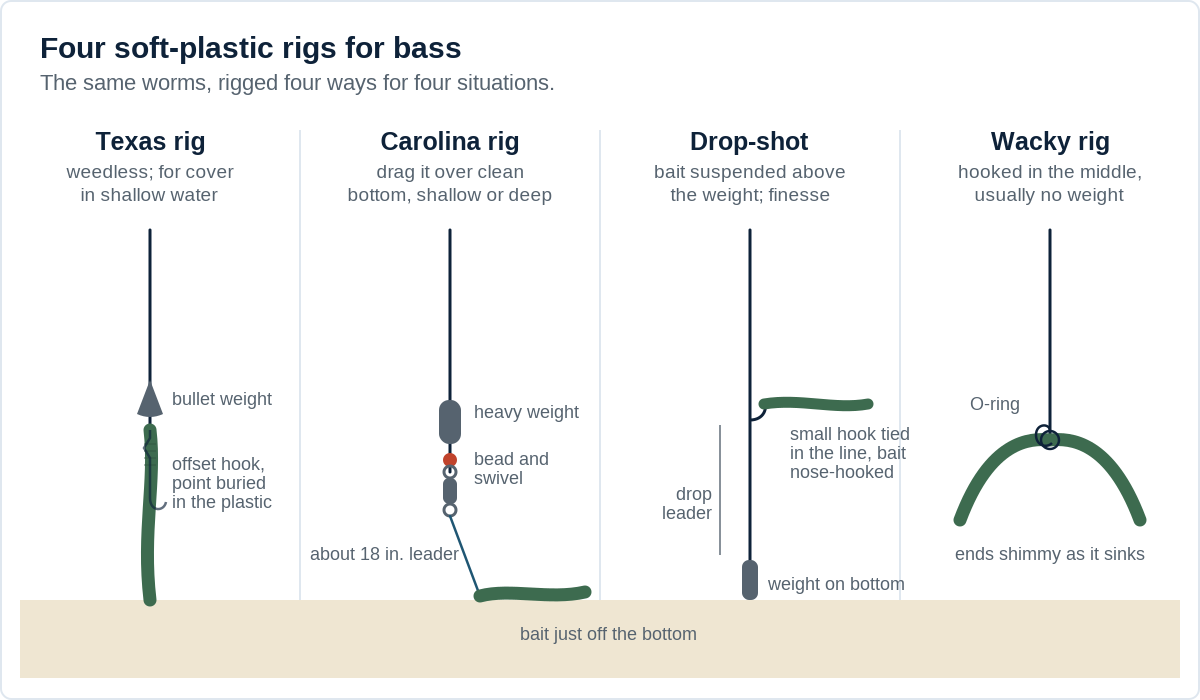
Tackle
Smallmouth fishing is mostly light-tackle fishing.
- Rivers: a medium spinning rod with 6- to 8-pound line handles almost everything.
- Lakes: a long medium-light spinning rod with light braid and a fluorocarbon leader for jerkbaits, hair jigs and drop-shots in clear water.
Before you go
Bass seasons, size limits and catch-and-release periods are set by each state and can differ for rivers and lakes. Smallmouth gathered on wintering spots are vulnerable, and heavy pressure on them can hurt a population, so go easy on winter fish. Check your state's current freshwater rules before you go.
For more, see Smallmouth Bass in Rivers and Lakes, The Ultimate Guide to Largemouth Bass Fishing and the smallmouth bass species page.
Cover photo: Sam Stukel, U.S. Fish and Wildlife Service (public domain). Diagrams: Basic Fishing.