Article
Soft Plastics for Bass: Texas, Wacky, Ned and More
Soft plastics catch bass in every season and at every depth. Here's how to rig and fish the Texas rig, wacky rig, Ned rig, drop-shot, Carolina rig, tube and jig, and when each one shines.
November 3, 2026
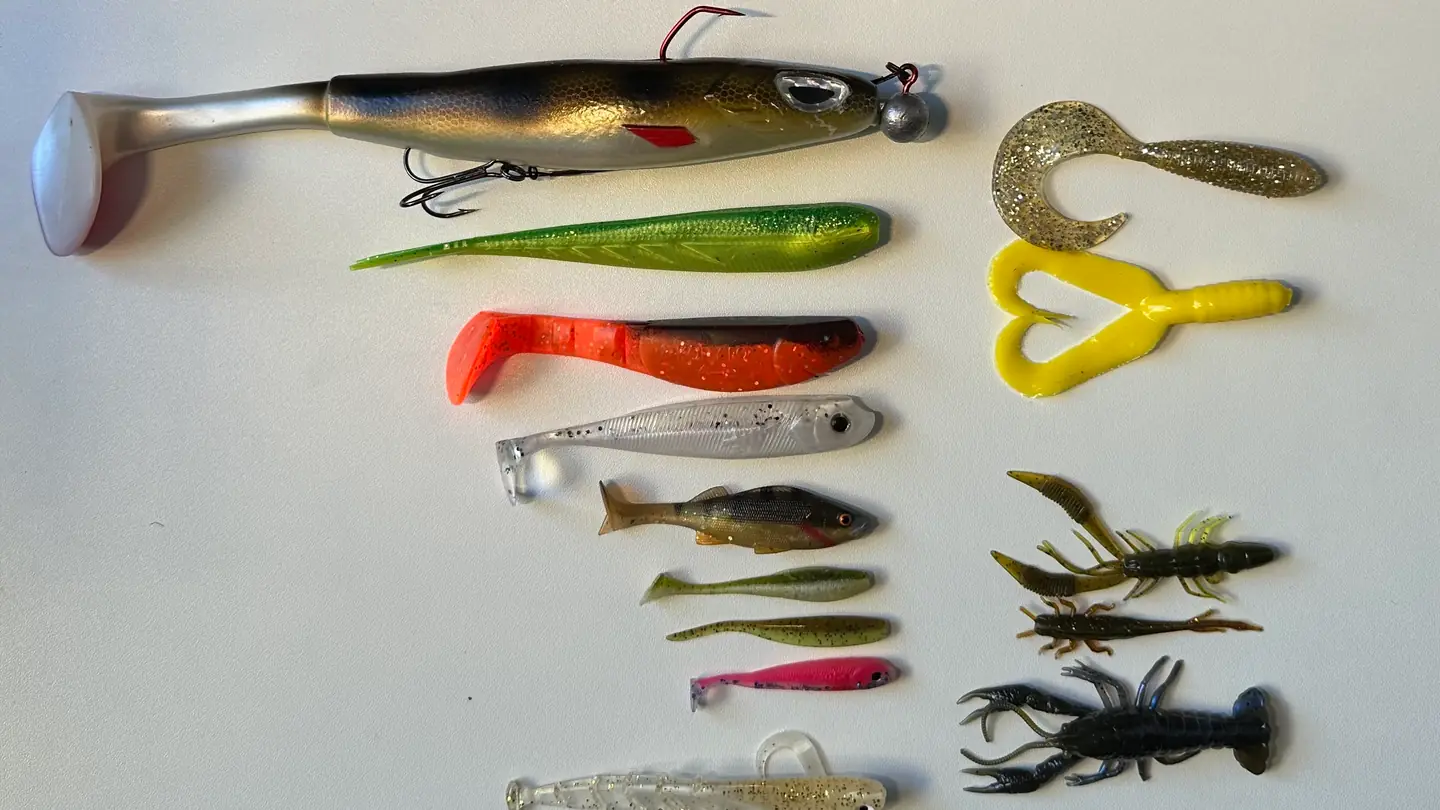
If you could only carry one kind of bass lure, it should be soft plastics. Worms, stick baits, creature baits, tubes and craws catch largemouth and smallmouth bass in every season, at every depth, from ponds to big reservoirs. The trick is the rig. The same worm fished on a Texas rig, a wacky rig or a drop-shot does completely different jobs.
Texas rig: the go-to in cover
The Texas rig is the most-used bass rig there is. The hook point is buried in the plastic, so you can drag it through weeds, wood and brush without snagging.
How to rig it:
- Slide a bullet weight onto the line, pointed end first. (To keep the weight tight against the bait, put a bobber stop on the line first. A pegged weight is more weedless and skips better under docks.)
- Tie on a worm hook. Offset-shank hooks suit worms and lizards; wide-gap hooks suit bulky creature baits; straight-shank hooks are for flipping and pitching.
- Push the hook point about a quarter inch into the nose of the bait and out the bottom.
- Slide the bait up the hook until the head covers the knot.
- Bend the bait slightly, run the point through the body so the bait lies perfectly straight, and tuck the point just under the skin.
How to fish it: cast or pitch it to cover, let it fall to the bottom, then drag and hop it back with pauses. In weeds, drop it into a hole, let it sink, then ease it to the edge. Shaking it in place on the bottom sometimes triggers a bite.
The bite: usually a sharp thump. Sometimes the line just swims away, or the bait never seems to reach bottom. Drop the rod tip, reel up the slack fast, and set the hook hard. You have to drive the hook through the plastic and into the fish.
Gear: a 3/8- to 1/2-ounce weight and a 4/0 hook with a creature bait or worm around shallow cover. Use a 7-foot heavy-action casting rod and 17-pound fluorocarbon, or 30-pound braid in thick cover. Deeper, around brush and rock in 10 to 15 feet, go a little lighter on 15-pound fluorocarbon.
Wacky rig: the bait they can't refuse
Hook a straight stick worm through the middle so both ends hang free. That's it. As it sinks, both ends shimmy, and bass eat it in almost any mood.
- Hook: a 2/0 octopus-style hook. Put a small rubber O-ring around the middle of the worm and run the hook under the ring instead of through the plastic, and the worm lasts much longer. Use a hook with a weedguard around grass.
- Bait: a 4- to 5-inch stick worm.
- How to fish it: cast near cover and let it sink on a slack line. In cold water, the plain slow fall is usually best. In warm water, add light twitches of the rod tip to make it dart. Over suspended baitfish, you can even swim it just under the surface.
- When: any time, but the postspawn is prime. Tired bass rest on the first cover they find in 8 to 12 feet of water, around docks and fallen trees, and a slowly sinking wacky worm is an easy meal.
Fish it on spinning gear.
Ned rig: the finesse fish-catcher
A mini soft plastic on a light, flat-headed jighead. It stands up on the bottom and looks like an easy meal.
- Where: water deeper than about 5 feet with bare bottom or sparse cover. On those spots, it's almost a sure bite.
- How: cast it out and work it back slowly along the bottom like a worm. Because it's so light, it rises and falls more than a heavier worm.
- When: it's one of the best baits in cold water, when bass won't chase.
Drop-shot: hang it in their face
A hook tied a short distance above a weight, with the bait on the hook. The weight sits on the bottom and the bait floats above it.
- Bait: a straight-tail worm or small minnow-shaped plastic, hooked through the nose.
- How: fish it around brush piles, boulders and sparse cover, or out in open areas with little cover. The weight drops straight to the bottom and holds the bait right where you put it.
- Leader length: longer to hold the bait above weeds, shorter when bass are feeding right on the bottom.
- Weight: round or teardrop weights for sand, gravel and rock; slim cylinder weights for weeds.
- Gear: spinning tackle and a light leader. It's a top summer technique on clear lakes, and smallmouth anglers rarely leave home without one.
Carolina rig: cover a lot of bottom
A weight on the main line, then a bead, a swivel, and a leader of about 18 inches to a Texas-rigged bait. Use an egg-shaped or cylindrical weight to cut down on snags. The weight clicking on the bead adds noise that draws bass in.
- Where: clean bottom, especially after the spawn, when bass are deeper than about 10 feet on points, flats and humps.
- How: drag it slowly along the bottom. Lengthen or shorten the leader to change how far the bait trails the weight.
Tubes
A hollow tube on an internal jighead pushed up inside the body, with only the line tie poking out. Tubes look like crawfish and gobies and are deadly on smallmouth around rock. A 3½-inch tube on a 1/8-ounce head is a common size. Hop or drag it along rocky bottom. See Smallmouth Bass in Rivers and Lakes.
Jigworm
A 5- to 7-inch worm on a light ballhead jig (1/16 to 1/8 ounce) with the hook exposed. Because the point is exposed, you only need to lift the rod to hook a fish, so you can use light spinning tackle: 6- to 10-pound braid with an 8- or 10-pound fluorocarbon leader in clear water. Fish it on the edges of cover rather than in it: the deep edge of a weedline, brush, or docks. Cast to the edge, let it fall on slack line, and let it sit on the bottom for 15 seconds before moving it.
Skirted jigs
Not a soft plastic by itself, but always fished with one. A jig with a rubber or silicone skirt and a soft-plastic craw or chunk trailer is one of the best big-bass lures there is, in any season and at almost any depth.
- Weights: 3/8 and 1/2 ounce are most popular, then 1/4 ounce. Heavier jigs fall faster and punch through weeds.
- Where: cast to fallen trees, docks and lily pads. In very thick cover, drop it straight down into holes, called flipping. That works best when the sun is bright and bass push into shade, and after cold fronts.
- Colors: black and blue, brown and purple, green pumpkin, and white cover most water.
For when to use which bait through the year, see Largemouth Bass Through the Seasons. For hard baits, see Bass Lures: Crankbaits, Spinnerbaits, Jerkbaits and Topwater.
Cover photo: Danndorfer1914 (CC0).