Article
Bass Lures: Crankbaits, Spinnerbaits, Jerkbaits and Topwater
Moving baits find active bass fast. Here's what each type of crankbait, spinnerbait, jerkbait, swimbait and topwater lure does, how to fish it, and the conditions that call for it.
November 3, 2026
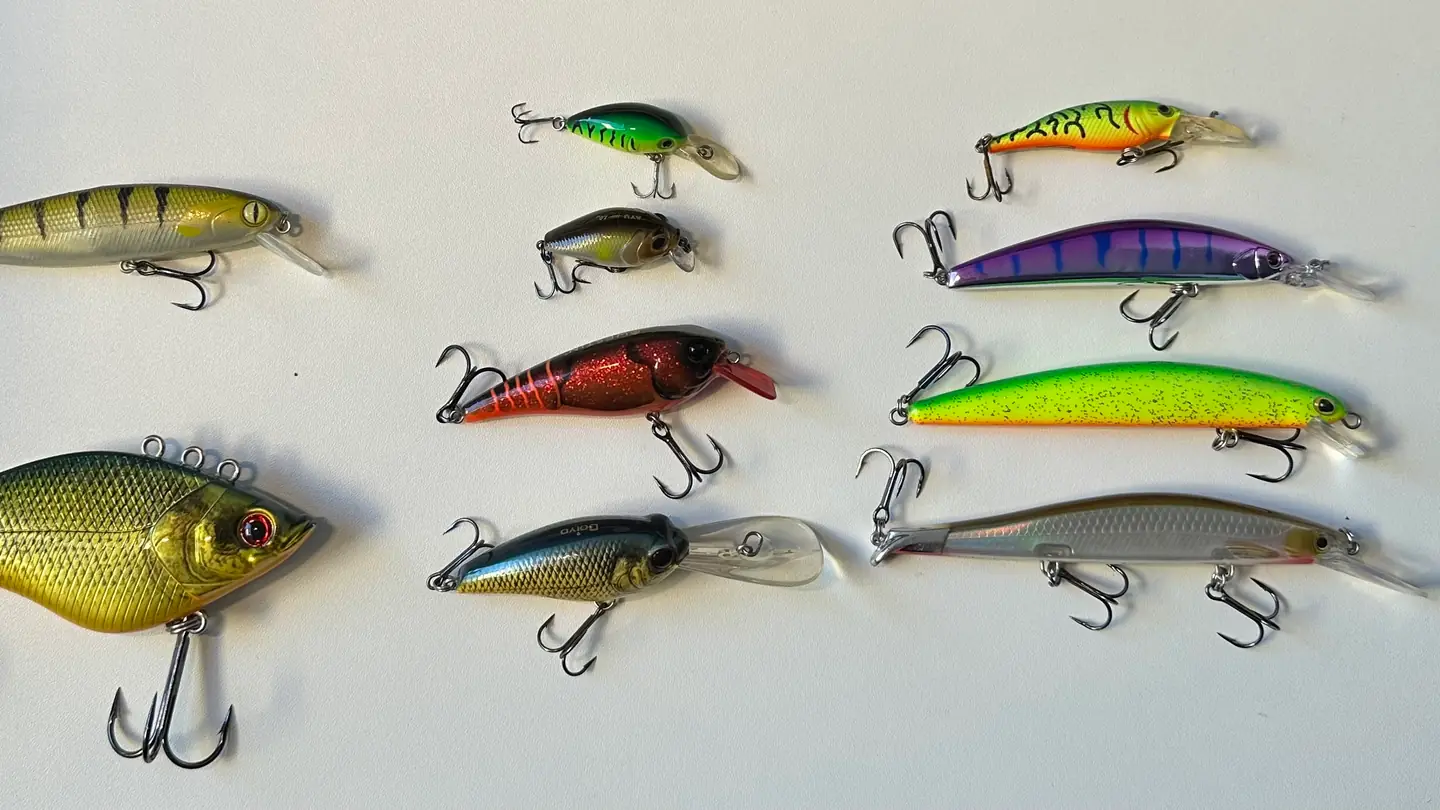
Soft plastics are for picking apart cover slowly. Moving baits, the crankbaits, spinnerbaits, jerkbaits and topwater lures, are for covering water and finding the bass that are ready to bite. Many good anglers start a day with a moving bait, find the fish, then slow down if they need to.
Crankbaits
A crankbait is a hard, fish-shaped lure with a plastic lip (the bill). The bill decides how deep the lure dives and how it wobbles. Most float at rest and dive when you reel.
- Squarebills and shallow cranks: run a few feet deep. Cast them around docks, stumps, laydowns and rocks, and retrieve slowly enough that they bump into things. That deflection is often what triggers the strike. They shine in prespawn and fall in water under about 10 feet.
- Medium and deep divers: for bass holding deeper on points, ledges and drop-offs, especially in summer and fall. Pick one that dives to the bottom depth you're fishing, then let it dig and bounce along the bottom or off structure.
- Lipless crankbaits (rattlebaits): sink and vibrate with rattles. Great for covering water fast over shallow, sparse weeds in early spring and early summer, when the plants are just growing in.
Colors: shad, shiner and perch patterns where those fish live; crawfish colors (greens, browns, reds and oranges) in spring and around rock. In fall, use shad colors in clear water and bright colors like chartreuse with a dark back in muddy water.
Spinnerbaits
A spinnerbait has a weighted head and skirt on one arm and spinning blades on the other. The arm deflects branches and weeds, so it comes through cover well. It works from shallow grass to deep structure.
Blades matter:
- Colorado (round): the most thump and vibration. Best in murky water, fished slowly.
- Willowleaf (long and narrow): the most flash, spins fast, slips through grass. Best for fast retrieves through cover, and a good baitfish imitation in fall.
- Indiana: in between.
Sizes: 3/8 and 1/2 ounce cover most water from 2 to 10 feet. Go to 1/4 ounce for slow fishing through shallow grass, heavier for deep water and rivers.
How to fish it: a slow, steady retrieve, or slow-roll it near the bottom and bump it into stumps and limbs. Let it fall to the bottom and then start it back; bass sometimes hit as the blades flutter down. If fish are bumping it without getting hooked, add a soft-plastic trailer.
When: stained or murky water, windy days, and around wood and weeds.
Bladed jigs
A skirted jig with a small metal blade on the nose that makes it vibrate and weave. The blade also bounces off weeds, so they come through grass well. Add a soft-plastic trailer. They're a strong choice in prespawn shallow water.
Jerkbaits
Long, slender minnow-shaped lures that dart side to side when you snap the rod, then stop. Suspending models hang in place when you pause them.
- When: cold, clear water. When the water is below about 50°F in early spring, or in winter, a suspending jerkbait is one of the best lures there is.
- How: jerk it down to its running depth, then twitch and pause. The colder the water, the longer the pause, sometimes 30 seconds or more. Bass often hit during the pause.
Swimbaits
Soft or hard lures that look and swim like a real baitfish, often with a paddle tail. Big ones imitate big prey like gizzard shad and bluegills and account for a lot of large bass. Fish them with a slow, steady retrieve and an occasional twitch or pause. Match your rod to the lure's weight.
Topwater
Nothing beats a bass exploding on a surface lure. Fish topwaters when bass are looking up: from late prespawn through the spawn, postspawn and summer, and again in fall when bass chase baitfish near the surface. In the Midwest, that usually starts when water reaches about 60°F for largemouth and 55°F for smallmouth. Calm water early in the morning and late in the evening is classic topwater time.
| Lure | What it does | Best for |
|---|---|---|
| Walking bait | Zigzags side to side ("walking the dog") with rapid twitches | Open water, schooling bass, summer |
| Popper | Cupped face spits and pops | Around cover; rest it between pops |
| Prop bait | Propellers churn the surface | Finesse popping; bigger versions fish like buzzbaits |
| Buzzbait | Blade gurgles across the top | Shallow flats and scattered weeds, early summer into fall; reel as slowly as you can keep it up |
| Wakebait | Lipped plug that swims on the surface | Weedy flats in summer, dawn and dusk |
| Floating minnow | Twitch it under, let it float back up | Cool spring water, shad |
| Weedless frog | Hollow body, double hook rides up | Thick weeds, pads and mats |
| Weedless spoon | Skims over pads and slop | Matted vegetation |
Match the conditions:
- Calm, clear water: subtle. Small twitches of a pencil-shaped lure, or a popper barely moved.
- Wind or murky water: loud. Pop and chug hard to get noticed.
- Bass busting bait on top: work it faster.
- Match the food: shad patterns where bass are chasing shad, bluegill patterns around spawning beds and in fall.
Frogs: the biggest bass often live in or under the thickest mats of weeds and pads. A weedless hollow frog crawls right over them. Use heavy tackle, a 7- to 8-foot heavy rod and 50- to 80-pound braid. When a bass blows up on it, give the fish a few seconds to take the frog before setting hard.
Choosing a moving bait
| Condition | Start with |
|---|---|
| Water below 50°F, clear | Suspending jerkbait |
| Early spring, shallow sparse grass | Lipless crankbait |
| Stained water, wind, wood cover | Spinnerbait (Colorado blade) |
| Prespawn, shallow cover | Squarebill crankbait, bladed jig |
| Summer, deep points and ledges | Deep-diving crankbait |
| Summer, thick weed mats | Weedless frog |
| Fall, bass chasing baitfish | Willowleaf spinnerbait, shallow crankbait, topwater |
For finesse and cover baits, see Soft Plastics for Bass. For where bass are each season, see Largemouth Bass Through the Seasons.
Cover photo: Danndorfer1914 (CC0).