Article
Speckled Trout Fishing
Speckled trout (spotted seatrout) school over grass, oyster shell and creek channels from the Chesapeake south. Here's where they hold through the year, how the tide and cold water change them, and the lures and baits that catch them.
November 10, 2026
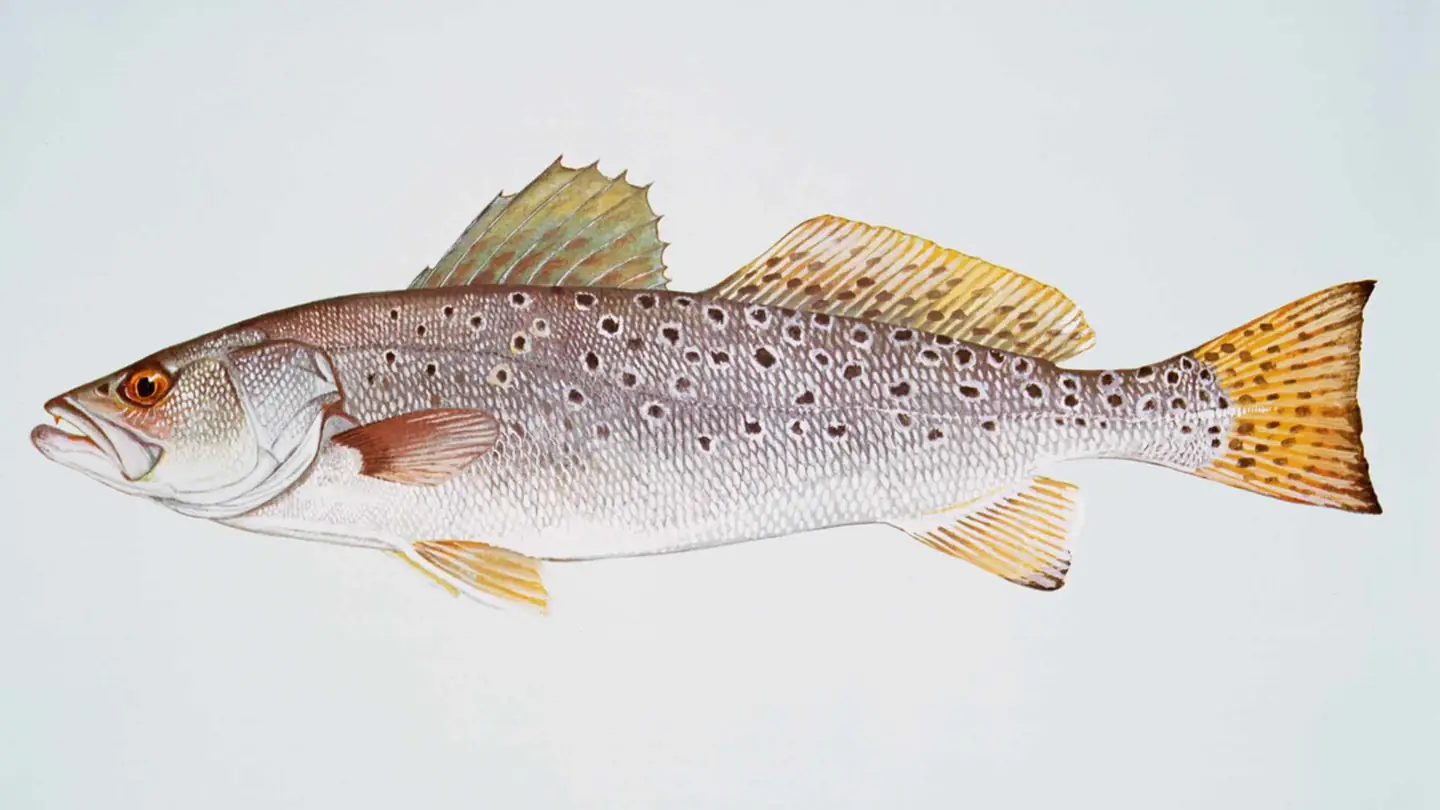
Speckled trout are the bread-and-butter fish of southern inshore waters. They school, they eat lures and live bait, and you can catch them from a kayak, a dock or a skiff in water you can see the bottom through. They're also moody, especially in cold water, and the anglers who catch them every week are the ones who know where the schools move as the season and tide change.
Know the fish
Speckled trout (spotted seatrout, specks) aren't trout at all. They're members of the drum family, cousins of red drum and weakfish. They have a dark gray or bluish back with round black spots scattered over the back, the upper sides, the second dorsal fin and the tail. Look for two big fang-like teeth at the front of the upper jaw. Weakfish look similar but don't have the round black spots.
Most specks run 14 to 20 inches and a pound or two. Fish of 2 to 4 pounds are common in good water. A "gator" trout over 24 inches or 5 pounds is a trophy, and the biggest reach about 12 pounds.
The small fish eat shrimp and other crustaceans. As trout grow, they switch to fish: menhaden, mullet, spot, croaker, pinfish and mud minnows. That's why big trout are caught on bigger baits and lures.
Specks live from the Chesapeake Bay south through the Carolinas, Georgia, Florida and the Gulf. They show up north of Virginia, but they're rare there. Unlike red drum, they can spend their entire lives in the estuary.
Where specks hold
Specks are structure fish. If a stretch of water doesn't have grass, shell or a channel edge, look elsewhere. When you catch one, slow down, because there are usually more.
- Grass beds. Submerged seagrass holds shrimp and baitfish. Fish the beds themselves, the sandy potholes in them and the edges where they drop into deeper water.
- Oyster bars. Shell holds crabs, shrimp and baitfish, and breaks the current so trout can sit and ambush.
- Creek mouths and channels. Specks gather where creeks empty into bigger water and along the edges of channels.
- Marsh edges. The edge of the grass, especially points and cuts, on higher tides.
- Docks, pilings and bridges. Specks hold around pilings, bridges and points, and they spawn around them too.
- Drop-offs and ledges. In deeper water, look for edges where the bottom falls from a flat into a channel.
Look for these signs:
- Birds. Gulls and terns diving on bait that feeding trout have pushed to the surface.
- Slicks. Feeding trout spit up bits of food, and the oil leaves a smooth, oval sheen on the surface. Some anglers say it smells like watermelon. A small slick is fresh and the fish are close. A big, wide slick has drifted and spread.
- Bait. Jumping mullet, dimpling bait on the surface, or bait schools on your sonar. Big trout sit near the bottom below bait schools.
Specks like water with a good amount of salt in it. After heavy rain, fresh water can push them down the rivers and toward the inlets. Move until you find them again.
How the tide moves specks
Moving water gets specks feeding. As the tide comes in, schools of adults move up onto the shoals and flats to feed, so a rising tide is the time to fish the shallows.
The falling tide pushes everything off the flats and out of the creeks. An outgoing tide concentrates trout in the spots that still hold water, such as creek channels, channel edges and the holes around oyster bars.
Speckled trout through the year
Spring
Specks spawn from about April into early fall, at night, in the deeper parts of bays and estuaries, often around pilings, bridges, points and holes. Big females move shallow in spring, and the spring spawn is a good time for a trophy fish. Once the water reaches about 70 °F, trout spread onto shallow flats of sand and oyster shell.
Summer
Summer trout live on the grass flats. Fish shallow early in the morning and late in the evening, then move with the fish into the drop-offs around the flats and the channels in the heat of the day. Night fishing around lights catches lots of trout in summer, though the biggest fish often hold away from the lights where the small ones crowd.
Fall
Fall is the best season for most speckled trout anglers. Young trout move from the small creeks into the bigger creeks and the deeper parts of the estuary, forming schools of similar-size fish. In southern Virginia, schools of migrating trout arrive in late September. Through the fall, look for them along channel edges, over oyster bars and on the flats, wherever bait gathers.
Winter
Specks don't like cold. A hard cold snap can kill them, and trout north of North Carolina tend to move south for the winter. Farther south, they stay in the estuary but pack into the deepest, steadiest water they can find: deep channels, rivers, creek bends and holes.
What changes in winter:
- The fish go deep, then come back. When the water first drops in early winter, trout can drop into 20 to 40 feet of water for a few weeks. Once the temperature levels off, they return to the creeks and flats. Late winter into early spring is a good time for big fish in the shallows.
- Slow down. Cold trout won't chase. Work sinking plugs and soft plastics slowly with lots of long pauses. Most bites come on the pause or just as the lure starts to move again, and the colder the water, the longer the pause should be.
- Expect finicky fish. In cold, clear water, specks get picky. Smaller soft plastics and scented lures help.
Baits
- Live shrimp. The top speckled trout bait. Fish it under a popping cork over grass, or on the bottom with a small sinker when trout are deep.
- Mud minnows. A natural trout food in the creeks and marsh edges.
- Finger mullet and pinfish. Live fish on a small circle hook, allowed to swim freely, catch bigger trout. Be patient: big trout can be picky.
- Cut bait. Strips of cut bait also catch trout.
Lures
- Soft-plastic jerkbaits and paddle tails. A 3- to 4-inch soft jerkbait, paddle tail or straight-tail minnow on a 1/16- to 1/4-ounce jig head is the most useful speck lure you can carry. Use the lightest head that reaches the fish. Bounce it slowly along the bottom or swim it steadily just above it. In clear water use natural, light colors. In darker water, use darker or brighter colors.
- Soft-plastic shrimp. Fished with a twitch-twitch-pause so it darts like a fleeing shrimp.
- Suspending and slow-sinking twitchbaits. Hard plugs that hang in the water when you stop reeling. Give them two light twitches, then a long pause. Most bites come on the pause or as the lure starts to move again. In cold water, make the pauses longer.
- Soft-bodied twitchbaits. These soft-plastic plugs are a favorite of trophy trout anglers in 3 to 6 feet of cold, clear water. Fish them the same way, with long pauses.
- Topwater. Walking baits catch big trout over oyster bars and shallow flats at high tide, early and late in the day and on cloudy days. Twitch, pause, reel and repeat so the plug walks from side to side.
- Weedless spoons. A small gold or silver weedless spoon twitched and allowed to flutter around oysters and grass.
- Popping cork with a jig or shrimp. See below.
Rigs
Popping cork
The popping cork is the classic speckled trout rig.
- Tie your main line to the top of the cork.
- Tie about 2 feet of fluorocarbon to the bottom. Set the length so the bait rides just above the grass or a foot or so off the bottom.
- Finish with a live shrimp on a small hook, or a soft-plastic shrimp or grub on a light jig head.
Cast it out, reel up the slack and snap the rod tip so the cork pops and splashes. The noise sounds like feeding trout and draws fish in, and the cork keeps your bait above the grass where it won't snag.
Bottom rig
When trout are in deeper holes and channels, fish a live shrimp or minnow on a small hook with a light sinker above it so it sinks to their level.
Free-lined live bait
For big trout, hook a live finger mullet or pinfish on a small circle hook with no weight and let it swim.
Fishing methods
Working flats and creeks with lures
Cover water with a paddle tail, spoon or topwater until you find fish, then slow down and work the area thoroughly. On the flats, fish the potholes and edges. In the creeks, fish the mouths, the first oyster bars and the deeper bends.
Fishing the edges
When trout are on a drop-off or ledge, cast parallel to it rather than straight across. Your lure then stays in the zone along the edge for the whole retrieve instead of crossing it once.
Drifting
Drifting with the tide lets you cover a big flat or channel with your bait moving naturally. Drift jigs or a popping cork with live shrimp over grass flats and channel edges. On a deeper drift, let a jig bump along the bottom with the rod in a holder. When a trout takes, the rod bends and you pick it up and reel.
Cold-water creeks
In winter, find the deepest water in the creeks and rivers: the bends, holes, channels and ledges. Work a sinking twitchbait or a soft plastic on a light jig head as slowly as you can, with long pauses. Count a sinking plug down at about a foot per second to reach the depth the fish are holding, and cast parallel to ledges so it stays in the zone. Or fish a live shrimp on the bottom with a small sinker.
Night fishing
Big trout move shallow at night, and they get much less fishing pressure. Night fishing with twitchbaits along creek channels and flats is a proven way to catch a big winter trout.
Tackle
Light to medium spinning tackle is all you need for specks.
- Rod: a 7- to 7½-foot medium or medium-fast spinning rod. A crisper tip gives twitchbaits a sharper action.
- Reel: 2500 size or similar.
- Line: 10-pound braid. It casts far, and you feel light bites.
- Leader: 18 inches or so of 20-pound fluorocarbon.
Before you go
Speckled trout limits and size rules differ by state, and many anglers release big females, the spawners that keep the fishery going. Check your state's current saltwater rules before you go.
Cover painting: Duane Raver, U.S. Fish and Wildlife Service (public domain).