Article
Weakfish Fishing
Weakfish feed after dark on moving tides around docks, channel edges and bars. Here's when the spring tiderunners show up, where weakfish hold in the bays, and the light tackle, soft plastics and shrimp chum that catch them.
November 10, 2026
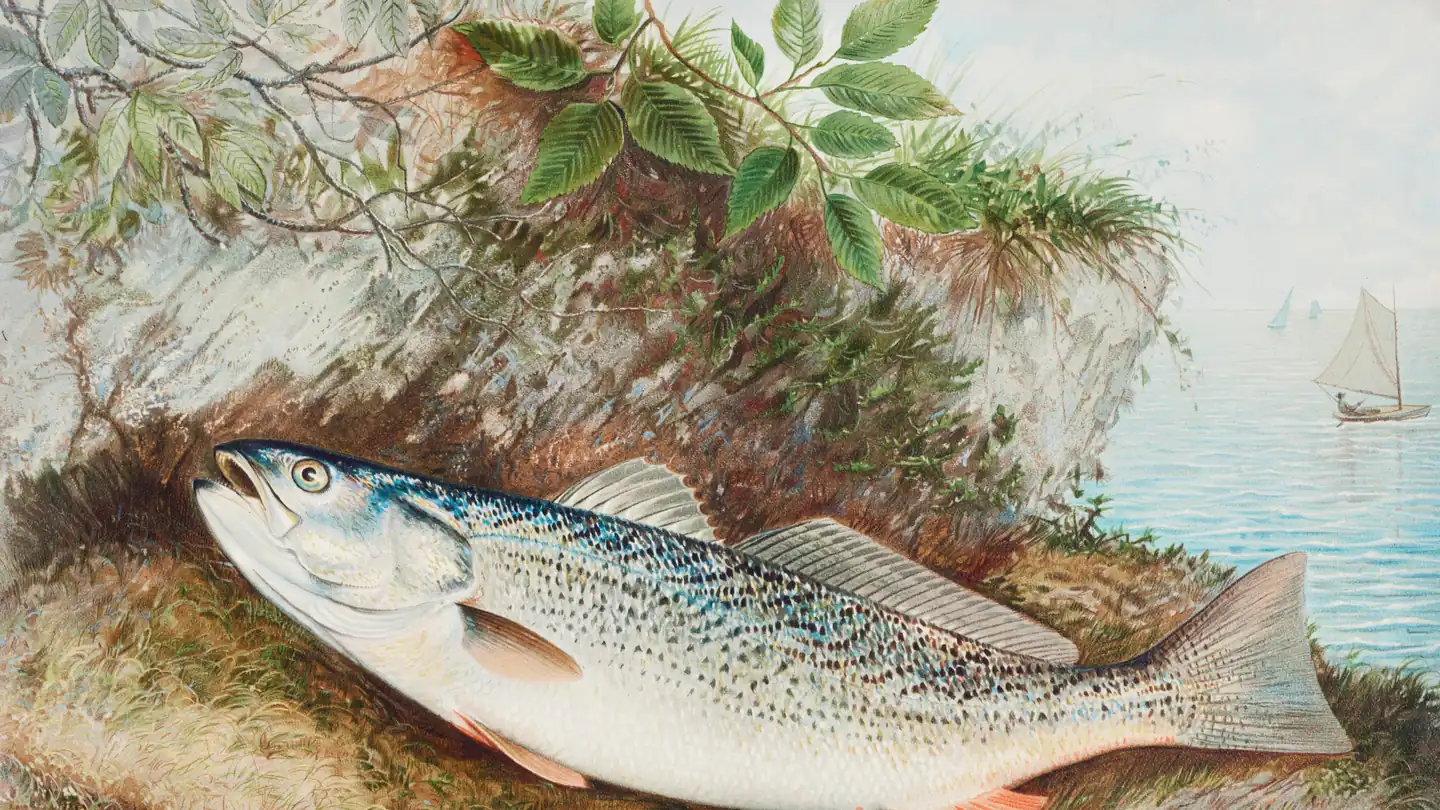
Weakfish are a fish people get attached to. They're beautiful, purple and gold with yellow fins, they hit soft plastics on light tackle, and the big spring "tiderunners" are among the hardest fish on the coast to land. They're also a fish you have to work for these days, because their numbers are low. When you know where and when they feed, you give yourself the best shot at finding them.
Know the fish
Weakfish (gray trout, squeteague, sea trout, tiderunner) are members of the drum family, related to speckled trout, red drum and croaker. They have a greenish-gray back with an iridescent sheen of blue, copper or purple, small dark spots in wavy diagonal lines, and yellow lower fins. Look for two big fang-like teeth at the tip of the upper jaw. Speckled trout look similar but have round black spots, not wavy lines.
The name comes from the mouth, not the fight. The tissue around a weakfish's jaw tears easily, so a hook that holds fine on another fish can rip out of a weakfish during the fight.
Sizes and names:
- Schoolies are weakfish under about 3 pounds. You'll often catch them while fishing for porgies or fluke.
- Tiderunners are the big ones, named because they move in and out of the bays with the tide. Weakfish average 12 to 18 inches but can reach about 3 feet and 12 pounds or more.
Weakfish live from Nova Scotia to Florida and are most common from New York to North Carolina. Most catches today come from New York, Virginia and North Carolina.
A fish in a low cycle
Weakfish numbers have been low for about two decades. Coastwide, the stock is considered depleted. Fishing isn't the main cause: something is killing weakfish naturally at a very high rate, with lack of food and predation by striped bass among the suspected reasons. Because of that, there's a coastwide limit of one weakfish per angler per day, and many anglers release every weakfish they catch.
That changes how you fish for them. Weakfish come and go in cycles, and some years and places are much better than others. Keep an eye on local reports, be ready to go when they show up, and release the big spawners.
The weakfish year
Spring: the tiderunner run
Weakfish winter offshore on the continental shelf between the Chesapeake Bay and Cape Lookout, North Carolina. In spring they move inshore and north into the bays, sounds and estuaries to spawn. The bigger fish enter the lower Chesapeake in April and May, and the first catches on Long Island's south shore come around the end of April.
Spawning peaks from about April into June, close to shore and at the mouths of estuaries. This is the season of the big tiderunners, when the largest fish of the year are in the bays and creeks.
Summer: the bays at night
Weakfish spend the summer in nearshore and bay waters north of North Carolina, with the bigger fish spreading from Delaware into New England. On Long Island, the best fishing runs from May through July. Weakfish in the bays are mostly a night fishery, with the best bite from dusk into the evening.
Fall: schools and the move south
In September, weakfish start to school up. Through October and into November, the schools leave the bays, move into the ocean and head offshore and south. On the way, weakfish can be caught in shallow nearshore ocean water, and in the back bays where they gather ahead of the move.
Where weakfish hold
Weakfish hunt by stalking prey and then lunging at it. They want spots where bait gets swept to them.
- Channel edges and drop-offs. Where a flat or bar falls off into deeper water. Fish the down-tide side of the drop-off, where bait gets swept over the edge.
- Creek and river mouths. Especially those with marsh banks or sandbars nearby.
- Docks and breakwaters. Weakfish use them for cover and to ambush bait.
- Sandbars and rocks that make rips. Anywhere current builds up and breaks.
- Eelgrass beds. In the Chesapeake, weakfish are the top predator in the grass beds.
When to fish: dusk, dark and moving tide
Fish low light and after dark. Weakfish are shy in shallow water during the day. They tend to hold deeper in daylight and move in toward dusk and after dark. A trip from dusk into the first hours of darkness is the classic weakfish trip.
Fish moving water. Big weakfish follow the tide. Fish the hours when the current is running, and pay special attention to a falling tide around dusk, when the current pulls bait out of the creeks and estuaries.
Baits
- Grass shrimp. The classic bay bait, used both as chum and on the hook (see below).
- Shedder crab. One of the best weakfish baits.
- Squid strips. Durable and easy to fish.
- Spearing (silversides). A natural match for bay weakfish.
- Sandworms. Fished on a small hook, or on a jig head.
- Bunker and eels. For bigger fish.
Lures
Weakfish eat lures readily, and most of the time you'll catch more on soft plastics than anything else.
- Soft-plastic jerkbaits and shads. 3- to 5-inch soft jerkbaits, paddle-tail shads and grubs on 1/4- to 1/2-ounce jig heads. Pink, or pink with white or chartreuse, has a long reputation as a weakfish color. Match the size to the bait: spearing, peanut bunker or bay anchovies.
- Straight tails in strong current. A straight-tail plastic tracks cleanly in fast water.
- Bucktails. A 1/2-ounce white or white-and-yellow bucktail tipped with a soft-plastic tail.
- Shad darts. Small, weighted jigs that are an old weakfish standby.
- Swimming plugs and spoons. Subsurface plugs and spoons catch weakfish too, especially the bigger fish.
- Worm imitations. When marine worms are swarming at the surface at night, weakfish feed on them and ignore everything else. A small soft-plastic sandworm on a 1/8-ounce head can save the night.
The retrieve
Most of the time, weakfish want a soft plastic reeled slowly and steadily, a couple of feet off the bottom, without twitching or hopping. Cast, let it sink close to the bottom, and reel just fast enough to keep it swimming. Work your lure naturally with the current, not against it.
The hit often feels like nothing more than added weight on the line, followed by head shakes. Don't swing hard. Lift the rod smoothly and keep steady pressure.
Grass shrimp chumming
Chumming with live grass shrimp is the old-school way to catch bay weakfish, and when it works you can catch them steadily.
- Get plenty of shrimp. Plan on 3 to 5 gallons for a trip.
- Pick your spot. Anchor up-current of a ledge that drops into a channel. The slick draws weakfish up out of the deep water onto the ledge.
- Start the slick. Toss a small handful of shrimp every minute and keep it going steadily. If you stop, the fish drift away.
- Rig light. Tie a small barrel swivel to 8-pound line, then about 28 inches of 12-pound fluorocarbon and a #2 baitholder hook.
- Spread your baits. Fish one line with no weight, one with a split shot so it sinks a little deeper, and one under a slip float set about 10 feet deep.
- Bait a shrimp ball. Thread one shrimp onto the hook through its shell, then add three or four more hooked through the tail.
- Let it drift. Leave the bail open with a little slack so the bait drifts at the same speed as the chum. When line peels off or the float goes down, close the bail and set the hook.
Tackle
Light tackle is the rule. A stiff rod and heavy drag pull hooks out of a weakfish's mouth.
- Casting lures: a 6½- to 7½-foot light or moderate-action spinning rod with a 2500 to 4000 reel. Spool with 10- to 20-pound braid or 8- to 15-pound mono. Add 2 feet or so of 15-pound fluorocarbon. Keep your lures under 2 ounces.
- Shore and surf: a 7- to 9-foot light rod.
- Chumming: a 5½- to 6-foot light rod, 2000 reel and 8-pound mono.
- Fly fishing: 8- to 10-weight with weighted baitfish and shrimp flies.
Set the drag just a few clicks above loose. Big weakfish make sudden turns and runs near the boat. Let the rod and drag soak them up and take your time. Patience lands more weakfish than muscle does.
Before you go
There's a coastwide limit of one weakfish per angler per day, and states set their own size limits and seasons. Check your state's current rules before you go. Weakfish are in short supply, so think about releasing the big spawning fish you catch.
Cover painting: Samuel A. Kilbourne, scan by Rawpixel (CC BY 2.0, cropped).