Article
Muskie Fishing
Muskies are called the fish of 10,000 casts for a reason, but you can shorten the odds. Here's where muskies hold through the seasons, the lures that catch them, the figure-eight that turns followers into biters, and the tackle and handling a fish this big needs.
November 10, 2026
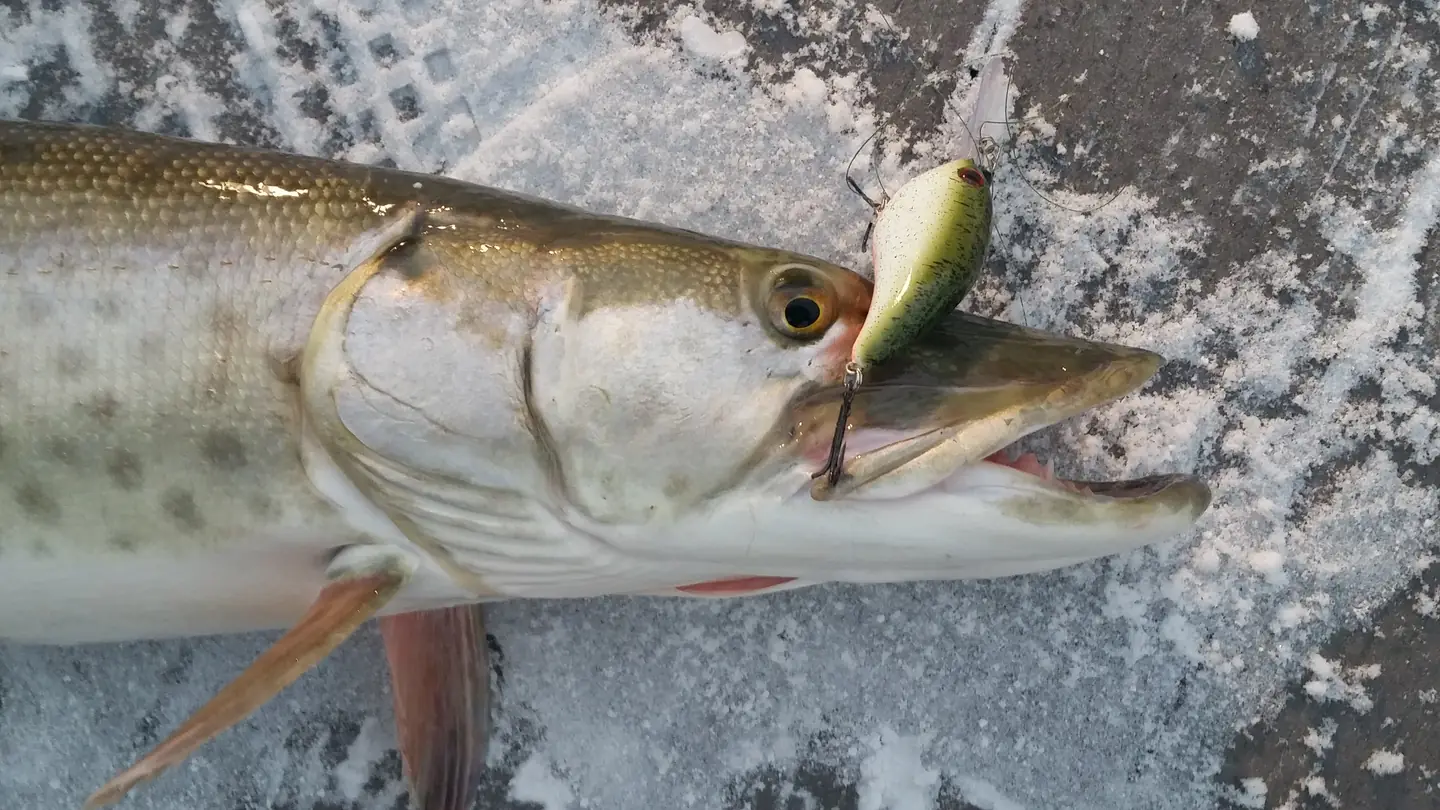
Muskies have a reputation: the fish of 10,000 casts. They're the biggest members of the pike family, they're scarce even in good water, and they're picky about when they feed. You'll have days when a 45-inch fish follows your lure to the boat, looks at it and sinks away. But you can shorten the odds. Put in the time where muskies live, fish the right lures for the season, and master the figure-eight, and your first muskie is a lot closer than 10,000 casts.
Know the fish
Muskellunge are long, torpedo-shaped predators with a flat, duck-bill snout and a mouth full of large teeth. Most are silver, olive or light brown with dark bars, spots or blotches on the sides, though some are almost plain. They grow big: many waters hold fish over 40 inches, and true trophies pass 50.
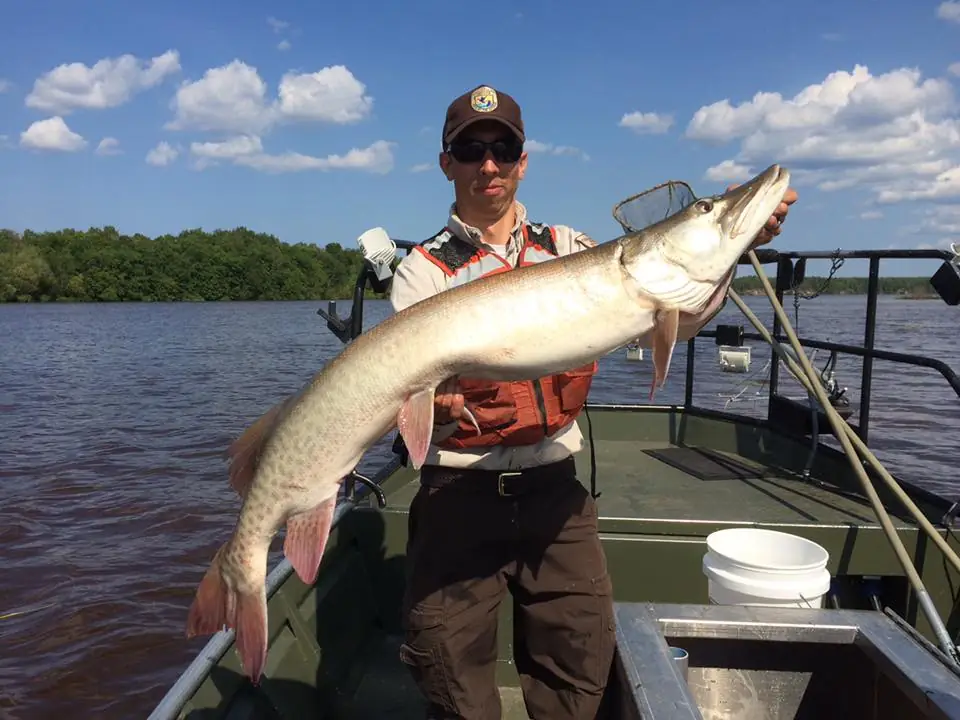
A 50-inch muskie caught by a U.S. Fish and Wildlife Service survey crew in the St. Louis River estuary. Photo: U.S. Fish and Wildlife Service (public domain).
Muskies are cousins of the northern pike and chain pickerel, but they don't act like them. Pike and pickerel are aggressive, hungry fish. Muskies are more wary and more selective, and they tend to feed in short windows set by the weather, the water and even the moon. A big muskie that eats a large sucker or bass may not feed again for days.
They're also never abundant. One adult per acre is considered a good muskie fishery, and many are stocked at low numbers. That means you need to find the specific spots where muskies hold.
Where muskies live
Muskies are native to the Great Lakes and St. Lawrence region, the Mississippi basin and parts of the Appalachians, and they've been stocked in lakes and rivers well beyond that. They're coolwater fish of weedy lakes, reservoirs and rivers.
The places that hold them:
- Weed beds and weedlines. The single most important muskie habitat. Look for the special spots along a weedline: inside turns, small points jutting into deeper water, and clumps of weeds thicker than the rest.
- Rock points, reefs and humps, especially near deep water.
- Places where structure meets deep, open water. Big-fish spots are often a mix of weeds, rock and drop-offs next to deep water.
- Timber and creek channels in reservoirs.
- Docks, in lakes without much weed.
- Rock jetties, riprap and dam faces.
- Rivers: eddies, current seams, deep holes, and spillways below dams.
Look for places where several kinds of cover come together, like a weedline that meets a rock pile. And take your time: fish a good spot thoroughly before moving on.
Muskies through the seasons
Spring
Muskies spawn in spring, when the water is about 48 to 56 °F, in shallow bays. Spawning fish are hard to catch, but muskies feed heavily before and after.
- Look for warm water. Shallow, weedy bays and coves warm first, especially those facing west and getting the afternoon sun. In reservoirs, check the upper arms and inflows.
- Prespawn fish. Before spawning, muskies often roam a bit deeper near schools of baitfish, about 10 to 15 feet in clear water, in deeper parts of bays and coves, and in deep wintering holes in rivers.
- Fresh weeds. Twitch crankbaits along the transition between shallow back bays and deeper water, especially where new weeds are starting to grow.
- Slow down. In cool water, use slower presentations: swimbaits, crankbaits twitched with long pauses, and glide baits.
Feeding picks up once the water reaches the mid-60s °F and the fish recover from spawning.
Summer
In summer, muskies live in and around the weeds. Once the weeds have grown in, look for fish in about 3 to 8 feet of water over and along weed beds, plus on rock reefs, docks and bulrush beds. Bigger fish may slide deeper in midsummer heat.
This is the time for bucktails and topwaters over the weeds, and for fast retrieves and fast trolling. In warm water, don't be afraid to burn your lures back as fast as you can reel.
Watch the water temperature. When water gets much above 70 °F, muskies stress badly during the fight, and a fish that swims away can die later from lack of oxygen. Many experienced anglers stop fishing for muskies in hot water.
Fall
Fall is the best season for most muskie anglers, and the best time for a beginner. As the water cools, muskies feed hard to bulk up for winter, and September and October are among the best months.
- Early fall: muskies hold over deeper weeds and where shallow flats drop off sharply.
- Later fall: as the water cools further, they move to deeper, open water near points and drop-offs, following the bait.
Big lures shine now: deep-diving crankbaits, large jigs and soft plastics, and glide baits. Topwaters still work on warm days.
Winter
Most northern muskie lakes freeze, and many states close the season. In rivers that stay open, muskies become predictable: they move into deep holes and slow eddies out of the current, where food is plentiful. Fish slowly and methodically, and expect short feeding windows. Muskies can also be caught through the ice in some waters.
When to fish
Muskies bite in the daytime, and the first and last hours of light are prime in spring and fall. Afternoons can be good, and summer nights produce too. Serious muskie anglers track the weather and moon to predict feeding windows, but plenty of muskies are caught by anglers who simply put in time on the water.
Lures
Muskie lures are big: usually 6 to 12 inches. Match the color to the main forage in the water you're fishing (perch, shad or bluegill patterns).
- Bucktails. Large inline spinners with a hair or tinsel skirt. The easiest way to start: cast and reel steadily, covering lots of water. They work best above about 50 °F, over and along the weeds.
- Crankbaits. Diving plugs of 6 to 10 inches or more, for casting or trolling. Easy for beginners. Use them in deeper water and in early and late season when the weeds are down, because their treble hooks foul in thick weeds.
- Spinnerbaits. Good around weeds. They sink, so let them get down before you start reeling.
- Jerkbaits. Floating wooden or plastic baits that dive and dart side to side when you jerk the rod. Best in 6 to 8 feet of water over shallow weeds. They take practice.
- Glide baits. Jointed lures that sway widely from side to side and hover when you pause. Work them with small twitches and long pauses.
- Soft-plastic swimbaits and big jigs. Fish them at any depth. Muskies tear them up, so carry spares.
- Topwaters. Late spring through early fall, when muskies come up to smash surface lures. A noisy topwater can sometimes trigger a fish that won't hit anything else.
Live bait (large suckers, shiners or bluegills) is also used for muskies where it's legal.
The figure-eight
The figure-eight is the most important skill in muskie fishing. Muskies often follow a lure all the way to the boat without biting. If you just lift the lure out, the fish leaves. A sudden change in the lure's speed or direction often makes it strike.
How to do it:
- Watch every retrieve. Keep your eyes on the lure all the way to the boat so you see a follower coming.
- Don't stop. When the lure gets near the boat, leave 12 to 24 inches of line between the rod tip and the lure.
- Push the rod tip into the water and sweep it in a wide figure-eight (or oval) beside the boat, keeping the lure moving.
- Make wide turns. A longer rod makes bigger, smoother figure-eights.
- Set the hook when the fish grabs, by sweeping the rod hard in the opposite direction from the way the fish is moving.
Do a figure-eight at the end of every cast, whether you see a fish or not. Muskies sometimes appear out of nowhere at the last second.
Reading a follower helps too. A fish level with or above the lure is often aggressive. Speeding the lure up, or changing its depth, usually triggers more strikes than slowing down.
Trolling
Where it's legal, trolling covers water and catches plenty of muskies. Run crankbaits 10 to 60 feet behind the boat at roughly 4 to 8 mph, following the outside edge of submerged weedlines, and use your depth finder to stay on the edge. In late summer, troll deeper along points and drop-offs.
Tackle
Muskie tackle is heavier than anything you'd use for bass.
- Rod: a heavy-power, fast-action baitcasting rod, about 7½ to 9 feet. Shorter rods are easier for jerkbaits and glide baits. Longer rods make better figure-eights.
- Reel: a large baitcasting reel with a strong drag. A high gear ratio helps with bucktails. A lower ratio suits jerkbaits.
- Line: 50- to 80-pound braid. Some anglers go as light as 30 to 40 pounds to cast smaller lures farther.
- Leader: always. Muskie teeth cut through line. Use a 12-inch or longer leader of 80-pound-plus fluorocarbon or steel wire. Fluorocarbon is less visible, and steel is bite-proof.
- Hooks: strong trebles, 3/0 or larger on most lures.
Muskies have hard, bony mouths, so you need a stout rod to drive the hooks in. A strong rod also lets you land the fish quickly, which matters for a healthy release.
Landing and releasing muskies
Most muskies are released, and many waters require it for anything under a large minimum size. To release a muskie well:
- Keep fights short. Use heavy tackle so you can land the fish quickly.
- Use a big net. A muskie net with a large hoop and a deep bag keeps the fish in the water while you unhook it.
- Unhook it in the net. With the fish resting in the water in the net, you can take your time with the hooks.
- Avoid hot water. Don't fish for muskies when the water is above about 70 °F.
Before you go
Muskie seasons, size limits and trolling rules differ by state and often by lake, and many waters have high minimum sizes. Check your state's current rules before you go.
Cover photo: BenitoJuarez98 (CC BY-SA 4.0, cropped).