Article
Kingfish, Spot and Croaker Fishing
Kingfish, spot and croaker are the small drum that fill coolers from piers, beaches and boats all summer. Here's how to tell them apart, when and where each one bites, and the simple bottom rigs and baits that catch all three.
November 10, 2026
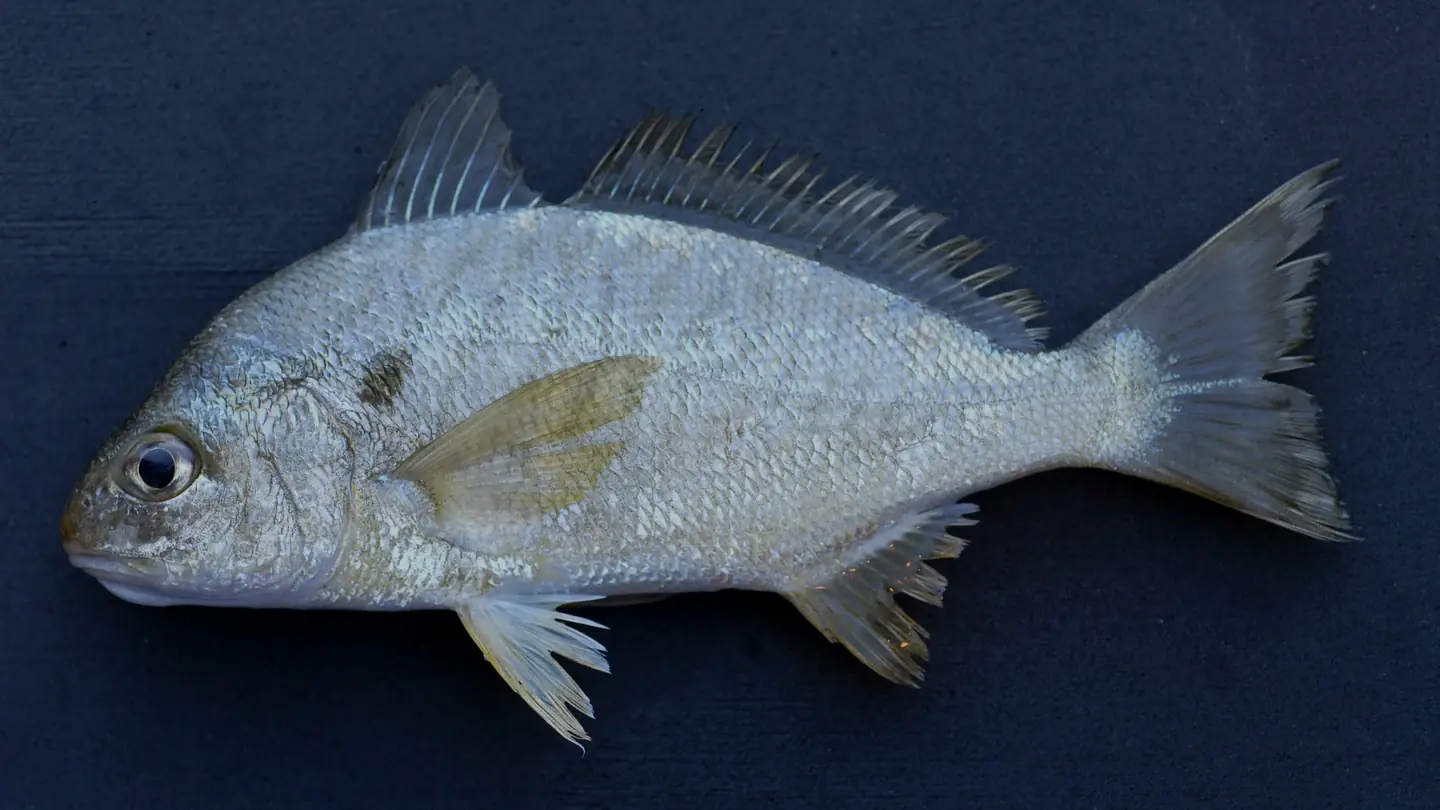
Not every fishing trip needs to be a hunt for a trophy. Kingfish, spot and croaker are the fish that keep piers, beaches and small boats busy all summer, and they're the fish most of us caught first. They bite readily, you catch them on simple tackle and cheap bait, and a good school can fill a cooler. All three are small members of the drum family, and they're caught the same way: a two-hook rig on the bottom with a piece of fresh bait.
Telling them apart
All three are silvery bottom feeders of about the same size, and they're often caught together.
Kingfish
Kingfish go by a pile of names: whiting, sea mullet, Virginia mullet and roundhead. (They have nothing to do with king mackerel, which are also called kingfish.) Look for:
- A long, slim body with a cone-shaped snout and a small mouth underneath.
- A single short barbel on the chin.
- Dusky bars on the sides. On northern kingfish, the first two bars form a V on the shoulder.
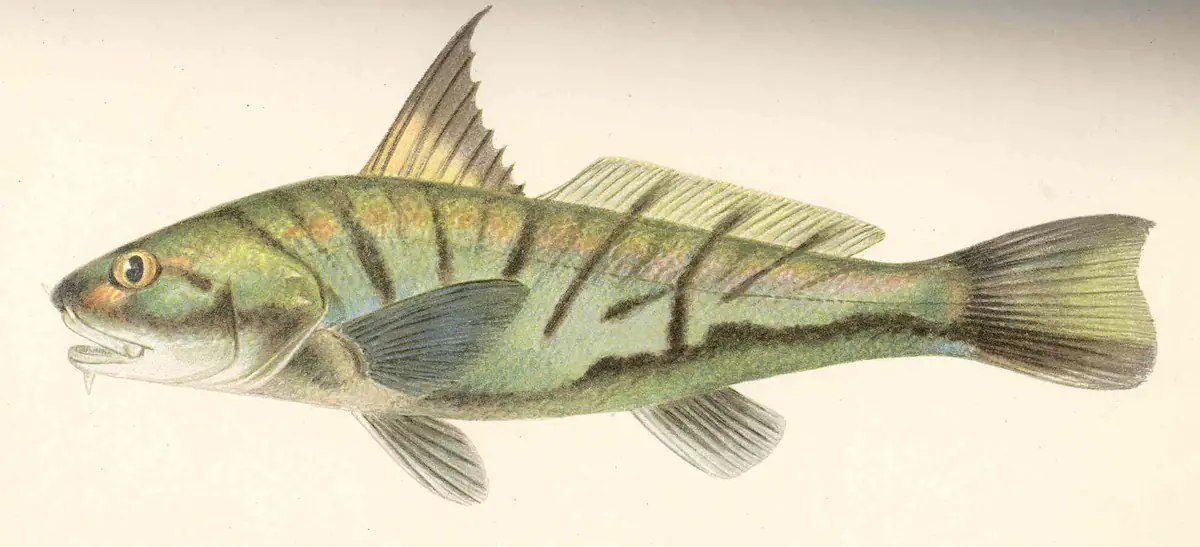
A northern kingfish, with its single chin barbel and the V-shaped bars on the shoulder. Painting: New York State Forest, Fish and Game Commission, 1907 (public domain).
Most kingfish run 10 to 14 inches, and the biggest reach about 18 inches.
Spot
Spot are short, deep-bodied fish. Look for:
- A black spot about the size of the eye just behind the gill cover.
- 12 to 15 thin, wavy, slanted lines on the sides.
- No chin barbels.
- A forked tail. In fall, big spot often have bright yellow bellies.
Typical spot run 7 to 10 inches and top out around 14 inches.
Croaker
Atlantic croaker (hardheads) make a loud croaking noise when you catch them. Look for:
- A silvery body with a pinkish or bronze cast and brassy spots forming wavy lines on the sides.
- Several pairs of small barbels on the chin.
- A long head with the mouth pointing down.
Croaker commonly run about 9 inches and a third of a pound, but they can reach 20 inches and 5 pounds. Their numbers swing widely from year to year.
| Chin barbels | Key mark | |
|---|---|---|
| Kingfish | One | Cone-shaped snout; first two bars form a V (northern kingfish) |
| Spot | None | Black spot behind the gill cover |
| Croaker | Several small pairs | Brassy spots in wavy lines; croaks loudly |
When and where they bite
Kingfish
Kingfish live from Cape Cod to Texas and are most common from the Chesapeake to New York in the north and as southern kingfish in the Carolinas. Along the Mid-Atlantic coast they're around from late April to October, with late summer often the best.
They school in shallow coastal water over sand or hard bottom. That puts them right in the surf, along the beaches and off piers and jetties in the nearshore ocean, plus in the bays. Kingfish are often caught by anglers fishing for weakfish.
Spot
Spot are most abundant from Delaware Bay to Georgia in summer and fall. They move into the bays and estuaries in spring and leave in late summer or fall. In summer they're in shallow water over sand and mud, especially over oyster beds and around pilings and jetties.
Fall is prime time for big spot. As they get ready to spawn offshore, the bigger fish gather near the inlets and beaches and move into the nearshore ocean, often in big schools. That fall run is a favorite on piers and in the surf.
Croaker
Croaker live on mud, sand and shell bottoms from Cape Cod to the Gulf, though they're uncommon north of New Jersey. They move up into the bays and estuaries in spring and head back to sea in fall, so spring through fall is croaker season. Fish channels and deep holes, especially just before and just after high tide.
Best spots for all three
- Oyster reefs and live bottom. In the bays, the best bottom fishing is over oyster reefs, which hold the worms, crabs and shrimp these fish eat. Old oyster bars are traditional bottom-fishing spots.
- Channel edges and holes.
- Piers, bridges and jetties.
- The surf. Kingfish and big fall spot especially.
Baits
All three eat worms, small crabs, shrimp and clams off the bottom. Fresh natural bait beats everything.
- Bloodworms. The classic bait, especially for spot. Many anglers consider them the best all-around bottom bait there is.
- Shrimp. Fresh or frozen shrimp catch all three.
- Squid. Cut into small strips. Tough, cheap and stays on the hook.
- Clams. Small pieces of fresh clam.
- Peeler and soft crab. A favorite for croaker.
- Sand fleas (mole crabs). A good kingfish bait in the surf.
- Scented artificial baits. Strips of scented synthetic bait catch fish and stay on the hook, though fresh natural bait usually works better.
Keep the pieces small. These fish have small mouths, and a big glob of bait just feeds them without hooking them.
The two-hook bottom rig
The top-and-bottom rig (hi-lo rig) is the standard for all three fish. You can buy them ready-made or tie your own:
- Start with a 2- to 3-foot piece of leader.
- Tie a bank sinker to the bottom end. Use about 2 ounces, or heavier in deep water or strong current.
- Above the sinker, add two short droppers about 8 inches long, spaced so they don't tangle, each with a small hook.
Use small hooks, because all three have small mouths. Kingfish and spot especially want small hooks and small baits.
From a boat or pier, drop the rig to the bottom and keep it there with a tight line. In the surf, cast it out to where the fish are feeding and keep the line tight.
Tackle
These fish don't need anything fancy.
- Rod: a 6- to 7-foot medium-fast spinning rod.
- Reel: 2500 to 3000 size.
- Line: 10- to 12-pound mono. Braid is more sensitive and lets you feel bites better, but it tangles easily and is harder for kids and beginners to manage.
Light tackle makes these little fish fun and helps you feel the quick bites.
Fishing tips
- Move if it's slow. These fish travel in schools. If you're not getting bites, move to another spot.
- Give others room. If other boats are on a spot, set up where you won't crowd them.
- Watch for bigger fish. Spot are a favorite food of striped bass, bluefish, weakfish and flounder, and small croaker are used as live bait for speckled trout.
Before you go
Spot, croaker and kingfish limits differ by state. Check your state's current saltwater rules before you go.
Cover photo: a spot, by Brandi Noble, NOAA Fisheries (public domain).