Article
Cobia Fishing
Cobia arrive with warm water in late spring and hang around buoys, rays, channel edges and wrecks all summer. Here's when and where to find them, how to sight-cast to cruising fish, how to chum them up, and the tackle that handles a 50-pounder.
November 10, 2026
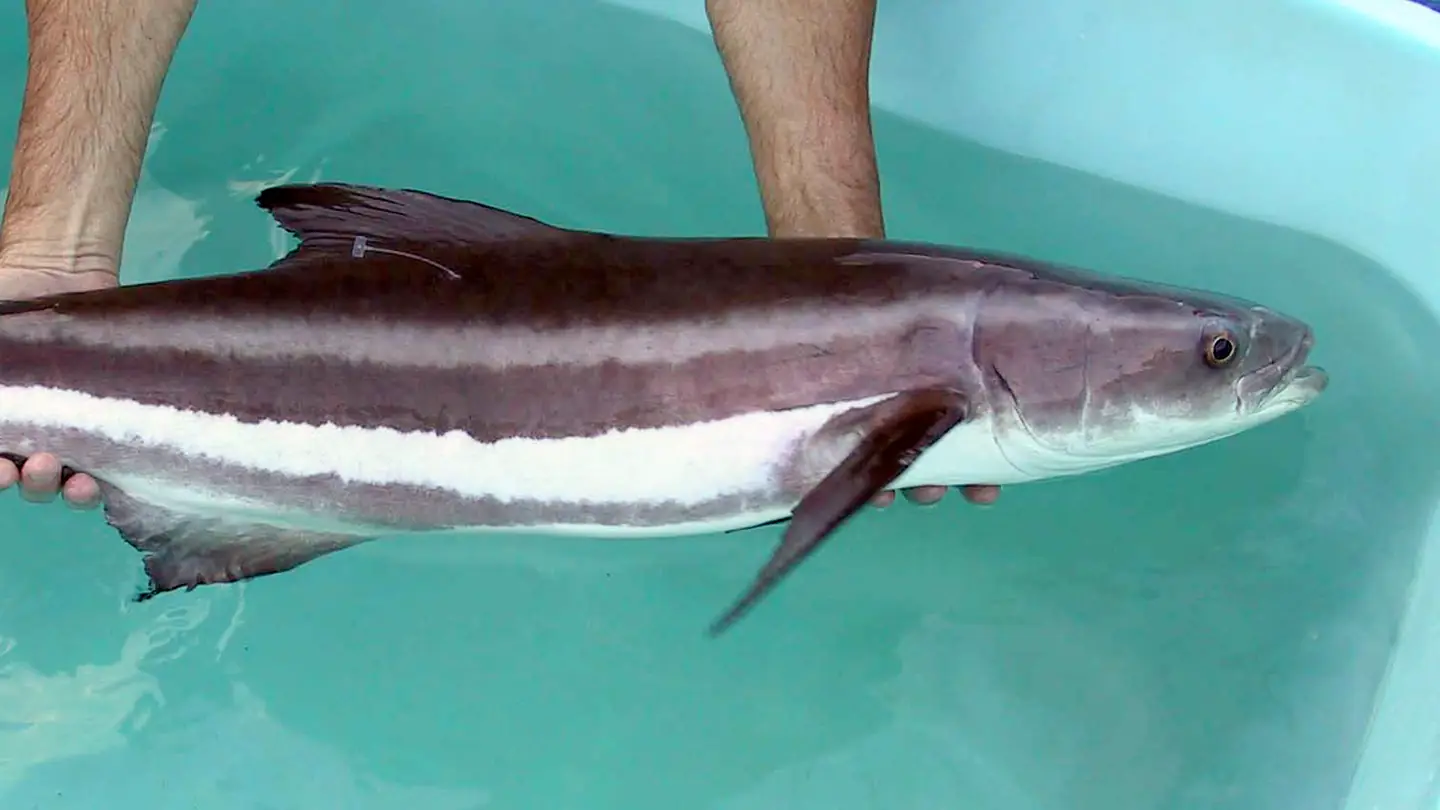
A cobia showing up beside the boat is one of the great moments in inshore fishing. A big brown fish swims up out of the green water, curious and unbothered, and everyone scrambles for a rod. Cobia grow to 100 pounds, they hit bucktails and live eels, and once hooked they do everything: run, dive, roll, jump and charge the boat. They're also moody and hard to find. This is how to find them and get one to eat.
Know the fish
Cobia (ling, lemonfish, crab-eater, brown bomber) have a long, torpedo-shaped body, a broad flat head with the lower jaw sticking out past the upper, and a dark brown back and sides with a darker stripe from the eye to the tail. The first dorsal fin is a row of short, separate spines. In the water they look a lot like a shark or a big remora, which is their closest relative.
Cobia average about 30 inches and 15 pounds, and fish of 20 to 50 pounds are caught regularly where they gather in summer. The biggest grow to 6 feet and over 100 pounds.
Despite the size, cobia mostly eat crabs. Blue crabs and other swimming crabs are their main food, along with shrimp, eels and fish.
When and where cobia show up
The migration
Cobia are warm-water fish. They like water from about 68 to 86 °F and follow it up and down the coast. On the Atlantic side they spend winter in Florida and off the Southeast coast, then move north in spring as the water warms. In summer they reach as far north as the Chesapeake Bay. In fall, as the water cools, they head south and offshore again.
The water temperature is your best guide. Cobia start to show up when inshore water reaches about 68 °F.
- South Carolina: cobia are in nearshore waters from April to October, with the peak in late spring. Most of the inshore fishing is in the sounds of the southern coast. After the spring peak, the big fish move offshore and smaller fish take their place.
- North Carolina: cobia pass along the coast on their spring migration, and they often hang around inlet buoys and channel markers.
- Chesapeake Bay: large numbers of cobia are in the bay from about Memorial Day to the end of September. The first fish show up in the lower bay as the water hits the high 60s.
Spawning
Cobia spawn from late spring through summer, repeatedly over the season. In the Southeast that's mostly late June to mid-August, at the mouths of bays and sounds and in the ocean. The big summer schools in the lower Chesapeake are thought to be spawning gatherings.
What cobia hang around
Cobia are drawn to anything that floats, sticks up or swims slowly. That's the key to finding them.
- Buoys and channel markers. Check every buoy, especially at inlets and along shipping channels. A cobia hanging under a buoy is a classic sight.
- Rays, turtles and sharks. Cobia shadow big animals. Cast to any big ray you see swimming near the surface.
- Pilings, bridges and piers.
- Wrecks, reefs and artificial reefs.
- Channel edges, shoals and contour lines. Edges where the bottom drops off are travel lanes.
- Bait pods. Schools of bait near the surface.
Cobia usually travel alone or in small groups of two or three, except when spawning.
Sight-casting
Sight-casting means cruising slowly, spotting cobia near the surface and casting to them. It lets you cover far more water than sitting at anchor.
Conditions
You need to see into the water. Pick clear, sunny, calm days. Wind ripple and cloud cover make cobia nearly impossible to spot. Height helps: a tower or a T-top lets you see much deeper and farther than standing on deck.
Searching
Run slowly along channel edges, shoals and contour lines, and check buoys, pilings, bridges, bait pods and rays as you go. Watch for a brown shape near the surface, a fin, or a fish riding on a ray's back. Good sonar helps you stay on the edges.
The cast
When you spot a fish, position the boat so you can cast well ahead of it, in the direction it's swimming. Land the bait or lure a few feet in front of the fish, not on top of it.
- Bucktail first. A heavy bucktail jig (about 3 ounces), with or without a soft-plastic trailer, is the classic first cast. Let it sink in front of the fish, then jig it up and swim it.
- Then live bait. If a cobia follows the lure and won't eat, throw it a live eel, croaker or spot.
- Change it up. Cobia can refuse one bait and eat another. Have several rods ready with different offerings.
Followers
Cobia often travel in pairs or small groups, and a second fish will follow a hooked one right to the boat. Keep a rod rigged with a jig ready. Cast it just behind the hooked fish without crossing the line, and you can hook a second cobia.
Chumming
On cloudy or windy days, when you can't see fish, anchor and chum. Chumming is slower and less exciting, but it puts cobia in the boat, and on many days you'll get more bites this way than by driving around looking.
Setting up
- Pick the spot. Anchor on a channel edge, sharp drop, hump, shoal edge or wreck. Set up so the boat sits on the shallow side and the chum slick drifts down into deeper water.
- Line up the wind and tide. It's easiest when the wind and current run the same way, so the boat and slick point in the same direction.
- Rig the anchor to drop. Tie the end of the anchor line to a float. When you hook a big fish, toss it over and chase the fish, then come back and pick it up.
- Start the chum. Ground menhaden (bunker) mixed with menhaden oil, in a weighted chum bucket with holes drilled in it, lowered to the bottom behind the boat. A gallon bucket of frozen chum in a chum pot works too.
Baits
Live eels, live croaker and live spot are the top baits. Cut menhaden, other fresh cut bait and half a blue crab all catch cobia too. Use a mix, because cobia often want one bait over another on a given day.
The spread
Put a couple of baits on the bottom close to the boat, right by the chum bucket. Most bites come on those. Set a couple more lines farther back, about 20 feet behind the boat. The biggest fish often take the baits farther back.
Expect company. Chum draws sharks, skates and rays as well as cobia. Keep a spare rod rigged so you can get a bait back out while you deal with a shark.
When a cobia takes, clear the other lines and pull the chum bucket up. A fish that runs through the other lines or the anchor rope is a fish you lose.
Lures
- Bucktail jigs. The classic cobia lure. Heavy heads (2 to 3 ounces or more) with or without a soft-plastic tail.
- Soft-plastic eels. Eels are a key cobia food, and plastic imitations work well. Carry several lengths and colors, because changing one or the other can turn a follower into a biter.
- Tube lures. A length of surgical tubing over a wire leader with a weight in the head, retrieved slowly and jigged. Cobia take it for an eel.
- Topwater chuggers. Good for drawing cruising fish from a distance. If a cobia follows, speed up so the plug seems to be getting away.
- Jigs tipped with plastic. Bounced along the bottom around wrecks, buoys and pilings for cobia holding deep.
Rigs
Live-bait pitch rig
For sight-casting live eels or baitfish, tie a 7/0 or 8/0 live-bait hook to a short fluorocarbon leader of about 2 feet. A short leader lets you make long, clean casts because the knot never goes through the rod guides.
Fish-finder rig
For chumming and bottom fishing:
- Slide a fish-finder slide (sinker slide) onto your main line and tie on a heavy swivel.
- Tie about 2½ feet of 60- to 80-pound leader to the swivel.
- Finish with a 7/0 to 8/0 hook for eels and smaller baits, or up to 10/0 for croaker.
- Clip a pyramid sinker of 4 to 8 ounces to the slide, depending on the current.
Tackle
| Use | Rod | Reel and line | Leader |
|---|---|---|---|
| Sight-casting | Medium-heavy to heavy spinning rod | 5000-size or larger spinning reel, 30 to 50 lb braid | 2 ft of 60 to 80 lb fluorocarbon |
| Chumming and bottom fishing | Medium-heavy to heavy boat rod | Conventional or large spinning reel, 50 to 65 lb braid | 2½ ft of 60 to 80 lb leader |
Heavier braid is stronger but casts shorter, so for sight-casting many anglers use about 30-pound braid to get the distance. Cobia will test every part of your gear around buoys, pilings and anchor ropes, so use fresh line and good knots.
Fighting and landing cobia
- Expect the unexpected. Cobia run, dive, roll, jump and often swim straight at the boat. Keep tight and stay ready.
- Don't rush the net. A green cobia that comes to the boat early will usually explode when it sees the net or touches the hull. Let it make another run or two.
- Release with care. To release a cobia, hold it in the water by the lip until it kicks off on its own.
Before you go
Cobia rules differ by state along the Atlantic coast, and there are federal limits in some waters. Check your state's current size limit, bag limit and season before you go.
Cover photo: Jorge Alarcon or Daniel Benetti, NOAA Photo Library (public domain).