Article
The Ultimate Guide to Catfish Fishing
Channel cats, blues and flatheads, from telling them apart to where they live through the year, the baits each one wants, the rigs that put those baits in front of them, and the tackle to land a big one.
November 10, 2026
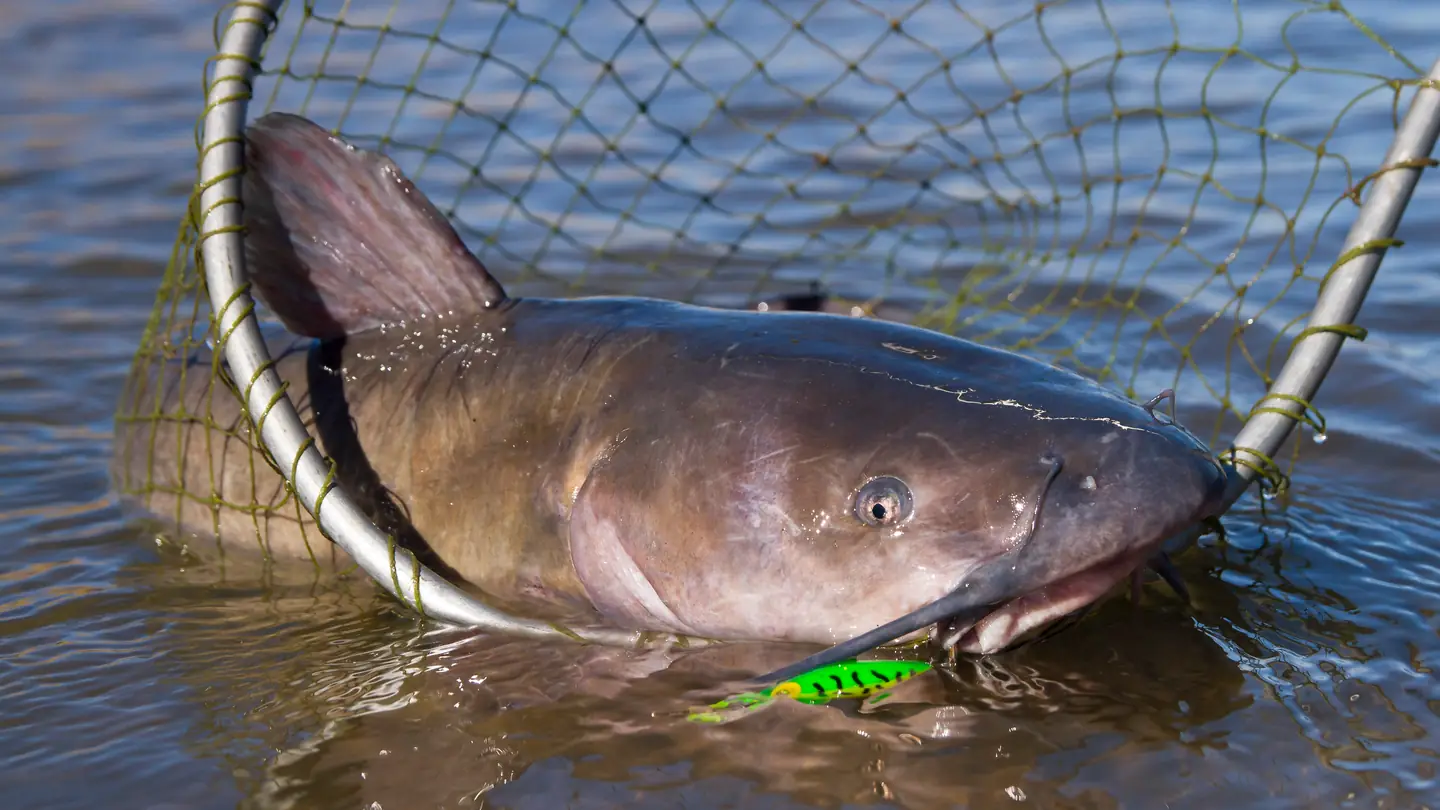
Catfish are the fish that keep a lot of anglers fishing all summer. Channel cats alone have been stocked into rivers, reservoirs and ponds across the country. Catfish grow big, pull hard and bite best at night, and you can catch them just as well from the bank as from a boat. Catching them is mostly a matter of putting the right bait in the right place at the right time. This guide covers all of it: telling the species apart, where they live through the year, what each one eats, the rigs that work, and the gear to land a big one.
Know your catfish
Three catfish make up most of what anglers target, plus a couple of smaller cousins you'll catch along the way. They live in different places and want different baits, so it pays to know which one you're after.
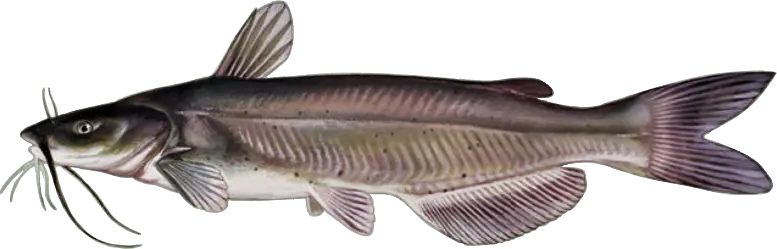
Channel catfish. Painting: Duane Raver, U.S. Fish and Wildlife Service (public domain).
Channel catfish are the most widespread and the ones most people start with. They're sleek, olive-brown to slate-blue, with a deeply forked tail. Smaller fish carry scattered black spots, which fade on big ones. The anal fin (the long fin on the belly, just ahead of the tail) has a rounded edge. Channel cats are omnivores and eat almost anything, and they hunt by sight as well as smell more than other catfish do.
Blue catfish are the giants: the largest catfish native to North America, commonly 20 to 44 inches and often over 40, with fish over 100 pounds on record. They look like a big channel cat but are pale bluish-silver above and white below, never have spots, and have a straight-edged anal fin that looks as if it was trimmed with scissors. The head and back slope steeply up to a hump in front of the dorsal fin, giving them a wedge-shaped profile. Blues are big-river fish native to the Mississippi, Missouri and Ohio drainages and have been introduced elsewhere, including tidal rivers of the Chesapeake Bay.
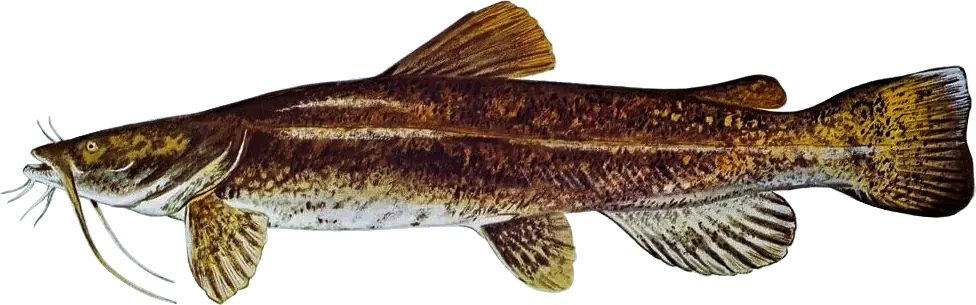
Flathead catfish. Painting: Duane Raver, U.S. Fish and Wildlife Service (public domain).
Flathead catfish are the predators. They have a broad, flat head, a lower jaw that juts past the upper, a squared-off or slightly notched tail, and mottled yellow-brown skin. Adults over about 10 inches eat almost nothing but live fish, and they grow past 100 pounds. They're native to the Mississippi basin and Gulf slope; where they've been introduced outside that range, some states treat them as invasive.
White catfish are smaller, light-gray catfish of Atlantic and Gulf coast rivers, often caught alongside channel cats. Their tail is only moderately forked, with rounded lobes; the anal fin is rounded; the head is broad; and the chin barbels are pale. Most run about a foot long. Bullheads have a straight or slightly notched tail and are smaller still.
| Tail | Anal fin | Spots | Favorite food | |
|---|---|---|---|---|
| Channel catfish | Deeply forked | Rounded edge | Small black spots on smaller fish | Almost anything |
| Blue catfish | Deeply forked | Long, straight edge | Never | Shad and other fish as they grow |
| Flathead catfish | Square or slightly notched | Short, rounded | Mottled, not spotted | Live fish only |
| White catfish | Moderately forked, rounded lobes | Rounded | None | Almost anything |
Where catfish live
Rivers
Rivers are home water for all three big catfish, but each uses a river differently.
- Channel cats are most abundant in rivers and large streams with low to moderate current, over sand, gravel or rock. Look in deep pools and runs, especially the head of a pool just below a riffle, and below dams.
- Blue cats like bigger, faster water than the others: swift chutes and pools with noticeable current over clean sand, gravel, rubble or bedrock. They're more of an open-water fish and tend to avoid silty backwaters.
- Flatheads live in deep, slow pools with logs, drift piles, rock and undercut banks. They're not sight feeders and do fine in muddy water.
Day and night matter more with catfish than with most fish. Blues and flatheads rest in deep holes through the brightest part of the day and move to shallower water to feed in low light and darkness. Flatheads in particular are night hunters.
Lakes and reservoirs
In lakes, ponds and reservoirs, catfish use the shallow flats and shorelines to feed and the deeper breaks, creek channels and old river channels to rest and winter. Windblown shorelines, the mouths of tributaries and the first drop-off off a feeding flat are the spots to learn. In big reservoirs, blue cats are tied to schools of shad, and the shad tell you where to fish.
Catfish through the year
The seasonal pattern is the same everywhere; only the calendar shifts with latitude.
| Season | Channel cats | Blue cats | Flatheads |
|---|---|---|---|
| Ice-out and early spring | Shallow bays and windblown shorelines where dead, winter-killed shad pile up | Still in deep water, following shad | Barely moving in deep holes with mild current |
| Late spring (prespawn) | Feeding hard; staging below dams and at tributary mouths | Moving toward spawning structure | Moving toward spawning areas once water passes 50–60°F, often the same river bend every year |
| Spawn | About 75°F, in dark cavities | 70–75°F, in smaller waters with structure | 75–80°F, in hollow logs, logjams, undercut banks and riprap |
| Summer | Most consistent fishing, especially at night | Shallow flats and shad schools | "Home" holes near cover, shallow at night |
| Fall | Shallow flats in mild weather; first break into deeper water after cold fronts | Following tightening shad schools deeper | Grouping in deep holes and channels |
| Winter | Deep holes; some caught through the ice | Deep river channels and basins with shad | Deep holes, nearly dormant |
A few seasonal windows are worth planning a trip around:
- Ice-out. Wind blows winter-killed shad into shallow bays and onto windblown shorelines, and channel cats follow. Small pieces of cut shad on a simple slip-sinker rig can make this some of the easiest fishing of the year.
- Prespawn. Late spring channel cats are gluttons. Fish below dams and at the mouths of tributaries where they stage.
- Early fall. Cats stay on shallow flats with young panfish and on windblown shores while the weather is mild. When a cold front hits, they slide to the first break into deeper water, often 6 to 15 feet, and to troughs and channels off the flats. Anchor and spread baits along the break.
- Winter blues. In reservoirs, cooling water from late summer on packs shad into tight schools, and the schools draw blue cats. By the time the water is near 50°F, most shad and blues have left the shallow flats. In midwinter they're often in 30 to 40 feet, and a river channel that cuts across a deep flat is the best spot on the lake when the shad school sits over it.
Baits: what each catfish wants
Catfish baits fall into two groups:
- Attractor baits draw fish in by scent: dip baits, pastes, doughs, prepared chunk baits and chum. They shine for channel cats, especially in summer.
- Triggering baits are natural food from the same water: fresh-cut or live baitfish, crayfish and the like. These are what the biggest fish eat.
Match the group to the fish:
- Channel cats will take nearly anything: nightcrawlers, chicken liver, cut gizzard shad or sucker, stink and cheese baits, shrimp and grasshoppers. In rivers, drift a crawler, crayfish tail or hellgrammite along the bottom. Fresh cut bait from that water is hard to beat in late spring. Once the water drops below about 60°F, stink baits lose their pull and smaller, fresh baits such as cut sucker strips or small live bluegills or chubs work better.
- Blue cats are fish-eaters as they get big. Fresh cut gizzard shad is the standard bait in reservoirs.
- Flatheads want live, moving bait and seldom bother with cut bait or liver. Live green sunfish (where legal), bluegills, bullheads, creek chubs and suckers are the top choices.
Use bait from the water you're fishing whenever you can. Many states restrict using game fish such as sunfish as bait and moving live bait between waters, so check before you net or buy it.
Rigs that catch catfish
Keep it simple. The fewer parts in a rig, the fewer knots to fail, the farther it casts, the less it tangles, and the easier it is to retie when you lose one to a snag. Choose the simplest rig that puts your bait where the fish are.
Freelining and split shot
The simplest rig is a hook and a bait. A piece of fresh cut sucker on a 2/0 hook, cast into a shoreline eddy, sinks slowly and tumbles along the bottom in the soft current. Pinch a split shot or two on 6 to 12 inches above the hook and it casts farther and sinks faster. Cast it alongside a snag in light current and let it work around the edge, or drift it with fresh cut bait across a shallow flat toward deep water on a summer night, when channel cats prowl the shallows.
The slip-sinker rig
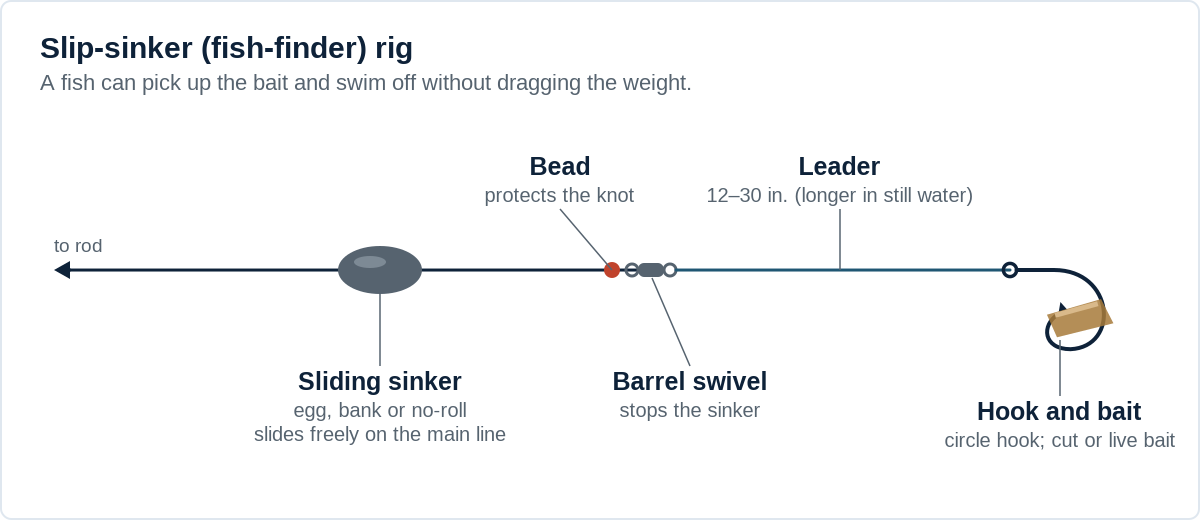
The sliding-sinker rig (in salt water it's called a fish-finder rig) is the most popular catfish rig there is. The sinker slides on the main line above a swivel, so a fish can pick up the bait and move off without feeling the weight. Build it this way:
- Slide a sinker onto the main line. A bell or bank sinker snags less than an egg sinker when you cast across current; an egg sinker is fine pitched straight behind a boat anchored in current.
- Add a small bead to protect the knot.
- Tie on a barrel swivel as the stop.
- Add a leader and hook.
Leader length controls how much the bait moves. A sinker is just another rock to a catfish, so don't lengthen the leader to hide it. A 12-inch leader might keep a piece of cut bait still on a pond bottom but let it flail in heavy current. Use about 30 inches for drifting cut bait over clean reservoir bottom for blues, 6 inches to pin a big live bait in front of a snag for flatheads, and almost none at all for working a rocky tailwater for channel cats. Use more weight and a shorter leader the stronger the current gets.
The three-way rig
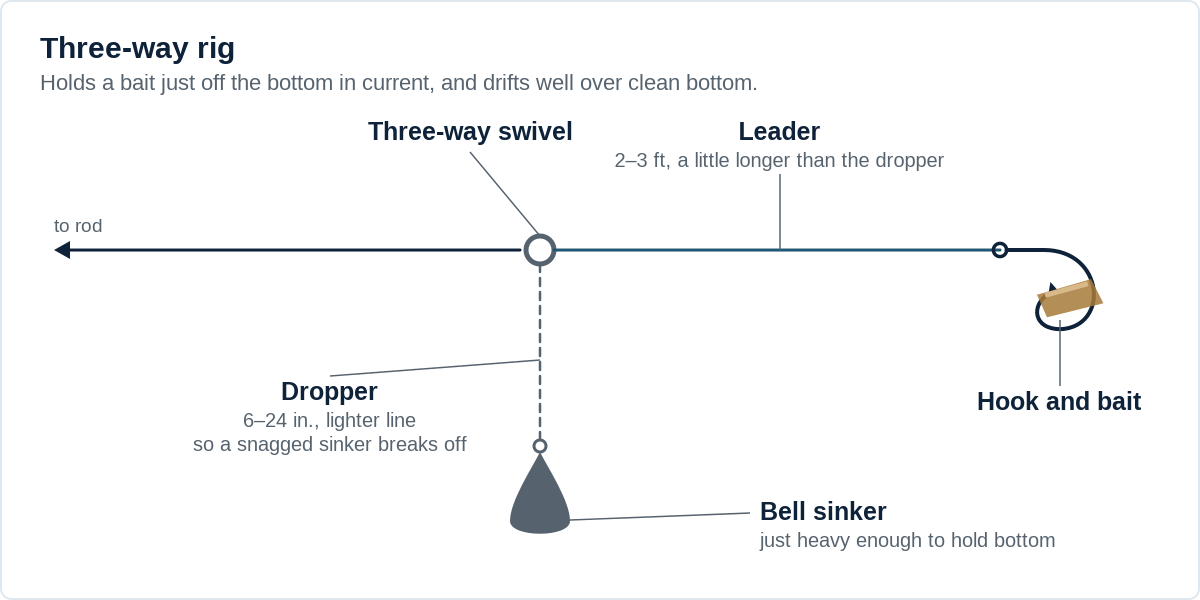
The three-way rig is worth considering almost anywhere you fish for catfish. A three-way swivel joins the main line, a leader to the hook and a dropper to a bell sinker. It holds a bait in place in a heavy tailrace, works in still water, and is the standard for slip-drifting big rivers and drifting windblown reservoir flats.
- Dropper: 6 to 24 inches. Make it from lighter line than the rest of the rig so a snagged sinker breaks off and you keep the hook and the fish. One proven setup for rocky water below a dam is 20-pound main line, a 17-pound leader and a 6-pound dropper.
- Sinker: half an ounce can do in still water; it can take 3 to 8 ounces to hold in heavy current around wing dams or a tailrace.
- Leader: usually 2 to 3 feet, a little longer than the dropper, depending on the current.
When you fish several rods from an anchored boat, try different dropper lengths (say 6, 12 and 18 inches) and different depths along a channel edge. When one starts getting bit, switch the rest to match.
The slip-float rig
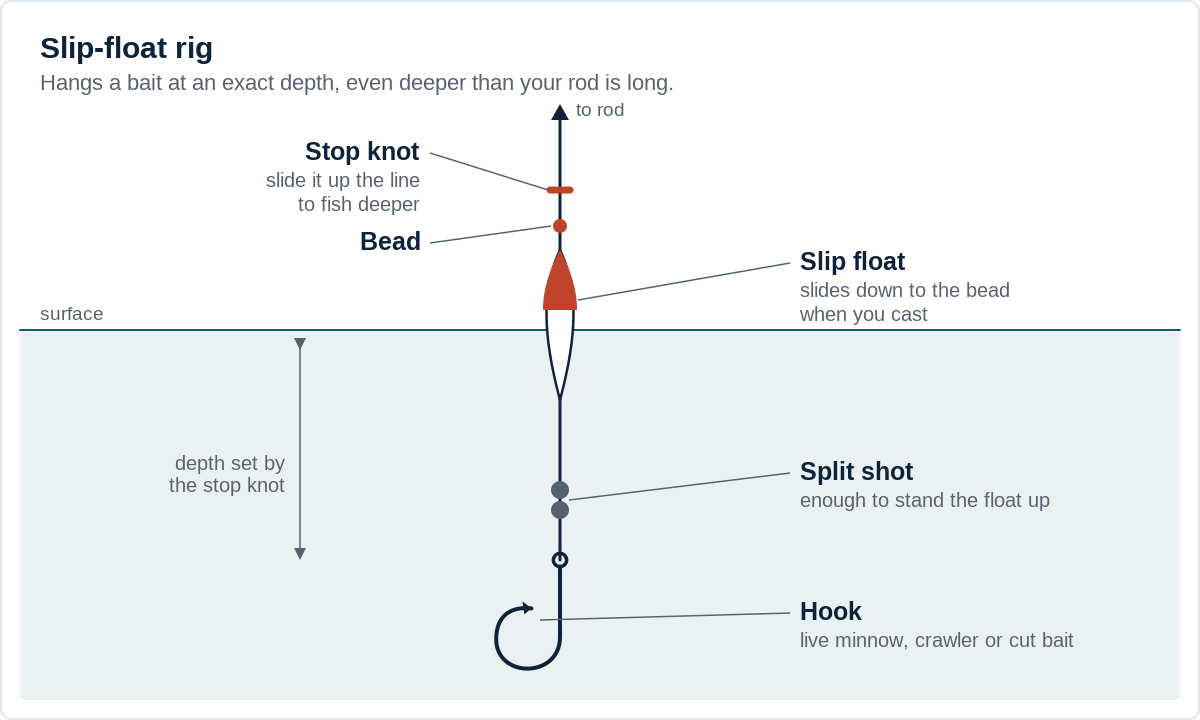
A float carries a bait along the bottom at the speed of the current and snags less than a weighted rig. It's also the way to hang a live bait over cover. Slim, cigar-shaped floats are more sensitive than round bobbers, so a cat can swim off with the bait without feeling much resistance.
- Tie a stop knot (a five-turn uni knot) around the main line with line of the same or slightly heavier test. Slide it up to fish deeper, down to fish shallower.
- Slide on a small bead, then the float.
- For cut bait and small live baits, pinch on a few split shot about a foot above a #2 to 3/0 hook.
- For big live baits for flatheads, use a bigger float, a 3/0 to 7/0 hook, a swivel about 20 inches above the hook and a 1- to 2-ounce egg sinker above the swivel.
Lifting a bait off the bottom
Live baits that swim above the bottom draw more strikes than ones hiding in it, and dead baits up off the debris are easier for fish to find. A small float or foam ball threaded on the leader of a slip-sinker rig lifts the bait. Reservoir drifters for blue cats use exactly that: a sinker sliding above a swivel, a leader of about 4 feet with a small float on it, and fresh cut shad on the hook.
How to fish for them
Fishing from the bank at night
The classic catfish trip: a few rods on the bank of a river pool or a reservoir point, slip-sinker rigs baited and cast out, rods in holders, clickers on. Nights are the most productive time for all three species, and summer is the most consistent season for channel cats. Set up on the edge where shallow feeding water meets deeper water: the head of a pool, a point, the mouth of a creek, a windblown shore.
Anchoring
Anchor upstream or upwind of the spot and let your baits sit on it. Precision matters more than anything. Blue cats in particular are fish of "edges and ledges," and you'll catch far more anchored on the lip of a channel than in the middle of a flat. Run back and forth across the channel with your sonar until you mark fish, drop a marker buoy where the bottom starts to fall, then come back from upwind and set your anchors so the boat sits just above the edge. In a river, put a second anchor off the stern to keep the boat from swinging.
Drifting
Drifting covers water and finds scattered fish, especially blue cats on big reservoir flats. A few rules:
- Control your speed. It's the single most important thing. Small catfish will chase a fast bait, but big ones rarely move far for a meal. If you're catching only small fish, slow down. Drift socks (sea anchors) off the side hold the boat broadside to the wind and spread your rods; in a hard wind, put them off the stern for the slowest drift.
- Use your sonar. Run into the wind across the flat looking for shad and big marks, then drift back over what you found.
- Keep moving. If you're marking fish but not catching them, give a spot about half an hour, then go find active fish.
- Drift with three-way or float-and-leader rigs over clean bottom.
Watch the water level on reservoirs. A big rain and a change in the dam's release can scatter fish that were stacked up the day before.
Daytime jigging for flatheads
Flatheads don't feed much during the day, but you can provoke one. Anchor above a deep resting hole near cover and work a live sunfish on a slip-sinker rig down into it, lifting and dropping, over and over. It can take many passes before a fish grabs it.
Setting the hook
Catfish aren't timid. When a decent cat picks up the bait, it usually has it. You'll hook more fish in the corner of the mouth, though, if you let it turn first. Keep tension on the line, follow the fish with your rod tip for a foot or two, then set. With the rod in a holder and the clicker on, let the fish take a foot of line, engage the reel and set. With a flathead on a live bait, give it a little line, set hard, and pull it away from the snags with steady pressure.
Tackle
| Fishing | Rod and reel | Line | Hooks and weights |
|---|---|---|---|
| Channel cats from the bank or a small boat | Medium to medium-heavy spinning or baitcasting | Sturdy line; 20-pound main line and a 17-pound leader for rocky tailwaters | #2 to 3/0 hooks; split shot to a few ounces of sinker |
| Drifting reservoirs for blue cats | 8-foot heavy rods with sturdy casting reels | Low-stretch 30-pound superline, so you can feel bottom and set at long range | Bell sinkers of 2 to 3 ounces; fresh cut shad |
| Flatheads on live bait | Heavy rod with a baitcasting reel with a clicker, or a spinning reel with a baitfeeder | 20-pound and up | 3/0 to 7/0 hooks; heavier weight and shorter leaders in current |
For night fishing, bring a headlamp and a big net.
Before you go
Catfish rules vary a lot from state to state: size and bag limits (often with a limit on the number of big fish), the number of rods you can fish, limb lines and jug lines, chumming, and which fish you can use for bait. Where blue or flathead catfish have been introduced, some states encourage or require you to keep them. Check your state's current regulations before every season.
For the details on each species, see the channel catfish, flathead catfish and white catfish guides.
Cover photo: U.S. Fish and Wildlife Service, Mountain-Prairie Region (public domain). Rig diagrams: Basic Fishing.