Article
Spanish Mackerel Fishing
Spanish mackerel arrive with warm water in late spring and tear through bait along the beaches, inlets and tide lines all summer. Here's when they show up, how to troll spoons for them, how to cast to feeding schools, and how to rig for teeth that cut light line.
November 10, 2026
Spanish mackerel are summer's speed demons. They show up when the ocean warms, travel in big, fast schools, and slash through bait along the beaches, inlets and tide lines. They're easy to catch when you find them, fun on light tackle, and they hit small, shiny lures as fast as you can reel. The challenges are finding the schools, which move constantly, and keeping your lure attached against a mouthful of razor-sharp teeth.
Know the fish
Spanish mackerel have a long, slim body with a bluish-green back and silver sides covered in yellow to bronze spots, with no stripes. The front of the first dorsal fin is black. They average about 15 inches and a pound and a half, and the biggest reach about 11 or 12 pounds.
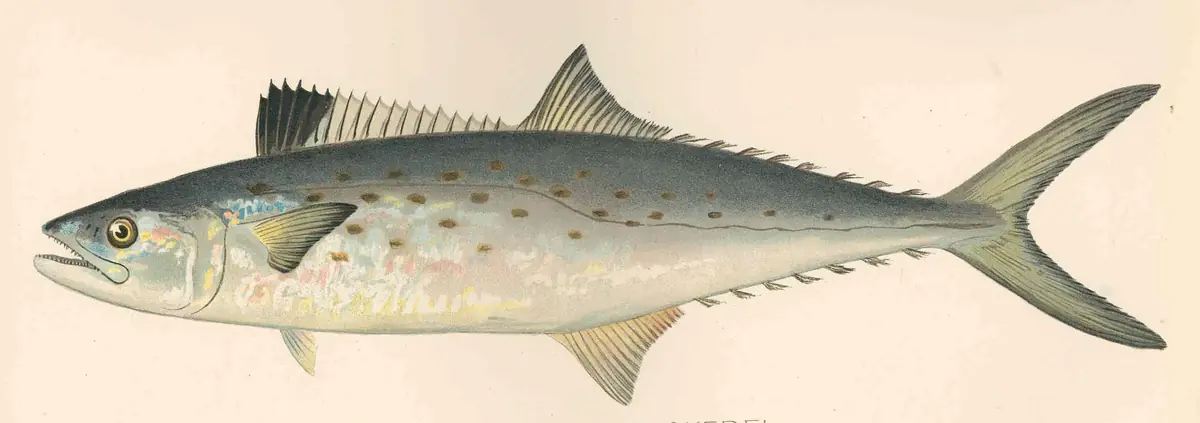
A Spanish mackerel: yellow-bronze spots, no stripes and a black patch at the front of the first dorsal fin. Painting: New York State Commissioners of Fisheries, Game and Forests, 1900 (public domain).
Two look-alikes:
- King mackerel are much bigger and their lateral line dips sharply down below the second dorsal fin. A Spanish mackerel's lateral line slopes gently to the tail.
- Cero have a yellow-bronze stripe along the side. Spanish don't.
Spanish feed near the surface on small schooling fish (anchovies, menhaden, herring, small jacks) plus squid and shrimp. Their teeth are as sharp as a bluefish's, so they cut light line easily.
When and where to find them
The migration
Spanish mackerel are warm-water fish. They prefer water of about 70 to 81 °F and are rarely found below about 64 °F.
They spend winter off south Florida and move north as the water warms in spring, staying close to shore. They typically reach the Carolinas in April or May and the Chesapeake Bay in May or June. Some push as far as New York, and occasionally southern New England. In fall, when the water cools below about 70 °F, they head back south.
In South Carolina, for example, they're around from April to November. The best fishing in most places is during the spring and fall runs, when the schools pass close to shore.
Spanish schools move fast and travel long distances. Fish can be in an area for a few days and gone the next week, so keep an eye on local reports.
Where they feed
Spanish hunt bait in open water close to shore. Look for:
- The beach. Spanish often feed within a quarter-mile of the surf line, especially early in the morning and late in the day.
- Inlet mouths. Bait pours in and out of inlets on the tide.
- Tide lines and rips. Where currents meet, debris and bait collect in a visible line.
- Temperature breaks. Where warmer and cooler water meet.
- Structure and contour edges. Reefs, wrecks, rock piles, live bottom and channel edges.
- Grass beds. In Florida and other southern waters.
- Bait schools.
The fastest way to find them: watch for birds. Terns and gulls diving on bait often mean mackerel are pushing it to the surface. Slicks on the water can also mark where they've been feeding.
Trolling
Trolling is the easiest way to find Spanish mackerel and the way most boats catch them. It covers lots of water, and when you find a school you can keep circling through it.
The lures
Small trolling spoons are the standard. Sizes 00 to 1 work best, roughly the size of a minnow. Silver and gold spoons work, and green is a favorite color.
Small feathers, dusters, small plugs and flies also catch them.
The setup
- Speed: troll at about 6 knots. Spanish like a fast lure.
- Depth: use trolling sinkers (3 to 4 ounces) and small planers (No. 1) to run lures at different depths. Fish some lines shallow and some deep until you find where they're feeding.
- Leader: run about 20 feet of 30- to 40-pound leader from the sinker or planer to the spoon. The long leader puts the spoon well back from the weight.
- Teaser: a small bird teaser splashing on the surface draws fish into the spread. It doesn't catch many fish itself, but it brings them to your other lures.
Where to troll
Run along the beach just outside the surf, past inlet mouths, and along rips, contour edges and temperature breaks. If you cross a tide line, troll both sides of it before moving on.
When a fish hits, slow down just enough to reel it in. Keep reeling steadily. On a planer, hand-line the last few feet of leader to the boat.
Casting to schools
When Spanish are busting bait on the surface, casting lures to them on light tackle is the most exciting way to catch them.
Approach
Stay back from the school and make long casts. Running the boat into the middle of feeding fish spooks them, and the school may not come back together. Cast ahead of the school's path or to its edge, not into the middle.
Lures
- Small metal spoons and jigs. Slim, shiny metal lures cast far and match small baitfish.
- Soft plastics. A soft-plastic jerkbait or shad on a 1/4-ounce jig head. Easy to replace when the mackerel chew it up.
- Small jerkbaits.
- Flies. White baitfish flies on a 7-weight rod.
Retrieve: fast
You can't reel too fast for a Spanish mackerel. They're among the fastest fish in the sea, and a fast lure draws reaction strikes. Hold the rod tip low and crank hard. A high-speed reel helps.
Chumming
Chumming can bring Spanish to the boat and keep them there.
- At anchor: set up on a channel edge, wreck or rock pile where Spanish hang out and start a slick of ground, frozen fish chum. Toss in some live bait or bait chunks now and then to really get them going. Then drift back a live bait or chunk, or cast lures into the slick.
- Glass minnow chum: in Florida, tossing a handful of small glass minnows before every cast draws mackerel in close. The most common mistake is not using enough chum.
Leaders: the trade-off
Spanish mackerel have razor teeth, and they also have sharp eyes. Heavy leader stops cut-offs but can cost you bites. Light leader gets more bites but loses more lures.
- Fluorocarbon or mono, 30 to 60 pounds: the usual choice. A 30-pound fluorocarbon leader is light enough for wary fish and loses relatively few lures.
- Light single-strand wire: stops almost all cut-offs. Use it when you're losing too many lures, especially when the fish are aggressive. If they turn picky, switch back to fluorocarbon.
Tackle
| Use | Rod and reel | Line | Leader |
|---|---|---|---|
| Casting | 7 ft fast-action spinning rod, 3000-size reel | 10 to 15 lb mono | 30 lb fluorocarbon, or light wire |
| Trolling | 20 lb-class boat rods | 50 lb braid | About 20 ft of 30 to 40 lb leader |
| Fly | 7-weight | Intermediate or floating line | 30 lb fluorocarbon |
Mono's stretch is a plus when casting: it cushions the hard strike of a fish hitting a fast lure.
Before you go
Spanish mackerel are managed with size limits and bag limits that differ by state and federal waters. Check the current rules for where you fish before you go.