Article
Sheepshead Fishing
Sheepshead live on pilings, jetties and rocks, eat crabs and barnacles, and steal bait better than any fish on the coast. Here's where to find them through the year, how to rig a fiddler crab, and how to hook a fish that barely seems to bite.
November 10, 2026
Sheepshead are the fish that teach you patience. They live right where you'd expect, tight to pilings, jetties and rocks, and they bite all day long. The trick is that they're expert bait thieves. Their teeth crack a crab and pick it clean while you're still waiting to feel something. Once you learn their bite, you can fill a cooler with some of the best-eating fish in salt water.
Know the fish
Sheepshead are deep, flat-sided fish with five or six black bars down silver-gray sides, which is why they're called "convict fish." Their front teeth look remarkably human, and behind them are rows of molars for crushing shells. Watch out for the sharp spines on the dorsal and anal fins and the razor-edged gill covers when you handle one.
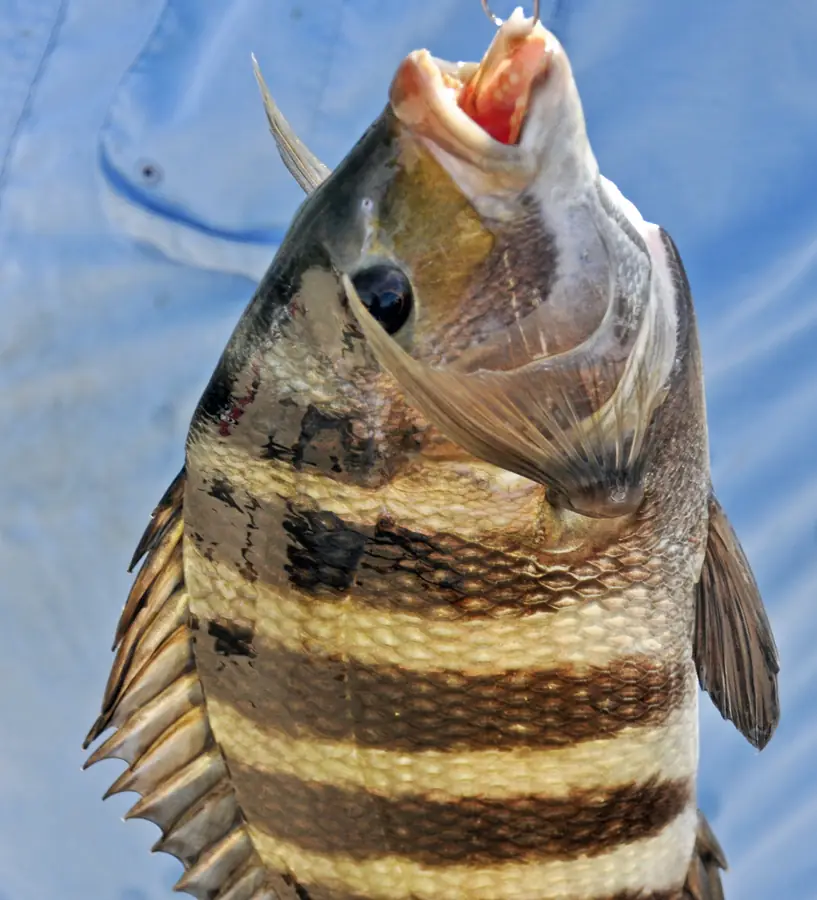
A sheepshead caught at Sanibel Island, Florida. Photo: James St. John (CC BY 2.0, cropped).
Most sheepshead run 10 to 20 inches and 3 to 4 pounds, and fish of 10 to 15 pounds are caught in good spots.
Don't confuse them with young black drum, which also have dark bars. Black drum have whisker-like barbels on the chin. Sheepshead don't, and they have those sheep-like teeth.
Sheepshead eat crabs, barnacles, mussels, oysters, clams, shrimp and small fish. They scrape barnacles off hard surfaces with their front teeth and crush crabs and shellfish with their molars.
Where sheepshead live
Sheepshead live from Nova Scotia to Brazil, with the most in the Southeast and the Gulf. They were scarce north of Virginia for most of the 20th century, but over the past two decades they've come back to New Jersey and New York waters.
The rule is simple: anywhere a hard surface grows barnacles and gives crabs a place to hide is sheepshead water.
- Bridge pilings. One of the best spots of all, especially big bridges with lots of pilings.
- Docks and piers. Older docks with lots of pilings, close to deep water, are best.
- Jetties and rock walls. Fish the rocks along the inside and the tips.
- Seawalls.
- Oyster bars and mussel beds.
- Rock piles, rubble and reefs. Natural and artificial reefs near shore.
- Sod banks and marsh edges. In the Mid-Atlantic, sheepshead feed along marsh banks and in tidal creeks in summer.
For bigger fish, go where others don't. A small rock pile, an old dock at the back of a long canal, or a rubble pile off the beaten path will often hold bigger sheepshead than the well-known public spots.
Sheepshead through the year
Late winter and spring: spawning
Sheepshead spawn in late winter and early spring, roughly February through April. In the Southeast and Gulf, they gather in big schools and move to nearshore wrecks, reefs, rock piles and jetties to spawn. On the Gulf coast, spawning schools gather from late fall through winter, which gives you a better shot at big fish.
Summer
After spawning, sheepshead spread back into the bays, creeks and inshore structure. In the Mid-Atlantic, they're around from about May into November, using tidal creeks, marsh banks, inlet structure, bridges and piers.
Fall and winter
In the Mid-Atlantic, sheepshead move offshore in fall as the water cools. Farther south they stay around inshore structure, and on the Gulf coast the big fish start gathering on structure in late fall ahead of spawning.
Baits
Sheepshead eat what lives on the structure, so bring baits that match.
- Fiddler crabs. The top sheepshead bait. Hold the big claw folded against the body so it can't pinch you, and hook the crab through the outer point of its shell, avoiding the insides so it stays alive.
- Oysters and mussels. Tougher than shrimp, so they stay on the hook better. Shuck them fresh.
- Clams.
- Sand fleas (mole crabs).
- Shrimp. Catches plenty of eating-size fish, but sheepshead pick shrimp off the hook fast.
- Barnacles. Scraped off pilings, they're both bait and chum.
Bring more bait than you think you need. You'll lose plenty to fish you never feel.
Chumming
Crushed shells make great sheepshead chum. Hammer a few freshly shucked oysters or mussels into a smelly grit and toss handfuls right where you're fishing. Scraping barnacles off the pilings does the same thing: the falling barnacles and crabs draw sheepshead in and get them feeding.
Rigs
Keep rigs small and simple. Sheepshead have small mouths, and you're fishing right next to structure that eats tackle.
Knocker rig
The simplest sheepshead rig: a small egg sinker slides on the leader and rests right against the hook eye. It keeps the bait close to the weight so you feel the bite, and it's easy to drop straight down a piling.
Split shot
In light current, a hook with a split shot or two lets the bait drift naturally down the piling.
Jig head
A light jig head tipped with a fiddler crab or piece of shellfish puts the weight and hook in one small package. It snags less in rocks and rubble, and works well when sheepshead seem to shy away from a sinker. In the Mid-Atlantic, many anglers work a light jig and fiddler crab tight to the piling, dropping it a little at a time.
Drop-shot rig
In strong current, a drop-shot holds a crab just off the bottom without snagging. Tie the hook on with a Palomar knot, leaving a long tag end. Pass the tag end back through the eye so the hook stands out from the line, and hang a sinker from the end of the tag.
Use a 1/0 or similar small, strong hook. A bigger hook just gets in the way of a small mouth.
Where to drop your bait
Fish straight down, tight to the structure. Sheepshead feed right on the pilings and rocks, and a bait a few feet away often goes untouched.
Don't assume they're all on the bottom. In the Mid-Atlantic, sheepshead often feed along pilings from just below the surface down to about 10 feet. Work your bait down the piling in steps, pausing at each level, until you find where they're feeding.
The bite
There's an old saying that you have to set the hook before a sheepshead bites, and it's close to the truth. A sheepshead's first bite cracks the shell or grabs the crab. The second is when it actually eats it. Often all you'll see is one small bounce of the rod tip, and when you reel up the hook is clean.
How to beat them:
- Keep a tight line. Slack line hides the bite.
- Stay in contact. Hold the rod, watch the tip and feel the line.
- Be quick. The first bite is your warning. Set the hook on the next tap or on any added weight.
- Expect to lose baits. Every angler donates crabs while learning the rhythm. Once you get it, you'll hook far more.
The tide
Sheepshead feed through the whole tide. You might expect a nibbler to want slack water, but they'll feed in strong current too, rising up along the pilings to pick off small crabs drifting past. In fast current, use a drop-shot or a heavier jig to keep your bait in place.
Tackle
- Rod: a medium-light to medium-heavy spinning rod. Match it to the structure you fish.
- Line: 15- to 20-pound braid. You feel more through braid, and it gives you the power to pull a fish away from the barnacles.
- Leader: 20-pound fluorocarbon or a little heavier.
- Hooks: small, strong hooks, around 1/0.
The power of braid matters here: you're pulling fish away from pilings and rocks covered in sharp barnacles and shell.
Before you go
Sheepshead size limits and bag limits differ by state. Check your state's current rules before you go.