Article
Shad Fishing
Every spring, American and hickory shad leave the ocean and run up East Coast rivers to spawn. They don't eat on the way, but they'll hit a dart, spoon or small jig put right in their path. Here's when the run happens, where shad travel in a river, and how to get your lure in front of them.
November 10, 2026
Shad are the first big run of spring. While most fish are still sluggish, thousands of American and hickory shad push up East Coast rivers from the ocean to spawn, and anglers line the banks to meet them. They jump, they make long runs, and they put a real bend in a light rod. They're also unlike almost any fish you'll target: they don't eat on the way upriver. You catch them by annoying them, and that changes everything about how you fish.
Know the fish
Shad are the largest members of the herring family. Both species are silver with a greenish back, a dark spot on the shoulder (often followed by a few fainter spots), and a row of sharp, saw-like scales along the belly.
- American shad are the bigger of the two, usually 15 to 24 inches and about 4 to 8 pounds, sometimes up to 30 inches. The lower jaw doesn't stick out past the upper.
- Hickory shad are smaller, about 12 to 20 inches. Their lower jaw sticks out past the upper, which is the easiest way to tell them apart.
Both are anadromous: they live at sea and come into fresh water only to spawn, usually returning to the river where they were born. American shad once ran up nearly every Atlantic river from Canada to Florida. Dams, pollution and overfishing cut those runs down badly, and many rivers are now catch-and-release only. Dam removals and fishways have reopened some rivers to them.
When the run happens
The run follows water temperature, so it starts in the South and moves north through spring.
- Southern rivers: runs begin in winter.
- Mid-Atlantic: March through May. In the Chesapeake region, hickory shad come first, starting in March, with the peak from mid-April to late May. American shad follow.
- New England: into June and early summer.
The fishing usually starts as the water nears 50 °F. Spawning peaks somewhere in the 50s to 60s °F, and in most of the Mid-Atlantic and Northeast it's usually over by early June.
River conditions matter as much as the calendar:
- High, fast water stalls the run. Very high flows stop shad from moving upstream.
- Muddy water fishes poorly. Shad have to see your lure.
- Low light is best. Shad are sensitive to light. Dawn and dusk are prime, and cloudy, rainy days can be good all day. On bright, clear days they hug the bottom and rest more.
- Moving tide. On tidal rivers, a moving tide is better than slack water.
Late in the season, warm water makes shad more likely to die after release. Many anglers stop fishing when the water gets warm.
Why shad bite
Once shad enter fresh water, they stop feeding. Their only goal is to reach the spawning grounds. They strike a lure out of annoyance, or to guard their spawning area, not hunger.
That has two big consequences:
- Your lure has to be right in front of them. Shad won't move more than a few feet out of their path to hit something. An angler a few yards away in the wrong spot can go all day without a strike while you catch fish after fish.
- Depth matters more than anything. The lure has to be at the same depth as the fish, which is usually close to the bottom.
Where shad travel
Shad move upriver along the path of least resistance, following the same lanes over and over. Find the lane and keep your lure in it.
- Current seams. The soft edge of fast water, where shad can swim upstream without fighting the full current.
- Choke points. Places where the river narrows and funnels the fish, including around bridge pilings.
- Eddies. Where shad rest before pushing on.
- Deep channels. Through shallow stretches of river.
- Below dams. Shad gather below dams and fishways on their way upstream, and some of the best fishing is in the river below a dam.
Water level shifts the lanes. At normal or low flows, shad run up the main channel. When the river is high, they move closer to shore, out of the heaviest current.
Lures
Shad darts
The classic shad lure: a small, weighted jig with a light-wire hook.
- In high, stained water, use bigger and brighter darts.
- In low, clear water, go smaller.
Flutter spoons
Small, thin spoons that flutter and wobble in the current. From shore, fish them behind a small casting weight. From a boat, hang them in the current behind the boat.
Small jigs and grubs
A 1/8-ounce jig head with a small curly-tail grub, the same setup you'd use for crappie, catches plenty of shad, sometimes more than darts in crowded spots. Pink, chartreuse and white are good colors. Add a split shot at least 12 inches above the jig to get it down.
Flies
Shad hit small wet flies and shad flies swung through the current.
Color vs. depth
When a few anglers are catching fish and everyone else isn't, it's rarely about color. Usually they're fishing the right lane or getting their lure to the right depth. When the bite is slow, change your weight before you change your color: go a little heavier, use a bigger dart, or add a split shot.
Fishing from shore
- Cast slightly upstream and across the current.
- Let it sink. Give the lure a few seconds to get down near the bottom.
- Swing it. Keep a tight line and reel just enough to stay in touch as the current sweeps the lure across the river in an arc. The strike often comes as the lure swings through the lane.
- Bounce the bottom. If you're not ticking the bottom now and then, add weight.
- Try an erratic retrieve. With a jig, crank a few turns, pause, crank again, and add a twitch. Strikes often come on the twitch or pause.
Repeat the same cast through the lane. Shad come through in waves, and when a school moves through, you can hook fish on cast after cast.
Fishing from a boat
The traditional boat method is to anchor in or just above a shad lane and let the current do the work.
- Anchor above a known lane or channel.
- Let out several rods with flutter spoons or darts behind the boat.
- Get them down with sinkers, small diving planers, or a hookless diving plug ahead of the spoon.
- Leave the rods in holders and let the current work the lures.
Boat anglers also troll or backtroll slowly upstream, using planers or diving plugs to hold their lures at the right depth.
Tackle
Light, soft tackle lands more shad.
- Rod: a light or ultralight spinning rod with a soft action. A soft rod absorbs the jumps, runs and sudden turns. Longer rods help when swinging lures across current.
- Line: 6- to 8-pound mono. Its stretch helps keep fish on. If you use braid, add a long mono leader.
- Drag: set loose.
- Hooks: light-wire.
Shad have paper-thin mouths. A heavy rod, tight drag or thick hook tears a hole, and one jump later the fish is gone. Let the rod and drag do the work and take your time.
Releasing shad
Many rivers are catch-and-release only for American shad, and hickory shad and river herring are protected in many places too. Release shad quickly, ideally without taking them out of the water, using a rubber net. Handle them as little as possible.
Before you go
Shad and river herring rules differ by state and often by river, and many waters are catch-and-release only. Check your state's current rules before you go.
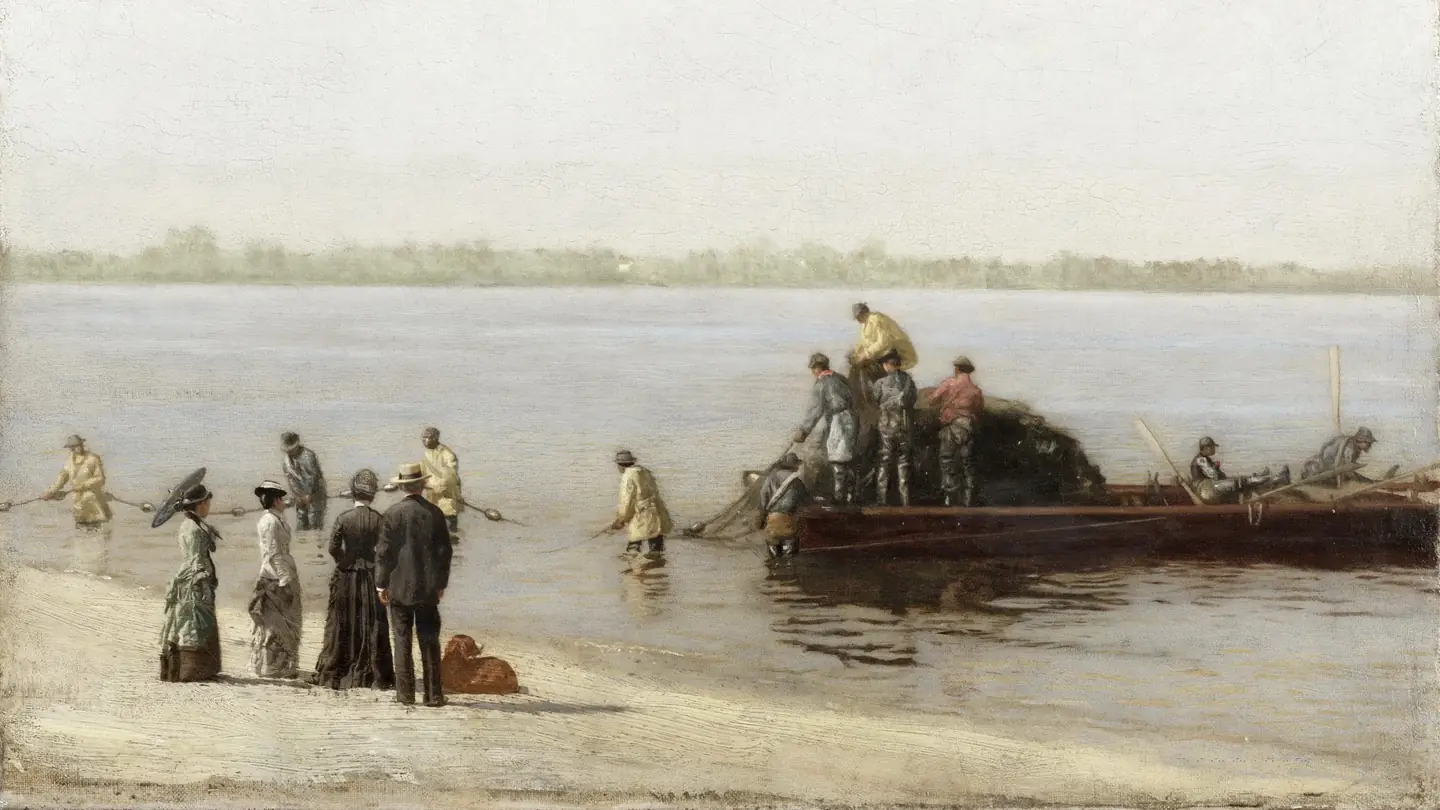
Cover painting: Thomas Eakins, Shad Fishing at Gloucester on the Delaware River (1881), Philadelphia Museum of Art (public domain).