Article
Hybrid Striped Bass Fishing
Hybrid striped bass (wipers) roam big lakes and reservoirs in packs, chasing shad and herring. Here's how to find them through the year, from spring tailwaters to summer surface blitzes and winter deep-water schools, plus the lures, baits and tackle that hold up to them.
November 10, 2026
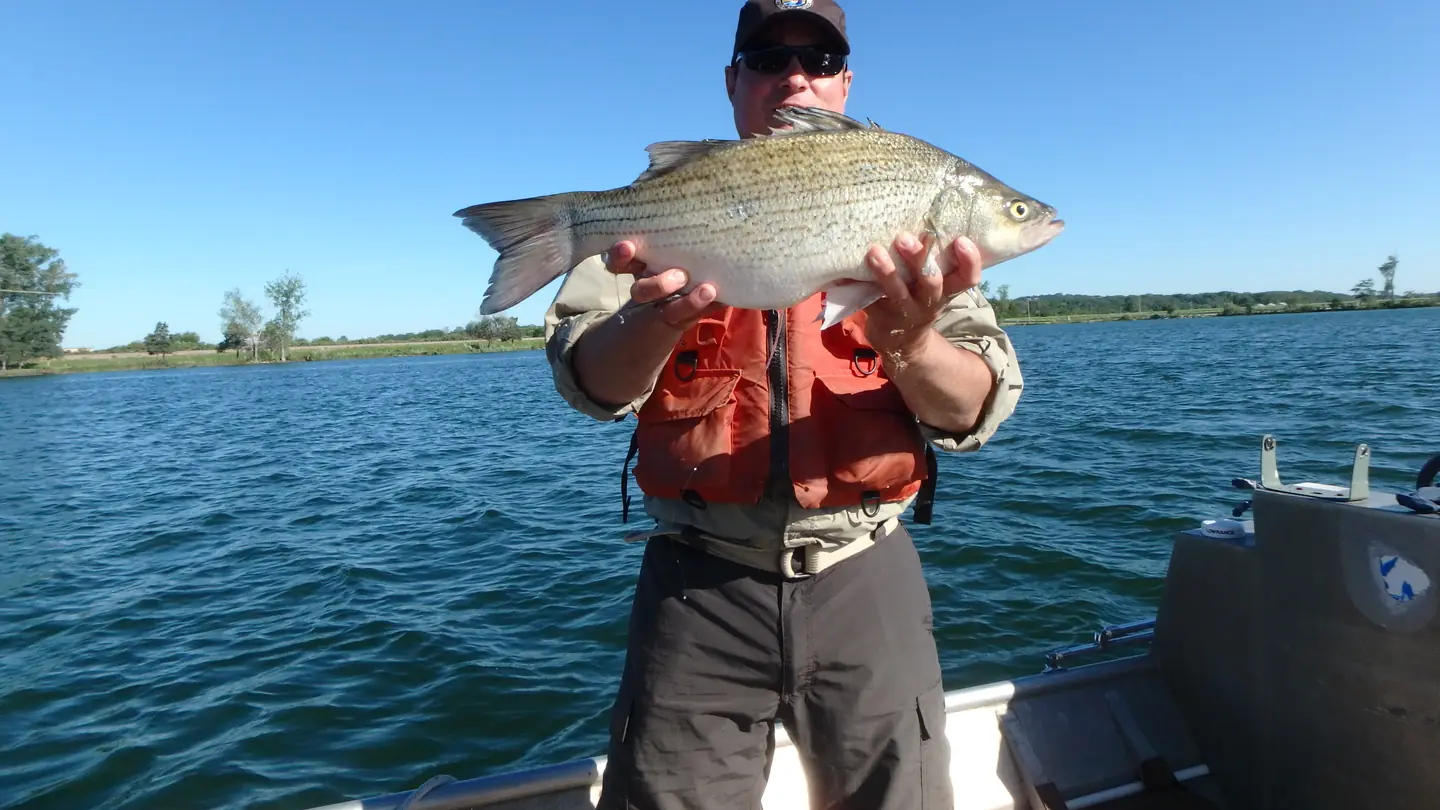
Hybrid striped bass are built to fight. Biologists created them to eat the huge schools of shad in big reservoirs, and they grow fast doing it. They travel in packs, they hit lures hard enough to break light line, and when a school pushes bait to the surface, the water explodes. Find the bait and you'll find the hybrids.
Know the fish
Hybrid striped bass (wipers, whiterock bass) are a hatchery cross, usually a female striped bass and a male white bass. They don't occur naturally and rarely reproduce, so nearly every hybrid you catch was stocked.
Hybrids look like a short, chunky striped bass: silvery with dark horizontal stripes, a deeper body, a smaller head and an arched back. The stripes below the lateral line are often broken. A hybrid on its own can be hard to tell from its parents, and identification is easiest side by side with a striper or white bass.
Most hybrids run 15 to 20 inches and a few pounds. Fish of 7 to 10 pounds are common in good lakes, and the biggest top 20 pounds.
Where hybrids live
Hybrids are open-water fish of large lakes and reservoirs, plus the rivers and tailwaters connected to them. They eat mostly shad (gizzard and threadfin) and, in northern lakes, herring and alewives.
The rule for hybrids: find the bait. They roam in packs following schools of baitfish, so a lake can look empty for hours until you find the bait.
Places to look:
- Tailwaters below dams. Hybrids are drawn to flowing water and gather below dams, especially in spring and when water is being released.
- Creek mouths, springs and inflows. Any flowing water, especially after rain.
- Drop-offs, channel edges and points. Hybrids herd bait along sharp drop-offs and points.
- Open water over deep basins, where bait schools suspend.
- Wind-blown shorelines. Waves stir up a mud line that confuses baitfish and gives hybrids an edge.
- Flooded timber near creek channels.
They rarely hang out in shallow, weedy water.
Hybrids through the year
Spring: tailwaters and warm bays
In spring, hybrids make "false spawning runs" up rivers and streams alongside white bass. They can't actually spawn, but they go through the motions. Dams block them, so big numbers of hybrids pile up in the tailwaters below. This is some of the best hybrid fishing of the year.
In many tailwaters, smaller hybrids run first, with the white bass. The bigger fish often come later in spring.
In the lakes, look for bait in the shallow back ends of bays and flats where warm water flows in. Hybrids rest in the nearest deep water, then push up into the shallows to pin bait against the bank. Later in spring, look where white bass and baitfish are spawning.
Summer: surface feeding and deep schools
Summer is a great time for hybrids. In northern lakes, they suspend above the thermocline, the layer where warm surface water meets cold, deep water. As the water reaches the 70s and 80s °F, bait can be anywhere in a lake, so hybrids roam bays and the open basin.
- Dawn and dusk: the best bites come at sunrise and sunset, and on cloudy or foggy days, when bait moves toward the surface to feed. Hybrids push the bait up and break the surface.
- Watch for gulls. Diving gulls are the fastest way to find a surface-feeding school.
- Night: hybrids chase herring near the surface after dark in some lakes.
- Midday: when nothing is showing on top, troll or watch your sonar for suspended bait schools with hybrids near them.
Fall
In fall, hybrids feed at varying depths as the water cools. As fall turns to winter, the bait drops into deep water and the hybrids follow.
Winter: deep and slow
In winter, hybrids hold near the bottom in deep water around suspended bait schools. In the South, winter can be one of the best times to catch them. In rivers, look in the deepest holes on outside bends and below dams. In northern lakes, hybrids can be caught through the ice on shiners fished over deep water.
Lures
Match the shad: white, silver and chrome are the standard colors, and fire tiger stands out in a school of bait. Hybrids can get picky about bait size, so try to match the size of the shad they're eating.
- Jigging spoons. Heavy metal spoons, up to about 3 ounces, for vertical jigging over deep schools. Drop them to the fish and jig them up and down. Some anglers add a sliver of cut shad for scent.
- Jigs and soft plastics. A 1/2-ounce or heavier jig head with a 5-inch white or chartreuse curly-tail grub, or a soft swimbait. In tailwaters, cast upstream and bump it along the bottom.
- Crankbaits and lipless rattle baits. Deep-diving crankbaits for trolling or casting to suspended fish, and lipless baits for covering water.
- Jerkbaits. Suspending jerkbaits around timber and over schools.
- Topwaters. Walking baits and poppers cast into surface-feeding schools, especially at dawn and dusk.
- Hair jigs. Tipped with a minnow or soft-plastic tail in rivers.
Working a surface-feeding school
- Cast topwaters, spoons, crankbaits or jigs into the breaking fish.
- When the surface feeding stops, don't leave. Let a jig or spoon sink before you start reeling. Hybrids hang around below to pick off injured bait.
- When the school is gone, look for the next one. Watch for birds and bait on the surface and on your sonar.
White bass and hybrids together
If you find a school of white bass feeding hard, the hybrids are often right below them. Switch to a bigger, heavier lure to get down past the white bass.
Bait
- Live shad, herring and alewives. The top baits, fished on the bottom, drifted or under a slip bobber.
- Shiners and minnows. Good where shad and herring aren't available, and through the ice.
- Cut shad. Oily and full of scent, great in current and muddy water.
- Chicken liver, shrimp and nightcrawlers. Catfish baits that catch plenty of hybrids, especially from shore. Hybrids are suckers for chicken liver.
Fish live bait drifting or at anchor, with a sliding egg sinker on the bottom or under a slip bobber at the depth of the bait schools.
Trolling
Trolling crankbaits and spoons is a great way to find scattered schools in open water. Long trolling rods with planer boards spread lures out wide behind the boat. Watch your depth finder for bait schools, and set your lures to run at or just above their depth.
Tackle
Hybrids hit hard and pull harder. If you have a weak link, they'll find it.
- Lakes: a medium to medium-heavy spinning or baitcasting rod with 8- to 12-pound line. An 8-foot rod with 12-pound line is a good all-round choice. Go heavier around docks and timber.
- Big tailwaters: where you need to cast far across heavy current, many anglers use 10- to 13-foot rods.
- Trolling: 7- to 10-foot trolling rods.
Use heavier tackle than you would for white bass. Light line that's fine for white bass will snap on a big hybrid.
Before you go
Hybrid striped bass limits differ by state and sometimes by lake. Check your state's current rules before you go.
Cover photo: U.S. Fish and Wildlife Service (public domain).