Article
Black Drum Fishing
Black drum run from 2-pound "puppy drum" around docks to 80-pound giants on the spring shoals. Here's when the big fish arrive, where they feed, why fresh clams and crab matter so much, and how to rig for a fish that bites gently and pulls like a truck.
November 10, 2026
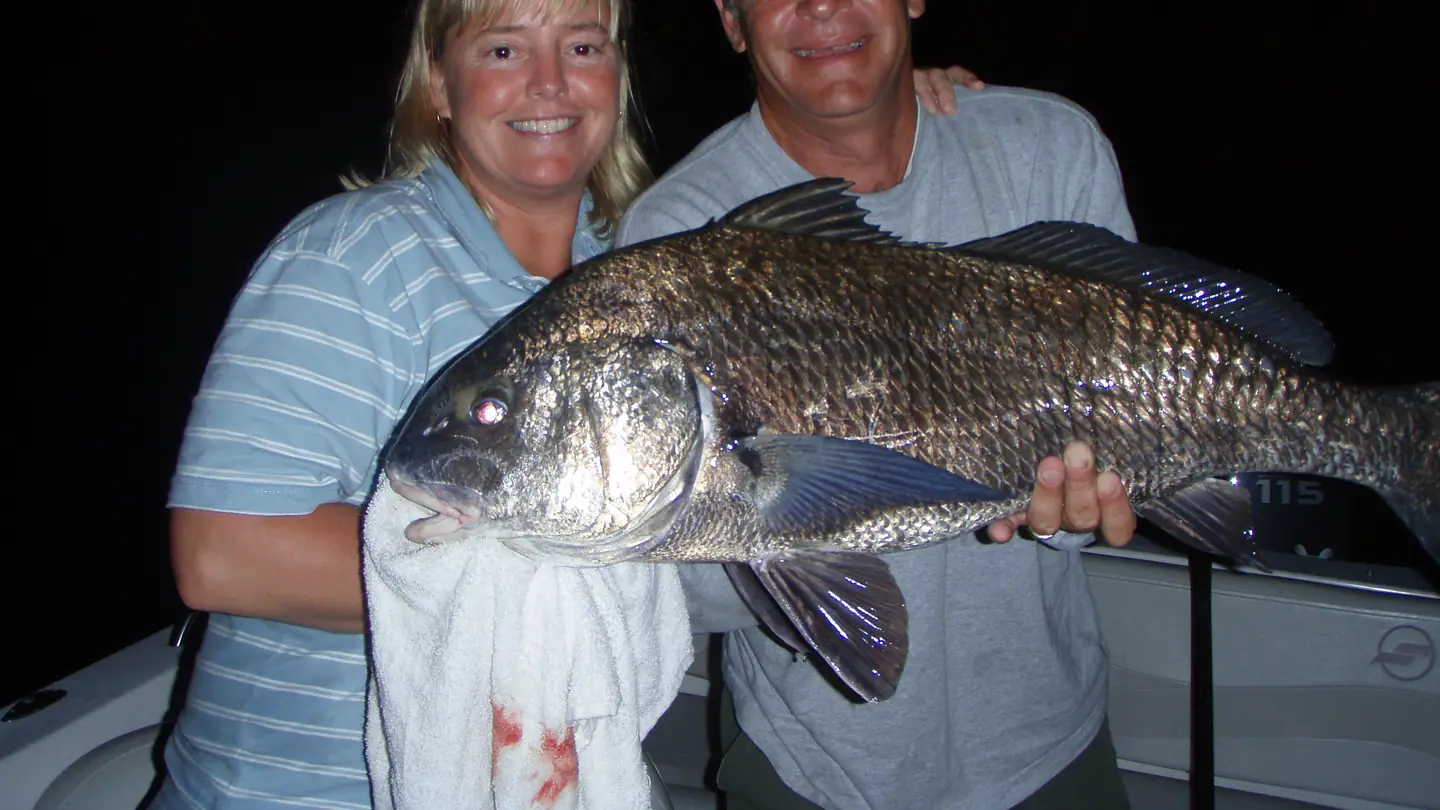
Black drum are two different fisheries in one fish. In the Southeast and Gulf, small drum of a few pounds live around docks, oyster bars and bridges and are caught all year on shrimp and crab. In the Mid-Atlantic, the spring brings giants: 40- to 80-pound drum that crowd the shoals at the mouths of the big bays, and you fish for them with fresh clams and heavy tackle. The basics are the same for both: find the shellfish, use the freshest bait you can get, and wait for a bite you can barely feel.
Know the fish
Black drum are the biggest members of the drum family. They have a high, arched back, a gray to black body with a brassy sheen, and a cluster of 10 to 14 short whiskers (barbels) under the chin. Young drum have four to six dark vertical bars that fade as they grow.
Two look-alikes:
- Sheepshead also have dark bars, but they have no chin barbels, they have sheep-like front teeth and sharp spines on the back.
- Red drum have no barbels and a black spot near the tail.
Black drum have huge, cobblestone-like crushing teeth in the throat, and they use them to grind up clams, mussels, oysters and crabs. They feed by rooting along the bottom, tasting and feeling for food with those chin barbels.
Sizes:
- Puppy drum (butterfly drum) are the young fish, up to about 8 pounds.
- Big drum (bull drum) are the mature adults, commonly 30 to 80 pounds in the spring fisheries of the Mid-Atlantic. The biggest reach well over 100 pounds.
Black drum grow slowly and live a long time. In the Chesapeake, they can live more than 50 years.
Where black drum live
Black drum live along the Atlantic coast from New York south and throughout the Gulf of Mexico. They're most common from the Chesapeake Bay to Florida and most abundant of all in Texas. They tolerate an enormous range of conditions, from clear flats to muddy sloughs and from a foot of water down to 100 feet.
The common thread is food on the bottom. Look for:
- Oyster bars and reefs, including oyster-restoration reefs.
- Mussel and clam beds.
- Docks and bridge pilings.
- Wrecks, artificial reefs and rock.
- Channel edges, drop-offs and sloughs.
- Jetties and deep channels where big drum gather before spawning.
- Marshes, where smaller black drum feed alongside red drum.
The spring run of big drum
In the Mid-Atlantic, the big drum are spring fish. They come inshore to spawn and to feed on crabs, clams and mussels as the water warms.
- April: the first big drum show up on the shoals at the mouth of the Chesapeake and in the surf along the Delmarva barrier islands. Delaware Bay gets fish around the same time.
- Late April into May: wrecks, reefs and shoals inside the Chesapeake light up a week or two later.
- Mid-May: the run is usually in full swing, with big drum from the bay mouth up into Maryland waters.
- Summer: the schools break up into small groups and singles, and big drum become mostly an accidental catch, though some stay around bridges and deep structure into fall.
The Chesapeake spawn runs from April into early June near the mouth of the bay and at the coastal inlets. Big drum that you mark in midwater on your sonar are often spawning fish. The ones sitting on the bottom are the ones feeding.
Farther south, big drum gather in deep bays, near jetties and in channels before spawning in late winter and early spring.
Baits
Black drum eat by smell and taste, and they're fussy about freshness. Bad bait catches nothing.
- Fresh clams. The standard bait for big drum on the shoals and in the bays. Use freshly shucked clams. Frozen, salted or spoiled clams don't work nearly as well.
- Soft crab and peeler crab. Chunks of soft crab are the top bait farther up the Chesapeake. Half a soft crab on a big hook is a standard big-drum bait.
- Blue crab. Pieces of hard blue crab work for drum of all sizes.
- Sand fleas (mole crabs). The surf bait.
- Shrimp. The everyday bait for smaller drum around docks and oyster bars.
- Cut bait and squid. Also catch drum, especially smaller ones.
Black drum rarely hit lures, but some anglers catch them on soft-plastic jigs with strong scent, especially when the drum are schooled up.
Rigs
Fish-finder rig
The standard big-drum rig:
- Slide a fish-finder slide (sinker slide) onto 50-pound braid and tie on a heavy swivel.
- Tie on a leader of 60-pound mono or fluorocarbon.
- Finish with an 8/0 circle hook for clams, up to a 10/0 to 12/0 for half a soft crab.
- Clip on a sinker heavy enough to hold bottom in the current.
An egg-sinker rig (sinker sliding on the line above the swivel) works the same way.
Top-and-bottom rig
In the surf, a two-hook top-and-bottom rig with sand fleas is the usual setup.
Smaller drum
For puppy drum around docks and oyster bars, scale down: a small circle hook, a light sinker and shrimp, crab or clam fished on the bottom.
How to fish for big drum
Anchoring
On the shoals and in the bays, most drum anglers anchor along a drop-off, slough or channel edge where drum have been feeding, then fan-cast four to six baits around the boat and wait. Look for fish on your sonar sitting on the bottom and set up just up-current of them.
A light chum of crushed clams can hold a school near your baits. Heavy chum draws rays and sharks, so go easy.
Drifting and dropping
Up the Chesapeake, anglers rarely anchor. Instead they cruise slowly over known spots, watching the sonar. Big drum make unmistakably large marks. When fish show up, stop the boat and drop baits straight down to them.
The surf
From the beach, cast sand fleas or clams on top-and-bottom or fish-finder rigs, and fish the deeper sloughs where drum root along the bottom.
The bite
Black drum bite softly for such big fish. They mouth the bait and crush it, and you might see only a light tap or a slow, steady pull. Many anglers lose their baits without ever feeling a thing.
- Use braid. It shows you the light bites that mono hides.
- Wait for the fish to move off. With a circle hook, don't swing. When the rod loads up and stays down, reel steadily and lift. The hook will set itself in the corner of the mouth.
Once hooked, a big drum pulls hard and slow and keeps on pulling.
Tackle
| Use | Rod | Line | Leader and hook |
|---|---|---|---|
| Big drum from a boat | Heavy conventional or spinning boat rod | 50 lb braid | 60 lb leader, 8/0 to 12/0 circle hook |
| Big drum in the surf | Heavy surf rod | 30 to 50 lb braid | Top-and-bottom or fish-finder rig, large circle hooks |
| Puppy drum around docks and bars | Medium spinning or baitcasting | 15 to 30 lb line | Small circle hook |
Releasing big drum
Big black drum are old fish. They are poor eating, and many drum over 30 pounds carry worms in their flesh. The worms are harmless but unappetizing. Most anglers release drum over about 20 to 30 pounds.
To release one well, use circle hooks, land it in a net with fish-friendly mesh, and keep it in the water if you can. Hold it upright, facing into the current, until it swims off.
Before you go
Black drum size and bag limits differ by state. Check your state's current rules before you go.
Cover photo: Attackgirl (public domain).